GS 1: Indian GeographyGS 1: Physical GeographyGS 3: EconomyPrelims
Southwest monsoon to set in over Kerala ‘around June 4’, Pg1
IMD pushes Southwest Monsoon onset in Kerala to June 4, missing forecast window; El Niño and stalled system raise concerns.
Practice MCQs
782 Students attempted
Key Highlights:
- The India Meteorological Department (IMD) revised its forecast for the Southwest Monsoon onset over Kerala to around June 4, 2026
- This revised date is later than the initial forecast of May 26, 2026, and overshoots the model's error margin of plus or minus four days.
- The IMD's operational forecasts for Kerala monsoon onset have been accurate annually since 2005, with the exception of 2015.
- Conditions, including an upper-air cyclonic circulation off the south Kerala coast, are favorable for the monsoon's advance into parts of the Arabian Sea, Kerala, Tamil Nadu, and the Bay of Bengal around the revised date.
- The overall monsoon season for 2026 is predicted to be below normal, at 90% of the Long Period Average (LPA), influenced by an emerging El Niño phenomenon.
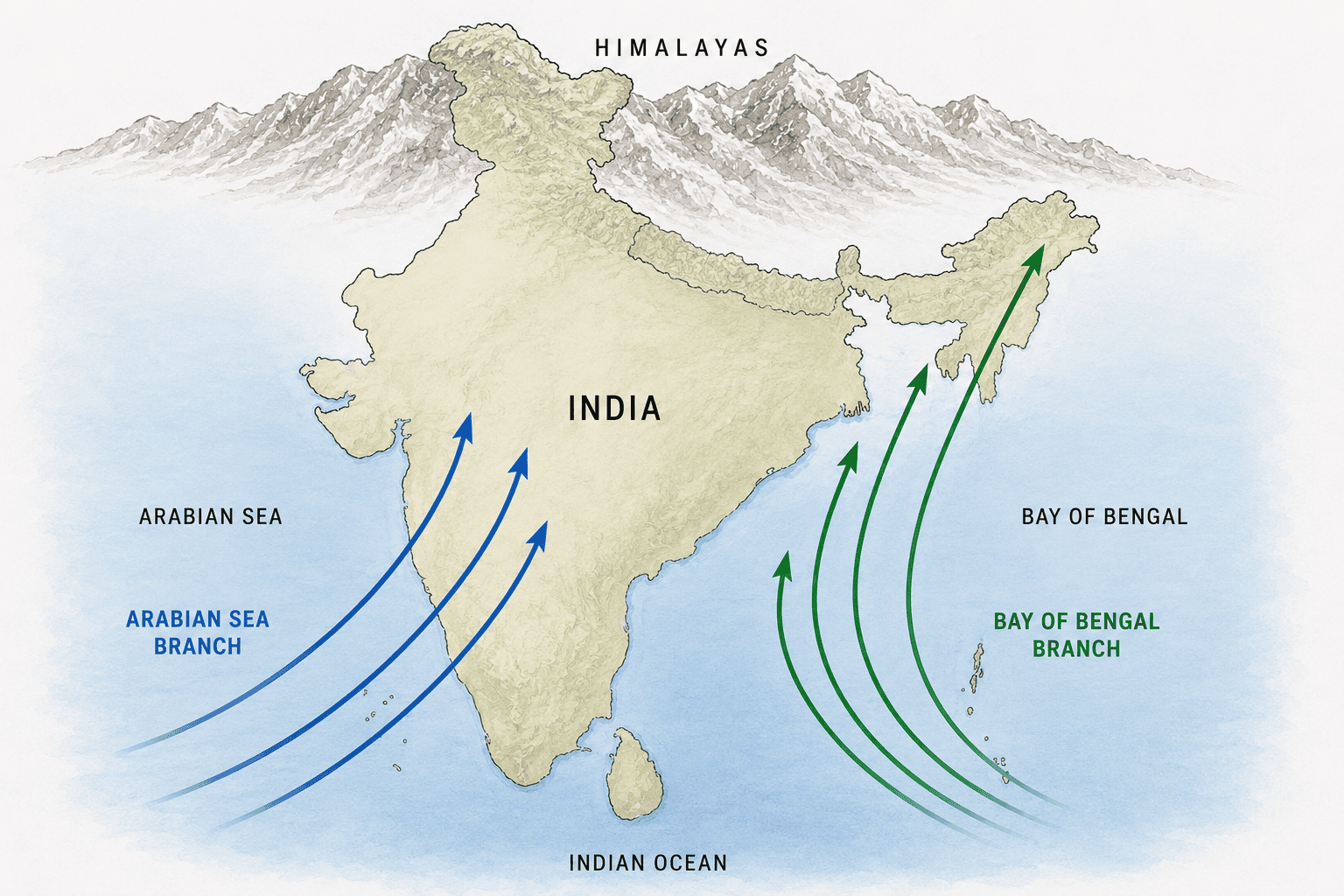
Monsoon.png
Detailed Insights:
- The normal onset date for the Southwest Monsoon over Kerala is June 1, marking the beginning of the four-month rainy season crucial for India's agriculture and economy.
- The delay in the 2026 monsoon onset follows a pattern seen in 2015, when a May 30 forecast resulted in a June 5 arrival, highlighting the challenges in precise long-range forecasting.
- The IMD declares monsoon onset based on specific criteria: sustained rainfall of 2.5 mm or more for two consecutive days at 60% of 14 designated stations, along with specific westerly wind conditions and Outgoing Longwave Radiation (OLR) values.
- An upper-air cyclonic circulation is expected to provide the necessary impetus for the monsoon's final push, with isolated heavy to very heavy rainfall forecasted for Kerala.
- The Northern Limit of Monsoon (NLM), which indicates the system's cloud promontory, was positioned along a line from 10°N/60°E through the southern Bay of Bengal to 22°N/97°E as of June 1, 2026.
- The forecast of below-normal rainfall for the season, at 90% of the LPA, raises concerns for agricultural output and water resources, especially with the influence of El Niño.
Scientific/Technical Concepts Involved:
- Southwest Monsoon: A seasonal wind system bringing heavy rainfall to the Indian subcontinent from June to September, crucial for the region's climate and economy.
- El Niño: A climate pattern characterized by the unusual warming of surface waters in the eastern tropical Pacific Ocean, typically leading to weaker Indian monsoons and reduced rainfall.
- Long Period Average (LPA): A benchmark representing the average rainfall over a specific region for a given period, calculated over a long duration (e.g., 30 or 50 years), used for monsoon forecasting.
- Outgoing Longwave Radiation (OLR): A measure of the energy radiated from the Earth's surface and atmosphere to space, used by meteorologists as a proxy for deep cloud convection and monsoon activity.

SuperKalam is your personal mentor for UPSC preparation, guiding you at every step of the exam journey.
Download the App


STUDY RESOURCES
CONTACT US
ⓒ Snapstack Technologies Private Limited