GS 2: International RelationsGS 3: Internal SecurityGS 1: World History
Israel, the U.S. and a war to build a unipolar West Asia, Pg6
U.S.-Israeli strikes ignite regional war with Iran following assassination of Supreme Leader, threatening global energy security and geopolitical stability.
Practice MCQs
761 Students attempted
Key Highlights:
- On February 28, 2026, the U.S. and Israel initiated military action against Iran, resulting in the death of Supreme Leader Ayatollah Ali Khamenei and other officials.
- Israel termed the operation a "pre-emptive" war, while U.S. President Donald Trump called for regime change in Iran.
- This conflict follows a 12-day war in June 2025, after which Trump claimed to have "obliterated" Iran's nuclear program.
- Iran has retaliated by targeting American bases in the region and announcing the closure of the Strait of Hormuz.
Detailed Insights:
- Israel views Iran as a revisionist state challenging its regional supremacy due to Iran's economic potential and missile program.
- Netanyahu opposed the 2015 nuclear deal, prioritizing the disarmament of Iran's missile program and support for non-state militias.
- Regime change in Iran would shift the regional balance of power, potentially creating a unipolar West Asia with Israel at its center.
- The current conflict has escalated into a regional war, with Iran targeting U.S. bases and impacting global energy trade through the Strait of Hormuz.
- Iran's strategy is designed to deny the U.S. a swift victory, potentially leading to a prolonged conflict with severe global economic implications.
Key Concepts Involved:
- Regime Change: The replacement of a country's government, often by external forces.
- Unipolar: A world order dominated by a single powerful state.
- Strait of Hormuz: A narrow waterway crucial for global oil transit, connecting the Persian Gulf and the Arabian Sea.
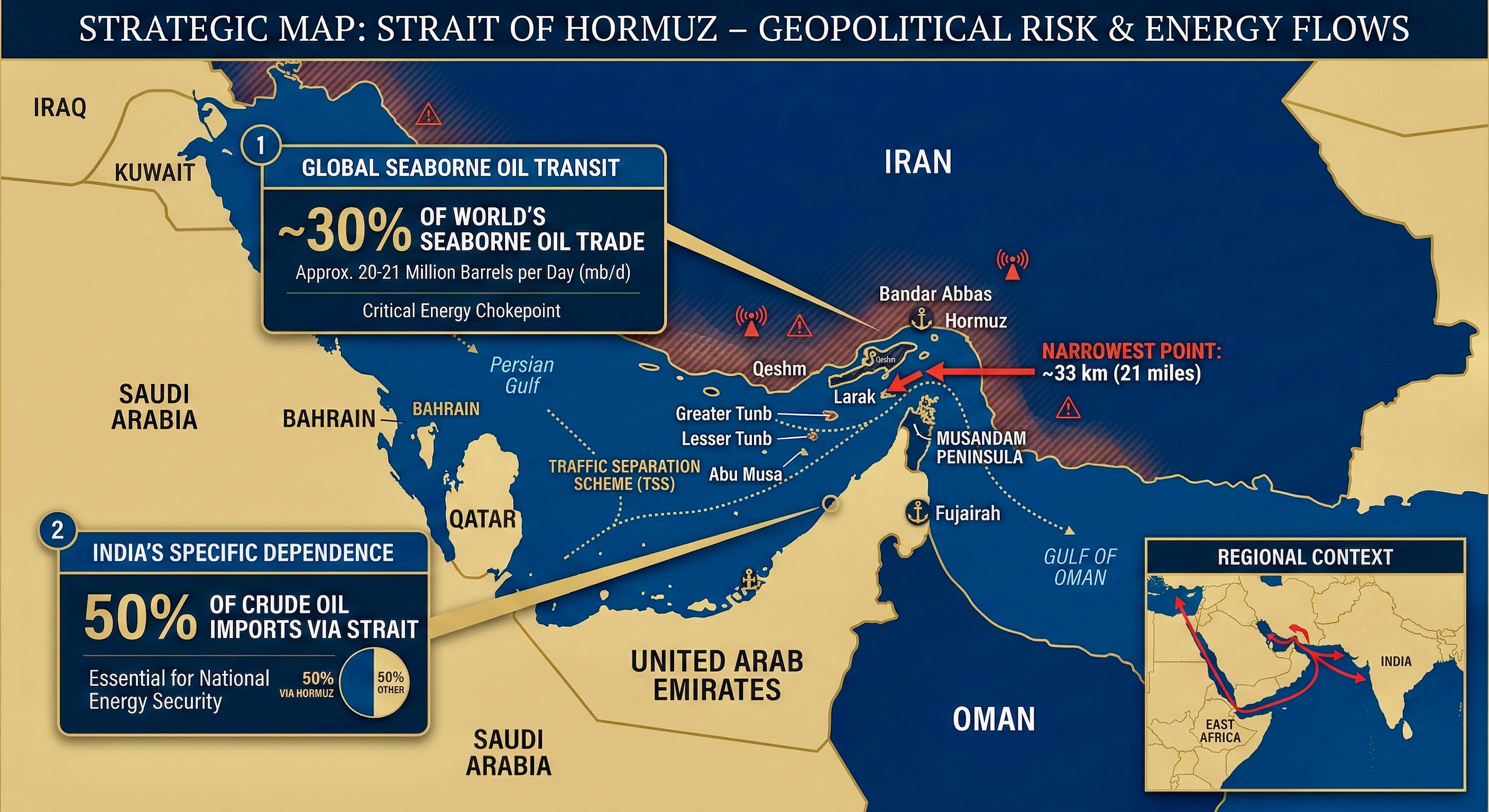
The Strait of Hormuz

SuperKalam is your personal mentor for UPSC preparation, guiding you at every step of the exam journey.
Download the App


STUDY RESOURCES
CONTACT US
ⓒ Snapstack Technologies Private Limited