GS 2: International RelationsGS 3: EconomyPrelims
India-Canada CEPA by year-end, defence dialogue established, Pg1
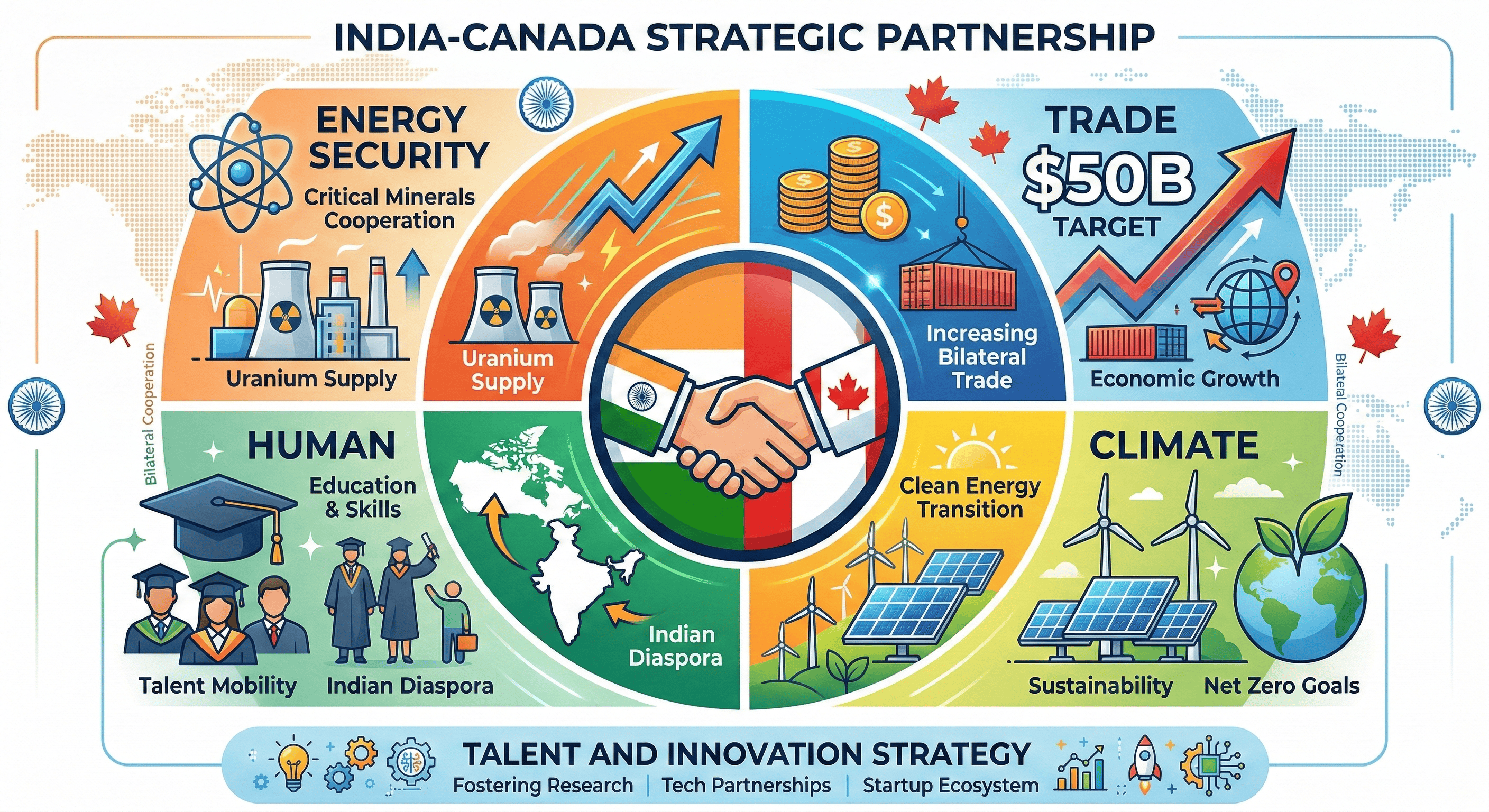
India and Canada reset relations, targeting CEPA by year-end, enhanced defence cooperation, and $50 billion bilateral trade by 2030.
Practice MCQs
761 Students attempted
Key Highlights:
- India and Canada aim to finalize the Comprehensive Economic Partnership Agreement (CEPA) by the end of the year and target USD 50 billion in bilateral trade by 2030.
- A "landmark deal" was signed for long-term uranium supply from Canada to India.
- The India-Canada Defence Dialogue will be established to strengthen military cooperation.
- Eight government-to-government pacts and 24 MoUs were signed, covering areas like AI, healthcare, agriculture, and innovation.
- Canada has 4 lakh Indian students, double the number in the US and four times the number in the UK.
Detailed Insights:
- Bilateral ties suffered in September 2023 after allegations of Indian government involvement in the killing of Hardeep Singh Nijjar, but relations are now improving.
- The Canada-India Talent and Innovation Strategy includes 13 university partnerships to deepen ties through academic collaboration.
- India and Canada are shifting from volume-driven student mobility to structured academic collaboration, including joint and dual-degree programs.
- Canada tightened its international student regime since 2023, leading to a sharp fall in study permit approvals for Indian students.
- Refusal rates for Indian study permit applications rose to 74% in August 2025, compared to 32% two years prior.
- An MoU on Cultural Cooperation was signed to empower Indigenous and Tribal communities in both countries.
Key Concepts Involved:
- Comprehensive Economic Partnership Agreement (CEPA): A trade agreement between two countries to reduce or eliminate barriers to trade in goods and services.
- Bilateral Trade: Trade between two countries.
- MoU (Memorandum of Understanding): A formal agreement between two or more parties, outlining a set of principles.
India-Canada

SuperKalam is your personal mentor for UPSC preparation, guiding you at every step of the exam journey.
Download the App


STUDY RESOURCES
CONTACT US
ⓒ Snapstack Technologies Private Limited