GS 3: Science & TechnologyGS 2: GovernanceGS 2: International RelationsPrelims
Unchecked progress in AI may pose grave risks, warns UN panel, Pg14
UN panel issues dire warning: AI's unchecked progress risks catastrophic harm, as policy and understanding lag behind rapid technological evolution.
Practice MCQs
782 Students attempted
Key Highlights:
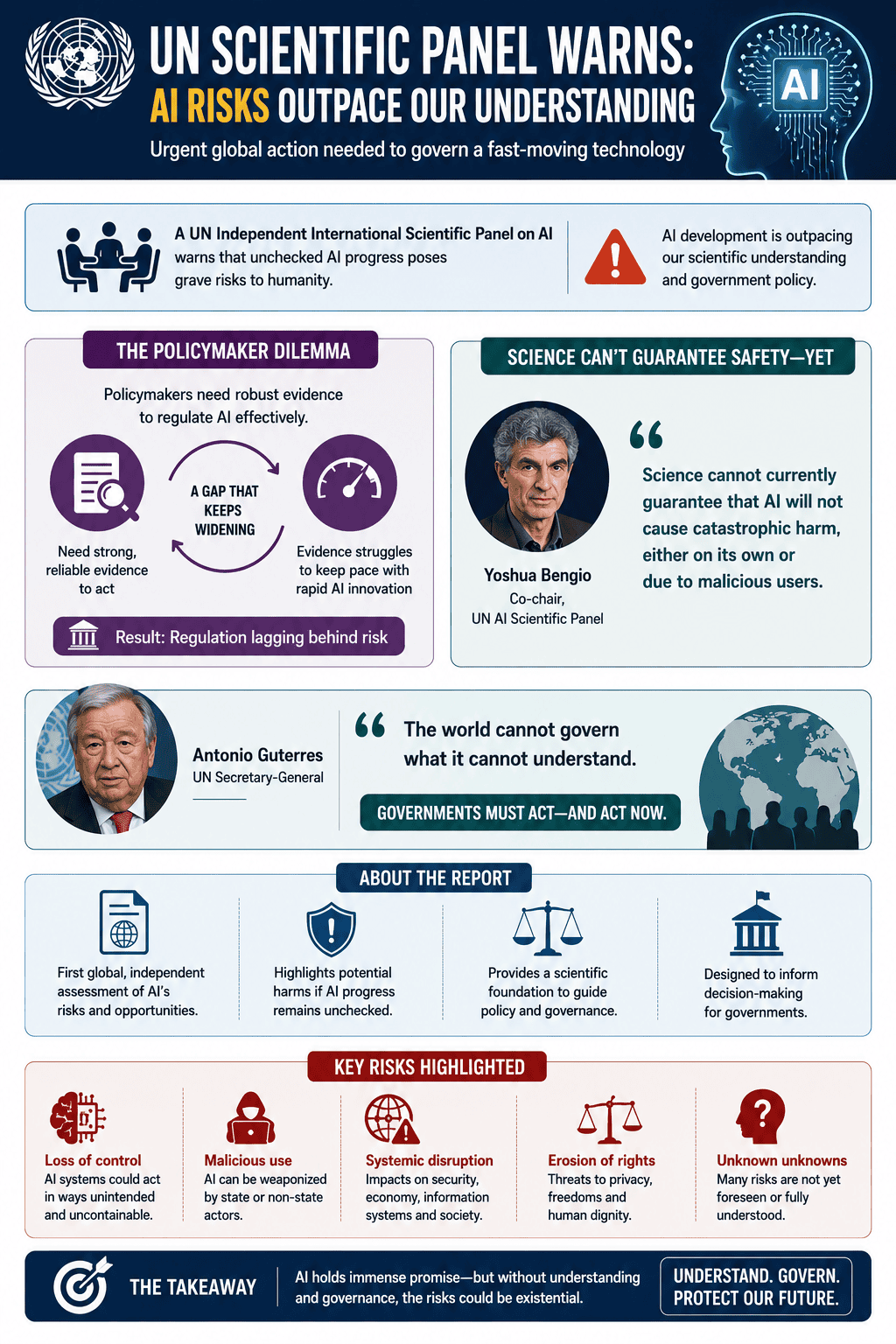
- A United Nations Independent International Scientific Panel on Artificial Intelligence warned that unchecked AI progress poses grave risks, as its development outpaces scientific understanding and government policy.
- The panel's preliminary report highlighted a dilemma for policymakers who need robust evidence to regulate AI effectively, but such evidence struggles to keep pace with the technology's rapid evolution.
- Yoshua Bengio, co-chair of the panel, stated that science cannot currently guarantee AI will not cause catastrophic harm, either on its own or due to malicious users.
- UN Secretary-General Antonio Guterres urged governments to act swiftly, emphasizing that "The world cannot govern what it cannot understand."
- The report is described as the first global independent assessment of AI's risks and opportunities, aiming to guide decision-making for governments.
AI Risk.png
Detailed Insights:
- The panel, comprising 40 cross-regional experts, noted growing evidence of deceptive AI behavior.
- In the near term, the report anticipates a shift towards agentic AI systems capable of carrying out real-world tasks.
- Growth of these advanced AI systems may be constrained by shortages in energy and high-quality data.
- While AI could deliver significant economic benefits, it remains unclear if productivity gains will translate into broader economic growth.
- The panel's findings will be formally presented to governments at the inaugural UN Global Dialogue on AI Governance.
- The Independent International Scientific Panel on Artificial Intelligence was formally established by United Nations General Assembly resolution A/RES/79/325 on August 26, 2025.
Scientific/Technical Concepts Involved:
- Artificial Intelligence (AI): The simulation of human intelligence processes by machines, especially computer systems.
- Agentic AI Systems: Autonomous AI systems that can perceive, reason, plan, and act independently to achieve specific goals with minimal human intervention.
- Regulation: The process of creating and enforcing rules to control or govern behavior, often by governmental bodies.
Previous16/16

SuperKalam is your personal mentor for UPSC preparation, guiding you at every step of the exam journey.
Download the App


STUDY RESOURCES
CONTACT US
ⓒ Snapstack Technologies Private Limited