GS 3: EconomyGS 3: Science & TechnologyGS 2: GovernancePrelims
The case for building India’s coal chemistry capability, Pg6
India leverages indigenous R&D to counter energy shocks, approving a ₹37,500 crore coal gasification scheme to produce DME, slashing LPG import dependence.
Practice MCQs
782 Students attempted
Key Highlights:
- India demonstrated significant energy resilience during a 2026 disruption in the Strait of Hormuz, primarily through the flexibility of its refinery sector.
- The crisis underscored the strategic importance of reducing dependence on imported energy resources, with coal chemistry emerging as a key opportunity.
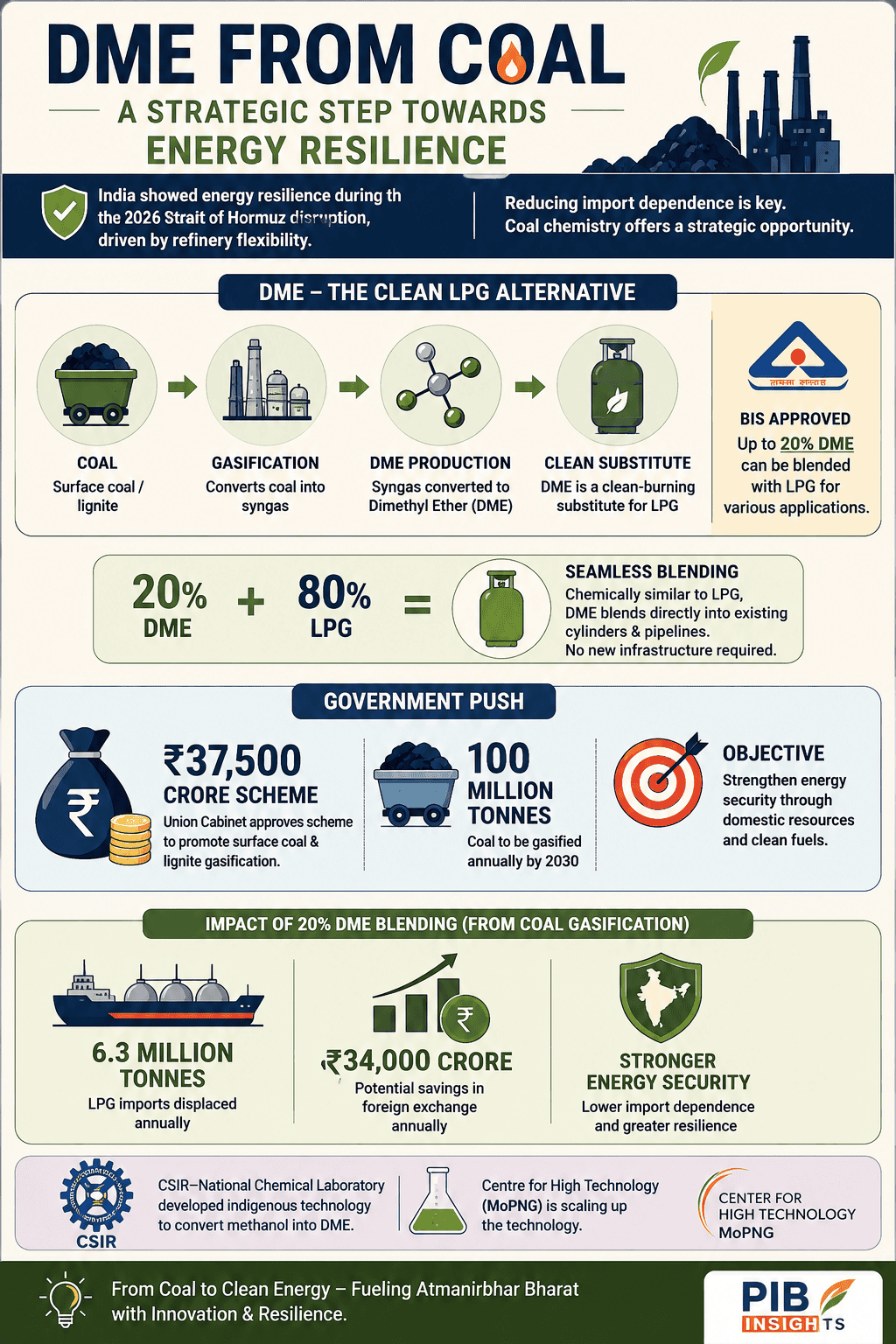
- Dimethyl ether (DME), produced through coal gasification, has been identified as a clean-burning substitute for LPG.
- The Bureau of Indian Standards has approved blending up to 20% DME with LPG for various applications.
- The Union Cabinet has approved a ₹37,500 crore scheme to promote surface coal and lignite gasification, aiming to gasify 100 million tonnes of coal annually by 2030.
DME.png
Detailed Insights:
- India's refining sector developed the capability to process diverse crude oil types through sustained investments in indigenous research, metallurgical advances, and workforce training.
- During the Strait of Hormuz disruption, India rapidly increased non-Hormuz crude sourcing from 55% to 70% of its total intake within weeks.
- Domestic LPG production saw a rapid increase from 35 Thousand Metric Tonnes (TMT) to 54 TMT per day within five days by optimizing refinery operations.
- DME is chemically similar to LPG, allowing it to be blended directly into existing cylinders and pipelines without requiring new distribution infrastructure.
- A 20% DME blend derived from coal gasification could displace approximately 6.3 million tonnes of LPG imports annually, potentially saving around ₹34,000 crore in foreign exchange.
- CSIR’s National Chemical Laboratory developed an indigenous technology for converting methanol into DME, which the Centre for High Technology under the Ministry of Petroleum and Natural Gas is scaling up.
- The ₹37,500 crore scheme offers financial incentives covering up to 20% of plant and machinery costs and extends coal linkage tenure to 30 years to encourage investment.
- A challenge for India is its coal's higher ash content compared to the cleaner coal used in China's established coal-to-chemicals industry.
Key Concepts Involved:
- Strait of Hormuz: A narrow, strategically vital waterway connecting the Persian Gulf to the Arabian Sea, crucial for global oil and gas shipments.
- Coal Gasification: A process that converts coal into syngas (a mixture of hydrogen, carbon monoxide, and carbon dioxide) under high temperature and pressure.
- Syngas: A fuel gas mixture, primarily composed of hydrogen and carbon monoxide, produced from various feedstocks like coal, used in chemical synthesis.
- Dimethyl ether (DME): A clean-burning synthetic fuel, chemically similar to LPG, that can be produced from syngas and blended with LPG.
- Bureau of Indian Standards (BIS): India's national standards body responsible for developing and promoting standards for various products and services.

SuperKalam is your personal mentor for UPSC preparation, guiding you at every step of the exam journey.
Download the App


STUDY RESOURCES
CONTACT US
ⓒ Snapstack Technologies Private Limited