GS 2: PolityGS 2: GovernancePrelims
Joint polls, Pg4
Delhi government signals readiness for 'One Nation One Election' despite tenure adjustments, as high-level committee consults stakeholders on electoral synchronisation.
Practice MCQs
782 Students attempted
Key Highlights:
- The Delhi Government has expressed a positive approach towards the One Nation One Election proposal, indicating willingness to cooperate if required in the national interest.
- A committee, formed in December 2024, has been consulting stakeholders in Delhi and other states regarding simultaneous elections.
- The initial proposal suggests the first simultaneous elections in 2034, by curtailing terms of Assemblies elected after the Lok Sabha elections of 2029.
- States, including Delhi, could potentially align their Assembly terms with the 2029 Lok Sabha elections if they choose to curtail their terms.
- Delhi's Chief Minister stated that One Nation One Election is the "need of the hour."
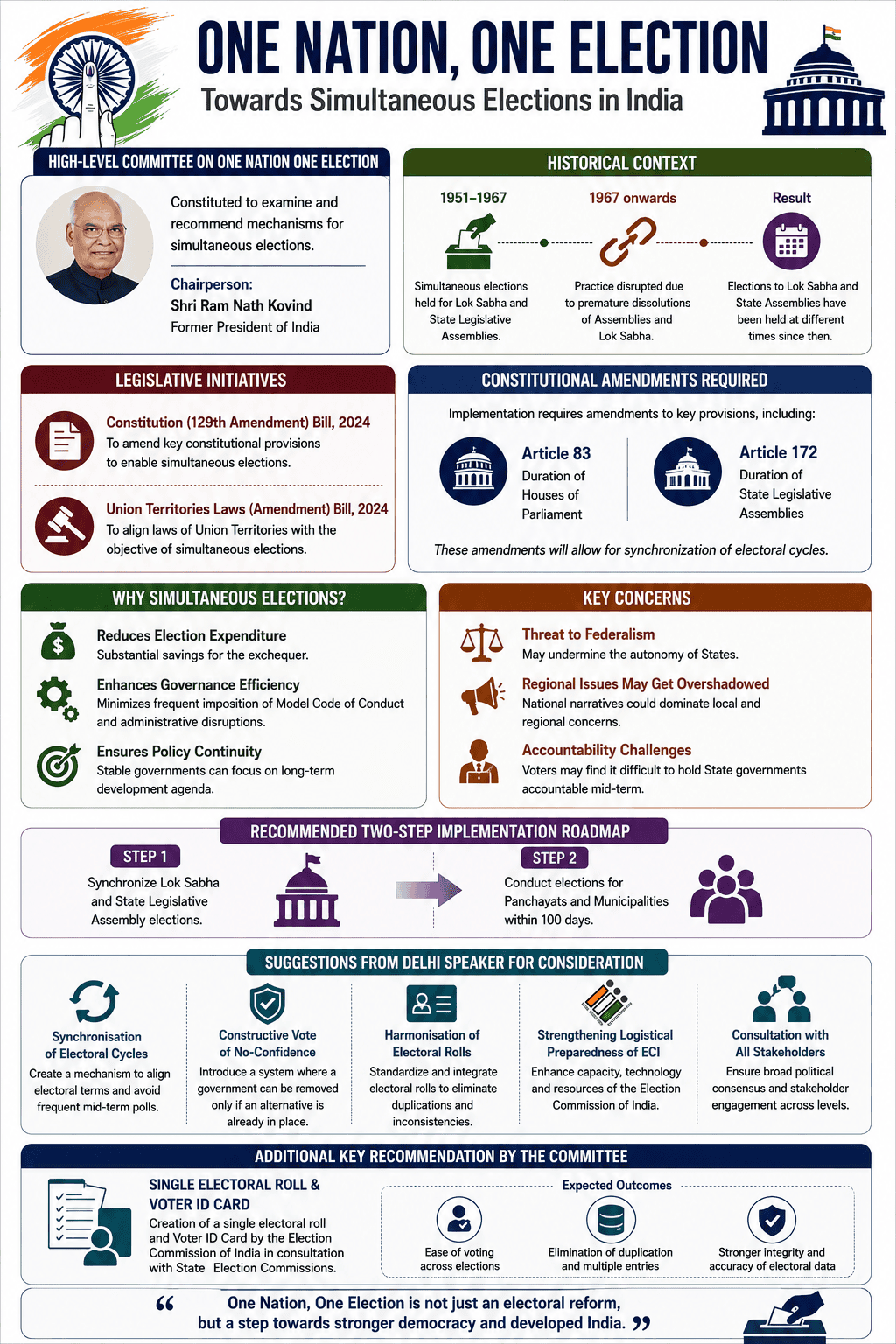
ONOE.png
Detailed Insights:
- The High-Level Committee on One Nation One Election, chaired by former President Ram Nath Kovind, was constituted to examine and recommend mechanisms for simultaneous polls.
- Historically, India conducted simultaneous elections for Lok Sabha and State Legislative Assemblies until 1967, a practice disrupted by premature dissolutions.
- The Constitution (129th Amendment) Bill, 2024 and the Union Territories Laws (Amendment) Bill, 2024 were introduced to enable simultaneous elections.
- Implementing simultaneous elections would necessitate amendments to key constitutional provisions, including Article 83 (duration of Houses of Parliament) and Article 172 (duration of State Legislative Assemblies).
- Proponents argue that simultaneous elections can reduce significant election expenditure, enhance governance efficiency by minimizing disruptions from the Model Code of Conduct, and ensure policy continuity.
- Concerns include potential threats to federalism, the overshadowing of regional issues by national narratives, and challenges to the accountability of state governments.
- The committee has recommended a two-step implementation: first, synchronizing Lok Sabha and State Assembly elections, followed by local body elections within 100 days.
- Suggestions from the Delhi Speaker included examining issues like synchronisation of electoral cycles, constructive votes of no-confidence, harmonisation of electoral rolls, and strengthening the logistical preparedness of the Election Commission of India.
- The committee also proposed the creation of a single electoral roll and Voter ID Card by the Election Commission of India in consultation with State Election Commissions.
Key Concepts Involved:
- One Nation One Election: A proposal to synchronize elections for the Lok Sabha and all State Legislative Assemblies to occur simultaneously.
- Lok Sabha: The lower house of India's bicameral Parliament, directly elected by universal adult suffrage.
- Legislative Assembly: The lower house of the legislature in Indian states, also known as Vidhan Sabha.
- Constructive Vote of No-Confidence: A parliamentary procedure where a government can be removed only if the opposition simultaneously proposes and elects a successor.
- Model Code of Conduct: A set of guidelines issued by the Election Commission of India for political parties and candidates to ensure free and fair elections.

SuperKalam is your personal mentor for UPSC preparation, guiding you at every step of the exam journey.
Download the App


STUDY RESOURCES
CONTACT US
ⓒ Snapstack Technologies Private Limited