GS 3: EconomyGS 3: Environment & EcologyGS 3: Science & TechnologyPrelims
India's cotton farms need better soil, not just new GM seeds, Pg13
Expert warns India's cotton productivity collapse stems from degraded soils, urging focus on regenerative agriculture and varietal development over new GM seeds.
Practice MCQs
782 Students attempted
Key Highlights:
- An analysis critiques the notion that Genetically Modified (GM) seeds, such as Bollgard-II, are the sole solution for India's cotton productivity challenges.
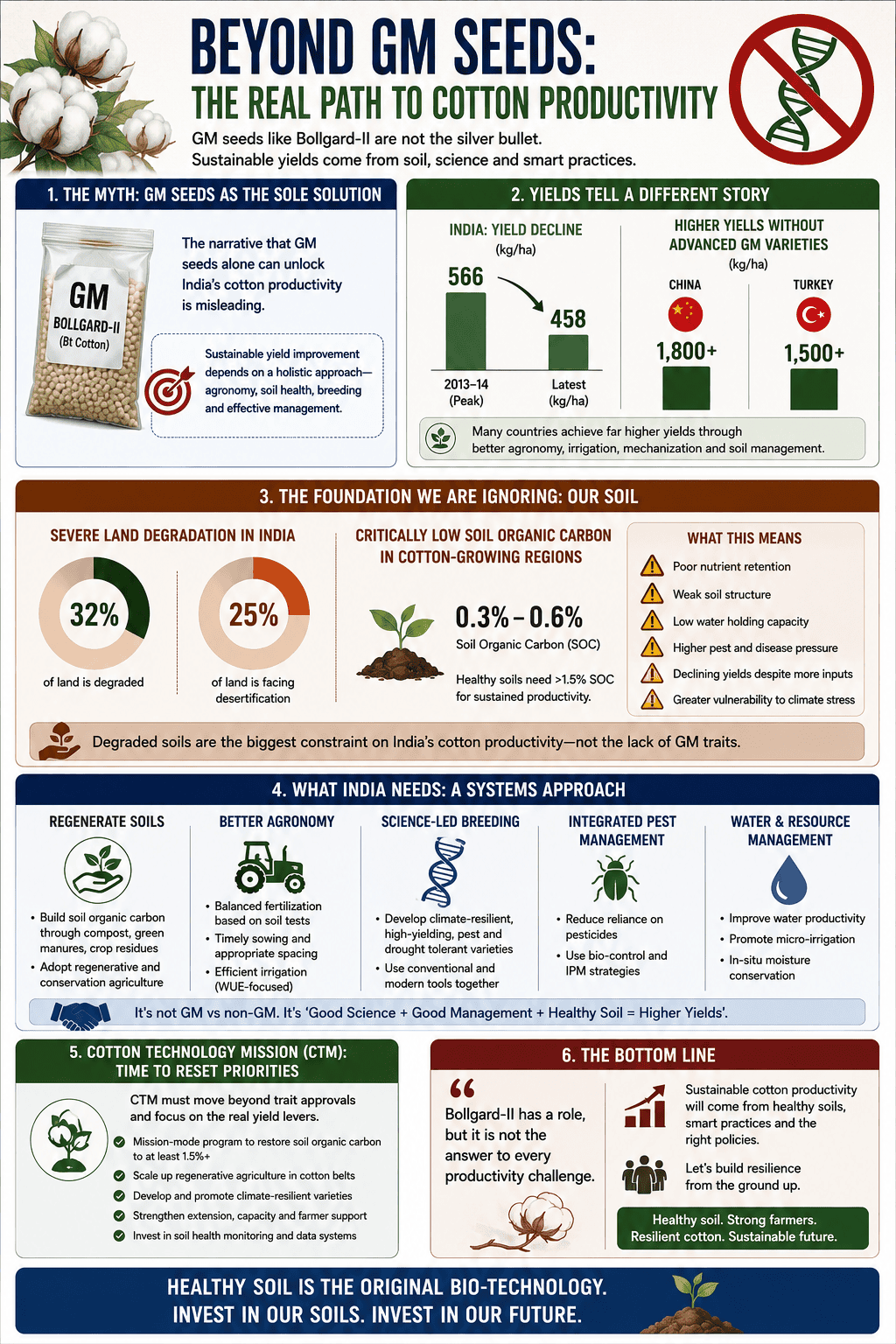
- The article emphasizes that sustainable yield improvement in cotton depends on agronomic practices, soil science, breeding, and management interventions, rather than just GM trait approvals.
- India's cotton yields, which peaked at 566 kg/ha in 2013-14, have declined to 458 kg/ha, while countries like China and Turkey achieve significantly higher yields without relying on advanced GM varieties.
- A major concern highlighted is the severe degradation of Indian land, with nearly 32% degraded and 25% facing desertification, and critically low soil organic carbon levels (0.3-0.6%) in cotton-growing regions.
- The Cotton Technology Mission is urged to prioritize restoring soil organic carbon through regenerative agriculture and developing climate-resilient varieties.
Cotton.png
Detailed Insights:
- A previous article attributed an 88% productivity increase in Indian cotton between 2002 and 2013 primarily to Bt cotton, particularly Bollgard-II.
- The critique argues that traits like Bollgard-II and Bollgard-III protect against bollworm damage, and RRFlex aids weed management, but do not directly increase yields.
- China, despite using the same Bt genes as India, achieves higher yields by cultivating Bt varieties instead of Bt hybrids.
- Turkey, without approved GM cotton, saw its yields rise from 1,100 kg/ha in 1999 to 1,728 kg/ha, demonstrating that varietal development and agronomic investment are crucial.
- India's productivity gains from 2002-2011 were a result of multiple factors, including effective bollworm control by Bt cotton, increased hybrid seed adoption, a 2.5-fold rise in fertilizer use, and expanded irrigated areas.
- The decline in productivity post-2014-15 is attributed to the law of diminishing returns on input saturation, rather than seed price policies.
- FAO data indicates that 32% of Indian land is degraded and 25% faces desertification, severely impacting agricultural potential.
- The average soil organic carbon in Indian croplands is 0.3-0.6%, significantly below the global minimum of 1-1.5% required for productive soils.
- Recommendations for the Cotton Technology Mission include promoting regenerative agriculture, specifically biochar-compost systems, and improving ginning outturn from 33% to the global average of 39%.
- The mission should also focus on raising the harvest index from 30% to 50% for better input-use efficiency, smallholder mechanization, and sustainable pink bollworm management.
Key Concepts Involved:
- Bt Cotton: Genetically modified cotton containing genes from Bacillus thuringiensis that produce proteins toxic to specific insect pests like bollworms.
- Regenerative Agriculture: A holistic farming system focused on restoring soil health, increasing biodiversity, and improving ecosystem services through practices like minimal tillage, cover cropping, and crop rotation.
- Soil Organic Carbon (SOC): The carbon component of organic compounds in soil, vital for soil fertility, structure, water retention, and overall soil health.
- Ginning Outturn (GOT): The percentage of lint (cotton fiber) obtained from a given mass of seed cotton after the ginning process.
- Harvest Index (HI): The ratio of the economic yield (e.g., cotton fiber) to the total biological yield (total plant biomass) of a crop.

SuperKalam is your personal mentor for UPSC preparation, guiding you at every step of the exam journey.
Download the App


STUDY RESOURCES
CONTACT US
ⓒ Snapstack Technologies Private Limited