GS 2: PolityGS 3: Economy
Sixteenth Finance Commission — misses and concerns, Pg6
Sixteenth Finance Commission retains states' share at 41%, recommends 'grand bargain' on cesses, raises concerns about fiscal impact.
Practice MCQs
754 Students attempted
Key Highlights:
- The retained the States' share at 41% in the divisible pool of central taxes.
- It discontinued revenue deficit grants and did not recommend any State and sector-specific grants.
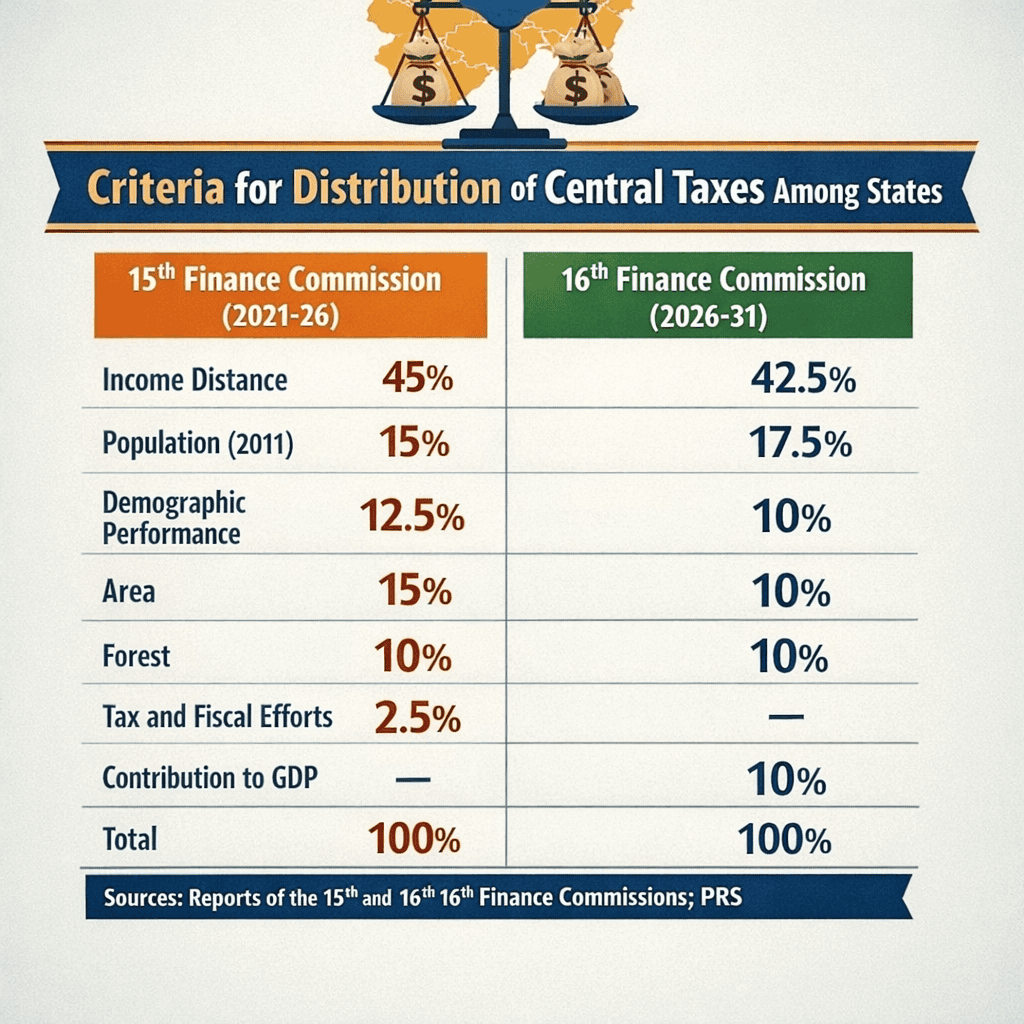
- The Commission introduced a new criterion of contribution measured through the share of a State’s Gross State Domestic Product (GSDP).
- States like Madhya Pradesh, Uttar Pradesh, West Bengal, Bihar, Odisha, Chhattisgarh, and Rajasthan are the main losers.
16th Finance Commission
Detailed Insights:
- The Fourteenth Finance Commission increased the states' share from 32% to 42%, which was later reduced to 41% due to changes in Jammu and Kashmir's status.
- The Sixteenth Finance Commission suggested a 'grand bargain' where states agree to a smaller share in a larger divisible pool if the Centre merges a large part of cesses and surcharges into regular taxes.
- The Commission did not account for its constitutional duty to objectively determine the share of states in the shareable pool of central taxes when observing cesses and surcharges.
- The average effective transfers to states as a percentage of the Centre’s pre-transfer gross revenue receipts were 34.4% during the Fifteenth Finance Commission period.
- The Commission's projection for nominal GDP growth at 11% is higher than the Budget estimate of 10% for 2026-27.
- The Commission did not factor in the revenue-reducing effect of the Goods and Services Tax (GST) reforms undertaken in September 2025.
- The Commission used the square root of GSDP to reduce the excessive effects of using GSDP to reflect contribution on some States.
- Dropping the tax effort/fiscal discipline criterion is inconsistent with the Commission’s own narrative.
- The losses of some States could have been mitigated through normatively determined revenue gap grants.
- Article 275 provides an important mode of fiscal transfers for the consideration of State-specific ‘needs’ to equalize standards of critical services such as health and education.
Key Concepts Involved:
- Finance Commission: A constitutional body that determines the distribution of tax revenues between the Union and the States.
- Divisible Pool: The portion of central taxes that is distributed between the Union and the States.
- Gross State Domestic Product (GSDP): A measure of the total value of goods and services produced within a state's boundaries.
- Cesses and Surcharges: Taxes levied by the Union government for specific purposes, not usually shared with states.

SuperKalam is your personal mentor for UPSC preparation, guiding you at every step of the exam journey.
Download the App


STUDY RESOURCES
CONTACT US
ⓒ Snapstack Technologies Private Limited