GS 3: Science & TechnologyPrelims
How do astronauts return from space and survive re-entry?, Pg9
Astronauts' perilous return: Mastering re-entry through heat shields, precise corridors, and parachute deployment for safe landing.
Practice MCQs
754 Students attempted
Key Highlights:
- Re-entry involves shedding immense orbital velocity against atmospheric resistance, converting kinetic energy into heat.
- The blunt body theory deflects re-entry heat, preventing capsule melting.
- A re-entry corridor is a precise atmospheric window for safe return, avoiding bouncing off or burning up.
- Semi-ballistic bodies use an angle of attack to generate lift, enabling steering toward a landing zone.
- A communication blackout occurs due to plasma interference, managed via relay satellites and high-frequency signals.
- Parachutes are deployed to reduce velocity after aerobraking for a safe landing.
- Gaganyaan's crew module (CM) will use a three-stage parachute system for a Bay of Bengal splashdown.
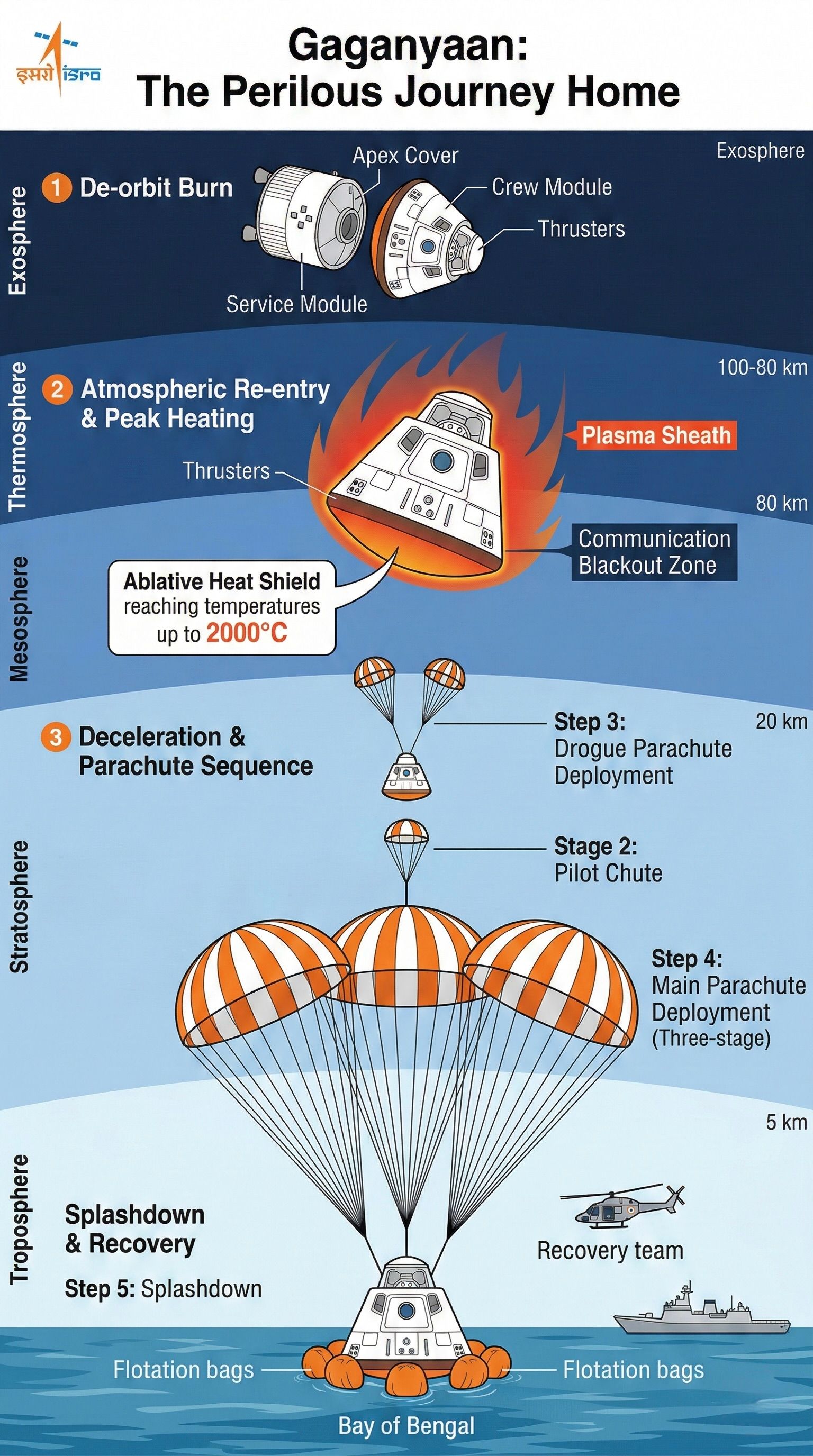
Gaganyaan
Detailed Insights:
- Aerospace scientists initially thought atmospheric re-entry survival impossible due to extreme heat.
- Over 98% of a re-entering capsule's energy dissipates as heat, shielded by ablative or thermal insulation systems.
- Deorbit burn reduces velocity, causing gravity to overcome centrifugal force, initiating a downward trajectory.
- Too shallow an entry angle causes the capsule to bounce off the atmosphere; too steep leads to lethal deceleration and heat.
- Semi-ballistic bodies fly at an angle, creating lift for gliding and banking toward a targeted landing zone.
- The plasma sheath during communication blackout blocks radio waves, disrupting communication until the capsule slows.
- Aerobraking uses atmospheric drag to decelerate the capsule; parachutes further reduce velocity for a soft landing.
- ISRO's Space Capsule Recovery Experiment (SRE) in 2007 and CARE in 2014 validated re-entry capabilities.
- Gaganyaan's service module (SM) will be destroyed during re-entry; the CM will maneuver within the re-entry corridor.
- The CM will modulate its lift vector via thruster firings to reach its Bay of Bengal landing site.
Key Concepts Involved:
- Re-entry Corridor: The narrow atmospheric path a spacecraft must follow to safely return to Earth.
- Semi-Ballistic Body: A vehicle that uses both aerodynamic lift and drag to control its descent.
- Aerobraking: Using atmospheric drag to decelerate a spacecraft during re-entry.

SuperKalam is your personal mentor for UPSC preparation, guiding you at every step of the exam journey.
Download the App


STUDY RESOURCES
CONTACT US
ⓒ Snapstack Technologies Private Limited