GS 1: Indian GeographyGS 3: Environment & EcologyGS 3: EconomyGS 3: Disaster ManagementPrelims
Below normal rain in July, current deficit 40%: IMD, Pg1
IMD warns of 'below normal' July rainfall, 40% deficit, threatening agriculture and water resources amidst 'Super El Niño' year.
Practice MCQs
775 Students attempted
Key Highlights:
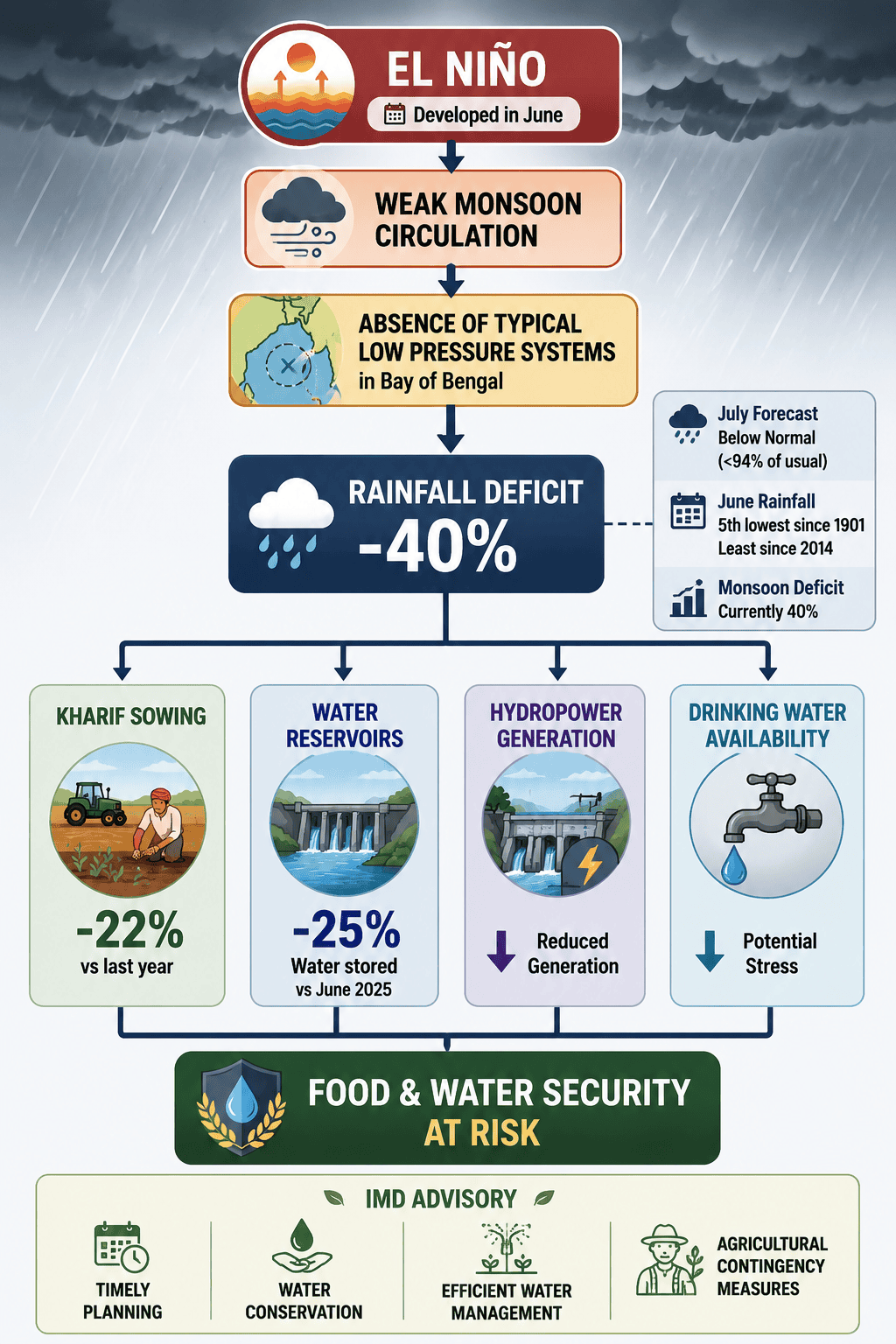
- The India Meteorological Department (IMD) has forecast "below normal" rainfall for July, which is less than 94% of the usual for the month.
- India is currently facing a monsoon deficit of 40%.
- June rainfall was the fifth lowest since 1901 and the least since 2014, with a nearly 40% shortfall.
- The El Niño phenomenon, which developed in June, is identified as a negative factor impacting rainfall.
- Sowing of Kharif crops has declined by 22% compared to last year, with key water reservoirs holding 25% less water than in June 2025.
El Nino.png
Detailed Insights:
- Below-normal rainfall poses significant challenges for agriculture, water resources, hydropower generation, and drinking water availability.
- The IMD has advised timely planning, water conservation, efficient water management, and suitable agricultural contingency measures.
- The weak June rainfall was attributed to the absence of typical low-pressure systems in the Bay of Bengal.
- While the first week of July is expected to bring good rainfall, the overall outlook for the month remains bleak due to the anticipated weak monsoon.
- Surplus water storage from previous good monsoons might deplete faster due to higher evaporation from low rains and high temperatures.
- The current year is warned to be a 'Super El Niño' year, with six out of ten El Niño years historically resulting in weak southwest monsoon rainfall.
- The Indian Ocean Dipole (IOD), a climate pattern affecting sea surface temperatures, could potentially ameliorate El Niño's impact if it develops in a positive phase.
- However, current models suggest a 'neutral' IOD, indicating it may not significantly offset the El Niño effect.
- Historically, only the 1997-98 El Niño year saw above-normal rainfall in India due to a favorable IOD phase.
Key Concepts Involved:
- Monsoon Deficit: A shortfall in rainfall compared to the long-period average during the monsoon season.
- El Niño: A climate pattern characterized by the unusual warming of surface waters in the central and eastern equatorial Pacific Ocean, often leading to weaker monsoons in India.
- Indian Ocean Dipole (IOD): An irregular oscillation of sea-surface temperatures between the western and eastern Indian Ocean, which can strengthen or weaken the Indian monsoon depending on its phase.
- Kharif Crop: Crops sown at the beginning of the southwest monsoon (June–July) and harvested in September–October, highly dependent on monsoon rainfall.

SuperKalam is your personal mentor for UPSC preparation, guiding you at every step of the exam journey.
Download the App


STUDY RESOURCES
CONTACT US
ⓒ Snapstack Technologies Private Limited