GS 3: Science & TechnologyPrelims
Webb telescope captures weather on exoplanet 700 lightyears away, Pg2
James Webb Telescope unveils extreme weather patterns on exoplanet WASP-94A b, revealing dynamic cloud formations and atmospheric composition.
Practice MCQs
768 Students attempted
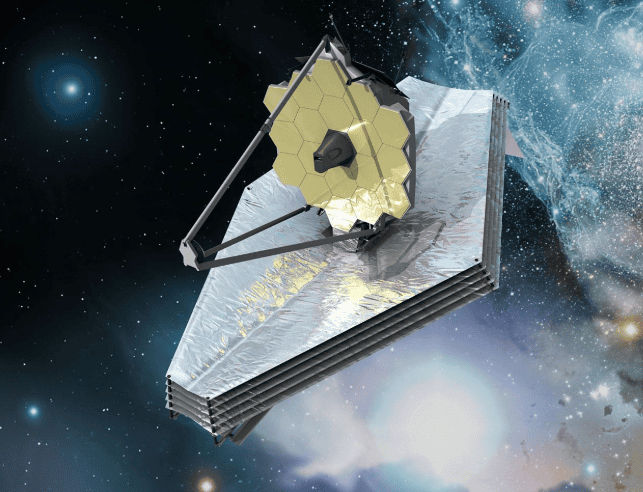
JWST.png
- JWST studied exoplanet WASP-94A b, nearly 700 lightyears away, revealing weather patterns.
- WASP-94A b is a hot Jupiter, almost twice the size of Jupiter but with half the mass, orbiting its star in just four days.
- The exoplanet's dayside is hot enough to melt rock, while the nightside is near absolute zero due to its tidally locked orbit.
- WASP-94A b has dynamic weather: mornings have clouds of magnesium silicate, iron, and magnesium sulphide, while evenings have clear skies.
Detailed Insights:
- Hot Jupiters are gas giants with high atmospheric temperatures and tidally locked orbits, resulting in extreme temperature differences between their daysides and nightsides.
- The transit method was used to study WASP-94A b, where the planet's atmosphere absorbs starlight as it passes in front of its star, revealing atmospheric composition and weather patterns.
- Studying exoplanet atmospheres helps understand planet formation, evolution, and differences compared to planets in our solar system.
- Understanding weather patterns on exoplanets is crucial for accurately estimating their atmospheric composition, which can be biased by cloud cover.
- Future instruments like the Extremely Large Telescope could discover more exoplanet nurseries, increasing the chances of finding Earth-like planets.
Scientific/Technical Concepts Involved:
- Exoplanet: A planet that orbits a star outside our Solar System.
- Hot Jupiter: A gas giant exoplanet with a high surface temperature and close orbit to its star.
- Tidally Locked: When an object's orbital period matches its rotational period, resulting in one side always facing the object it orbits.
- Spectroscopy: Analyzing light wavelengths to determine the composition of a substance, such as a planet's atmosphere.

SuperKalam is your personal mentor for UPSC preparation, guiding you at every step of the exam journey.
Download the App


STUDY RESOURCES
CONTACT US
ⓒ Snapstack Technologies Private Limited