GS 2: International RelationsGS 3: EconomyGS 3: Internal Security
The West Asia cauldron of conflict and its fallout, Pg6
Netanyahu's war escalates as US-Israel military operations against Iran continue, risking global oil crisis and wider conflict across West Asia.
Practice MCQs
754 Students attempted
Key Highlights:
- On February 28, 2026, the United States and Israel initiated "Operation Epic Fury," a large-scale joint military operation against Iran, resulting in thousands of Iranian casualties, including civilians.
- Despite facing widespread disruption and the assassination of key leaders like Ayatollah Ali Khamenei, Iran has maintained its uranium stockpile and is prepared for a prolonged conflict.
- Iran is threatening to blockade the Strait of Hormuz, a critical route for approximately 30% of global oil shipments, potentially triggering a severe oil crisis.
- Many U.S. allies have declined to assist in reopening the Strait of Hormuz, while Iran has offered safe passage to friendly nations.
- The conflict has evolved into a phase of "no peace, no large-scale war," characterized by the weaponization of global economic infrastructure, including energy prices and shipping lanes.
- The appointment of Mojtaba Khamenei as Supreme Leader after the death of Ali Khamenei is seen as a resurgence of radical Shiite militancy.
Detailed Insights:
- The ongoing conflict is largely attributed to Benjamin Netanyahu's agenda, exacerbated by Donald Trump's policies, leading to extensive devastation in West Asia.
- The U.S. strategy of saturation bombardment is causing war weariness within the U.S. military, and Israel's strategy of using U.S. support to contain Iran may be failing.
- Israel's pursuit of the "Biblical Promise of the chosen land" is driving its determination to continue the war, potentially expanding the conflict to include Lebanon, Iraq, and Syria.
- Military experts doubt that regime change in Iran is possible without a ground invasion, a move that lacks support from the U.S. and Europe and would likely face opposition from China and Russia.
- Shiite political culture, influenced by the "Battle of Karbala," emphasizes resistance, patience, and strategic endurance, suggesting that external efforts to change the regime may strengthen Shiite Islam.
- Israel's recent attack near Iran's Bushehr nuclear power plant is viewed as a deliberate provocation that could escalate the conflict into a larger global war.
Key Concepts Involved:
- Strait of Hormuz: A narrow waterway between Oman and Iran, connecting the Persian Gulf to the Gulf of Oman and the Arabian Sea, critical for global oil transport.
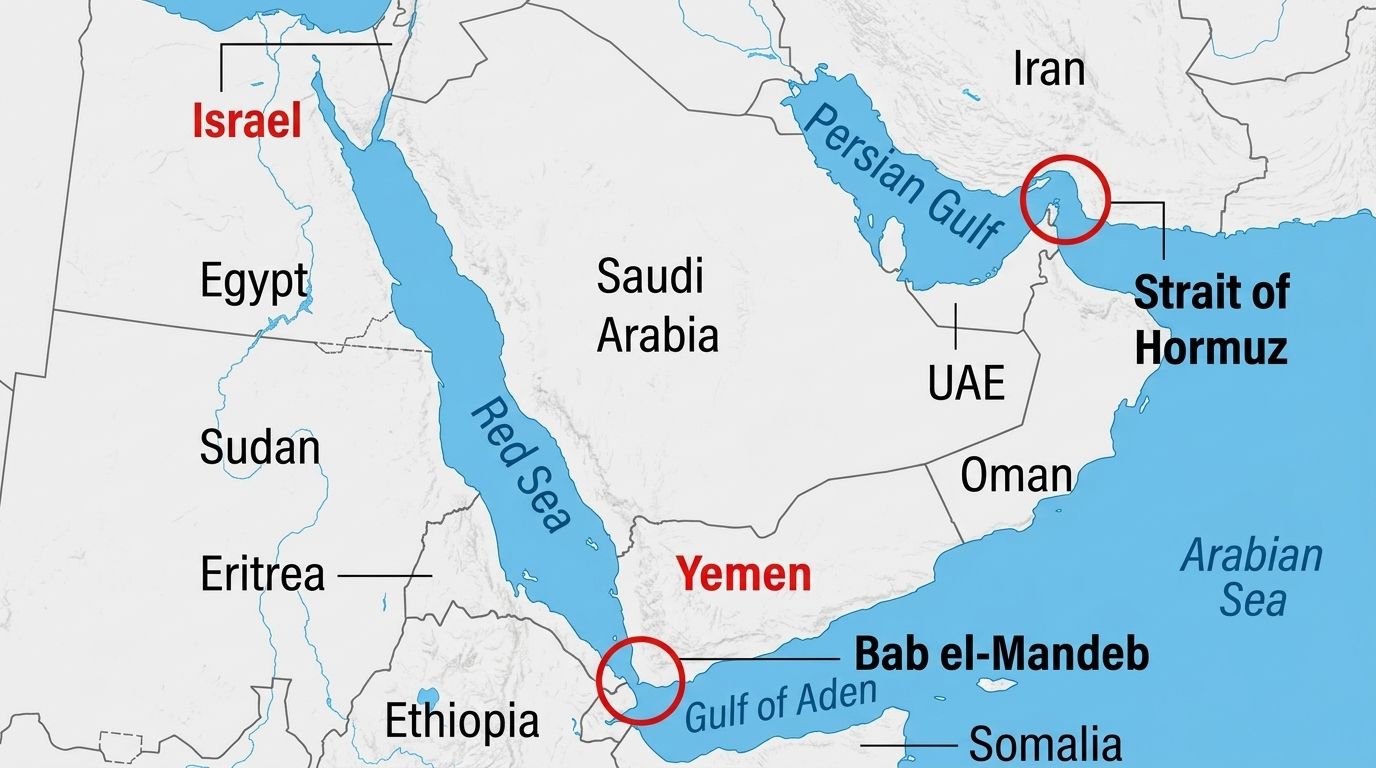
Straight of Hormuz
- Shia Islam: The second-largest branch of Islam, whose adherents believe that the Islamic prophet Muhammad's son-in-law Ali was his successor.
- Weaponization of infrastructure: The strategic use of essential economic systems like energy, shipping, and logistics as tools of conflict.

SuperKalam is your personal mentor for UPSC preparation, guiding you at every step of the exam journey.
Download the App


STUDY RESOURCES
CONTACT US
ⓒ Snapstack Technologies Private Limited