GS 3: Internal SecurityGS 2: International RelationsGS 1: Modern HistoryPrelimsGS 3: Security Challenges and Management in Border Areas
Can India and China coexist peacefully?, Pg8
Amidst historical conflicts and border standoffs, this analysis critically examines whether India and China can forge peaceful coexistence, navigating strategic challenges and military realities.
Practice MCQs
832 Students attempted
Key Highlights:
- India-China relations are currently characterized by "managed coexistence," facing challenges despite not being at war.
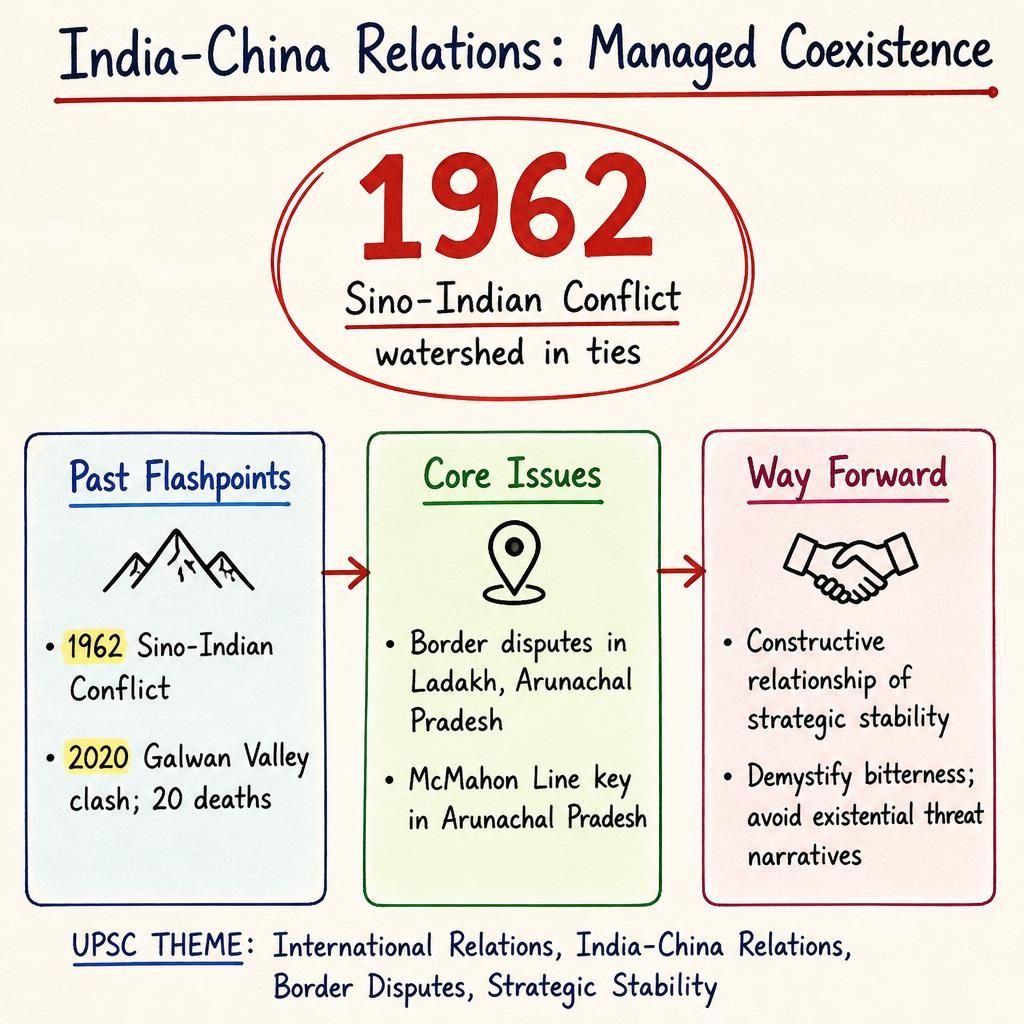
- The 1962 Sino-Indian conflict and the 2020 Galwan Valley clash are cited as significant events contributing to ongoing tensions.
- Border disagreements in Ladakh and Arunachal Pradesh, linked to the McMahon Line, remain a primary point of contention.
- Former Prime Minister Rajiv Gandhi's 1988 visit to China, meeting Deng Xiaoping, is highlighted as a past watershed in improving relations.
- External factors like the U.S.-sponsored QUAD (Quadrilateral Security Dialogue) are seen by some Chinese strategists as a ploy to contain China.
India-China Relations.jpg
Detailed Insights:
- The article suggests that the 1962 conflict might have been influenced by Mao's "hubris" following the Great Leap Forward.
- India views China with distrust due to perceived perfidy after the 1962 war and territorial losses in Ladakh and Arunachal Pradesh.
- The Galwan Valley clash in 2020, which resulted in 20 Indian soldiers' deaths, significantly exacerbated bilateral tensions.
- The McMahon Line is identified as a key factor in the improperly demarcated border in the Arunachal Pradesh sector.
- The article advocates for demystifying the reasons for bitterness to allow both nations to assume their global roles.
- It suggests that India should not view China as an existential threat, despite China potentially seeing India as a challenge to its pre-eminence.
- A "constructive relationship of strategic stability" is proposed as a model for Sino-Indian relations, similar to Sino-U.S. relations.
- The article argues against the myth of China's overwhelming military edge, stating that the People’s Liberation Army (PLA) and People’s Liberation Army Navy (PLAN) are not yet world-class.
- It emphasizes that India is a match for China's capabilities in the high Himalayas, and direct conflict would set China back from its 2049 global leadership target.
- A 2005 agreement signed under President Hu Jintao, fostering a long-term cooperative partnership, is cited as an example of China's willingness to bend.
- Understanding the historical frailties of the Qing Dynasty and its boundary elasticity is crucial for nations dealing with China.
Key Concepts Involved:
- Managed Coexistence: A state of relations where countries avoid direct conflict but maintain a degree of competition and distrust.
- McMahon Line: A boundary line between Tibet and British India, largely forming the current border between India and China in the eastern sector.
- QUAD (Quadrilateral Security Dialogue): A strategic dialogue between the United States, India, Japan, and Australia, often perceived as a counter to China's growing influence.

SuperKalam is your personal mentor for UPSC preparation, guiding you at every step of the exam journey.
Download the App


STUDY RESOURCES
CONTACT US
ⓒ Snapstack Technologies Private Limited