GS 2: GovernanceGS 3: Environment & EcologyPrelimsGS 3: Conservation, Pollution and DegradationGS 2: Government policies and interventions for development in various sectors
After Dropping Plan For Highway, Bihar Pushes For Tourism Project In Sanctuary, Pg3
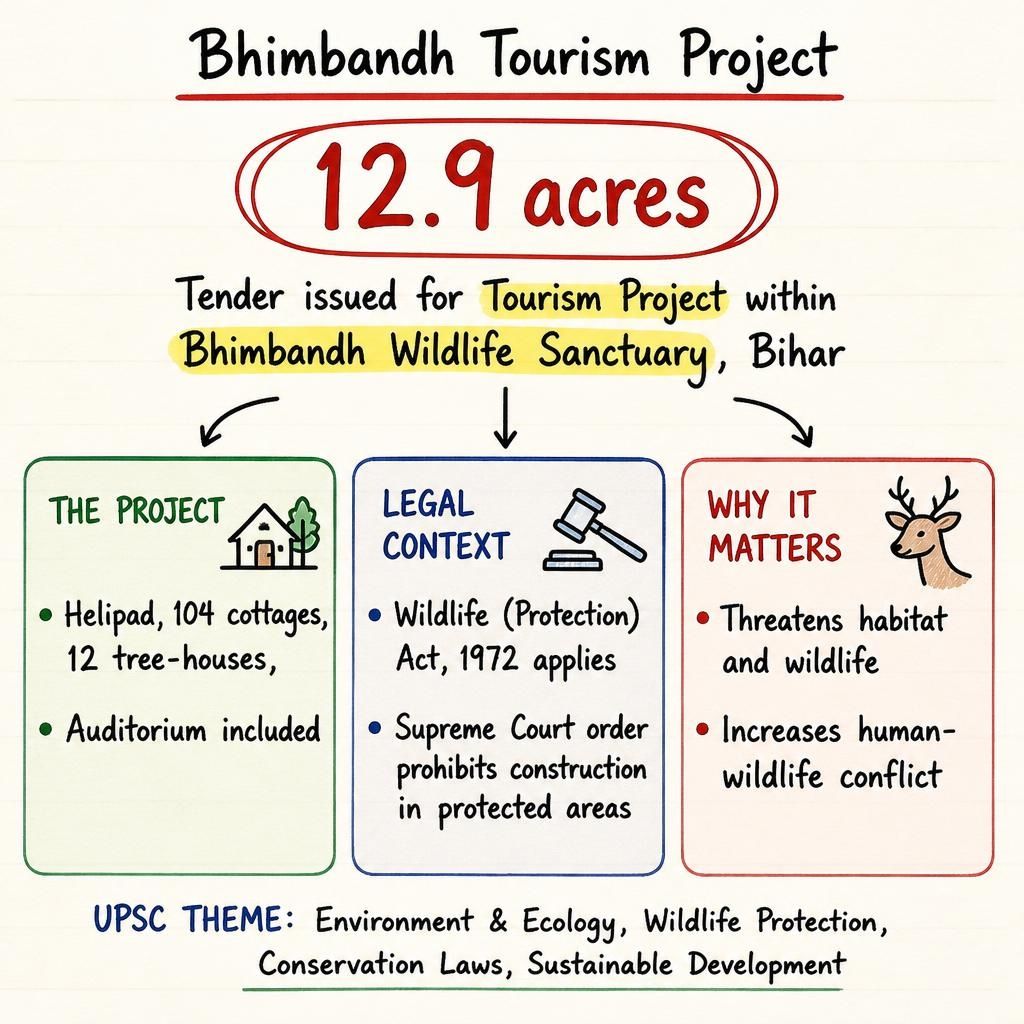
Bihar Forest Department defies Supreme Court order, tenders massive tourism project including helipad and 104 cottages inside Bhimbandh Wildlife Sanctuary.
Practice MCQs
832 Students attempted
Key Highlights:
- The Bihar Forest Department has issued a tender for a large-scale tourism project within Bhimbandh Wildlife Sanctuary, covering 12.9 acres.
- The proposed project includes a helipad, 104 cottages, 12 tree-houses, and an auditorium.
- This initiative proceeds despite existing statutory restrictions and a Supreme Court order prohibiting construction in protected areas.
- The plan follows the department's recent decision to drop a proposal for highway widening in the same region.
Bihar Tourism Proejct.jpg
Detailed Insights:
- Bhimbandh Wildlife Sanctuary is located in the Munger district of Bihar, known for its hot springs, diverse flora, and fauna, and was established in 1976.
- Construction within Wildlife Sanctuaries is strictly regulated under the Wildlife (Protection) Act, 1972, which aims to conserve wildlife and their habitats.
- Projects in protected areas typically require prior approval from the National Board for Wildlife (NBWL).
- The Supreme Court has issued directives, including a June 2022 order, that initially mandated a minimum 1 km Eco-sensitive Zone (ESZ) around protected areas where new permanent structures were prohibited.
- While the Supreme Court later modified this order in April 2023, allowing certain activities within ESZs under strict adherence to the Ministry of Environment, Forest and Climate Change (MoEFCC) guidelines, it maintained a ban on mining within 1 km of protected areas.
- The establishment of large commercial tourism infrastructure within a sanctuary raises concerns about habitat degradation, disturbance to wildlife, and potential for increased human-wildlife conflict.
- Eco-sensitive Zones are designed as "shock absorbers" around protected areas to regulate activities and minimize negative impacts on fragile ecosystems.
Key Concepts Involved:
- Wildlife Sanctuary: An area designated by the state government for the protection of wildlife and its habitat, where certain human activities are regulated.
- Protected Areas: Geographically defined areas such as National Parks and Wildlife Sanctuaries, managed to achieve specific conservation objectives.
- Eco-sensitive Zones (ESZ): Areas notified by the MoEFCC around Protected Areas to regulate activities and minimize adverse impacts on the ecosystem.
- Wildlife (Protection) Act, 1972: A landmark Indian legislation providing a legal framework for the protection of wild animals, birds, and plants, and establishing protected areas.

SuperKalam is your personal mentor for UPSC preparation, guiding you at every step of the exam journey.
Download the App


STUDY RESOURCES
CONTACT US
ⓒ Snapstack Technologies Private Limited