GS 2: GovernanceGS 3: EconomyPrelimsGS 3: Government BudgetingGS 3: Indian Economy, Planning, Mobilization of Resources, Growth, Development and Employment
Worries behind India’s robust GDP, inflation data, Pg9
India's economy shows surprising resilience with robust GDP growth and contained inflation despite global disruptions, though underlying risks persist.
Practice MCQs
818 Students attempted
Key Highlights:
- India's economy recorded over 7% GDP growth and a sharp drop in inflation over the past three financial years.
- Initial concerns about the US-Israeli War and El Niño impacting this trajectory were largely mitigated.
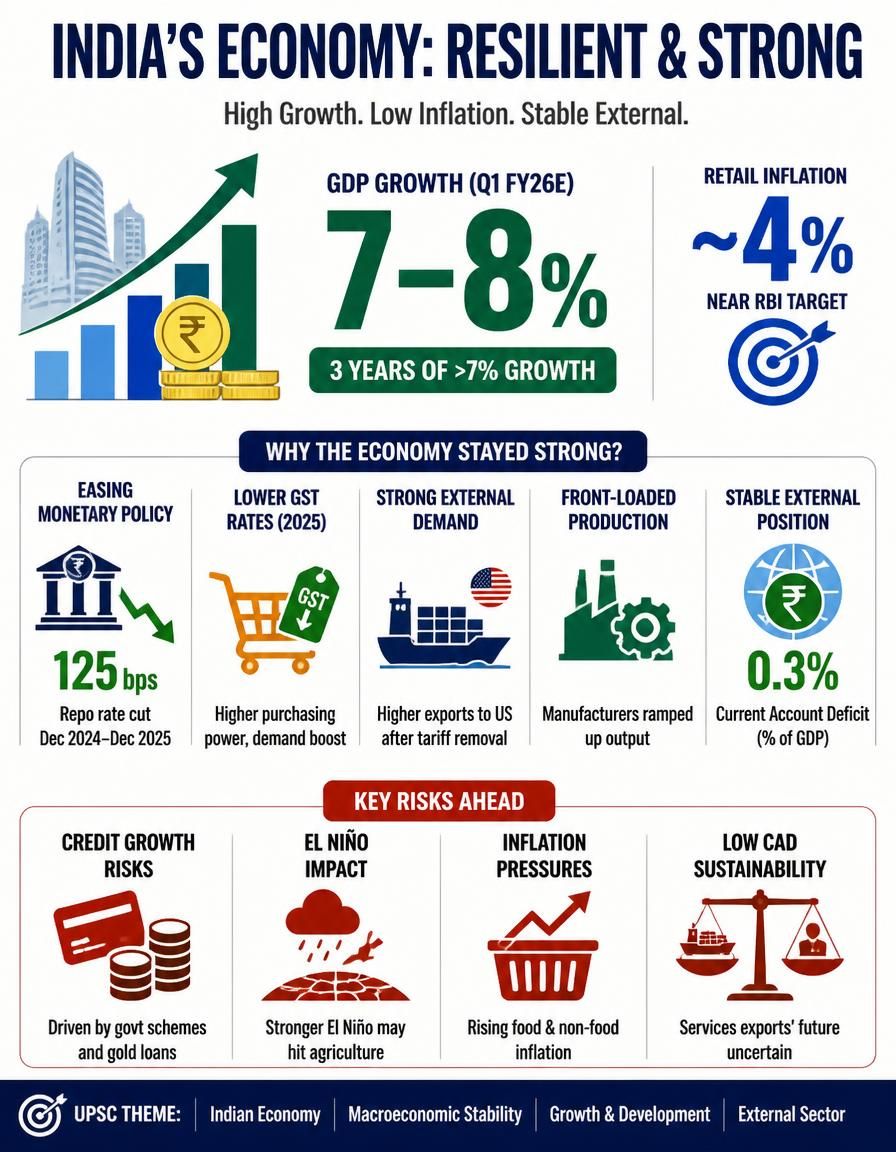
- Macroeconomic data for Q1 is expected to show GDP growth again exceeding 7%, indicating resilience.
- HSBC and SBI research teams project GDP growth between 7-8% for the first quarter.
- Prime Minister Narendra Modi had appealed to citizens to reduce gold purchases and fuel consumption to manage economic pressures.
India's Economy.jpg
Detailed Insights:
- The economy's resilience is partly attributed to a 125-basis point cut in the repo rate between December 2024 and December 2025.
- Lower Goods and Services Tax (GST) rates in 2025 also boosted economic activity by improving purchasing power.
- Increased exports to the US, following the removal of tariffs, contributed to the positive economic performance.
- Manufacturers front-loaded production due to anxiety about future energy availability, supporting growth.
- Retail inflation has remained well-contained near the RBI's target of 4%, despite supply pressures and robust demand.
- The Current Account Deficit (CAD) has remained low at 0.3% of GDP, offsetting a growing goods trade deficit.
- Risks to growth include credit growth driven by government schemes and gold loans, and potential agricultural impact from a stronger El Niño.
- Inflation risks stem from rising food and non-food goods inflation, with services inflation currently keeping the headline rate low.
- The sustainability of a low CAD is questioned due to uncertainties in services export growth, which currently offsets the trade deficit.
- The services sector, accounting for 55% of India's GDP, is crucial in maintaining economic stability.
- A rise in services inflation or a hit to services exports could force the RBI to raise interest rates, potentially dampening growth.
Key Concepts Involved:
- GDP (Gross Domestic Product): The total monetary value of all finished goods and services produced within a country's borders in a specific time period.
- Inflation: The rate at which the general level of prices for goods and services is rising, and subsequently, purchasing power is falling.
- Repo Rate: The interest rate at which the Reserve Bank of India (RBI) lends money to commercial banks.
- Current Account Deficit (CAD): Occurs when a country's total value of imports of goods, services, and transfers is greater than its total value of exports.
- El Niño: A climate pattern describing the unusual warming of surface waters in the eastern tropical Pacific Ocean, impacting global weather.

SuperKalam is your personal mentor for UPSC preparation, guiding you at every step of the exam journey.
Download the App


STUDY RESOURCES
CONTACT US
ⓒ Snapstack Technologies Private Limited