GS 3: Science & TechnologyPrelimsGS 3: Achievements of Indians in Science and TechnologyGS 3: Science and Technology in Everyday LifeGS 3: Space Technology
Study Sheds Light On Early Warning Signs Before Eruption Of Solar Flares, Pg12
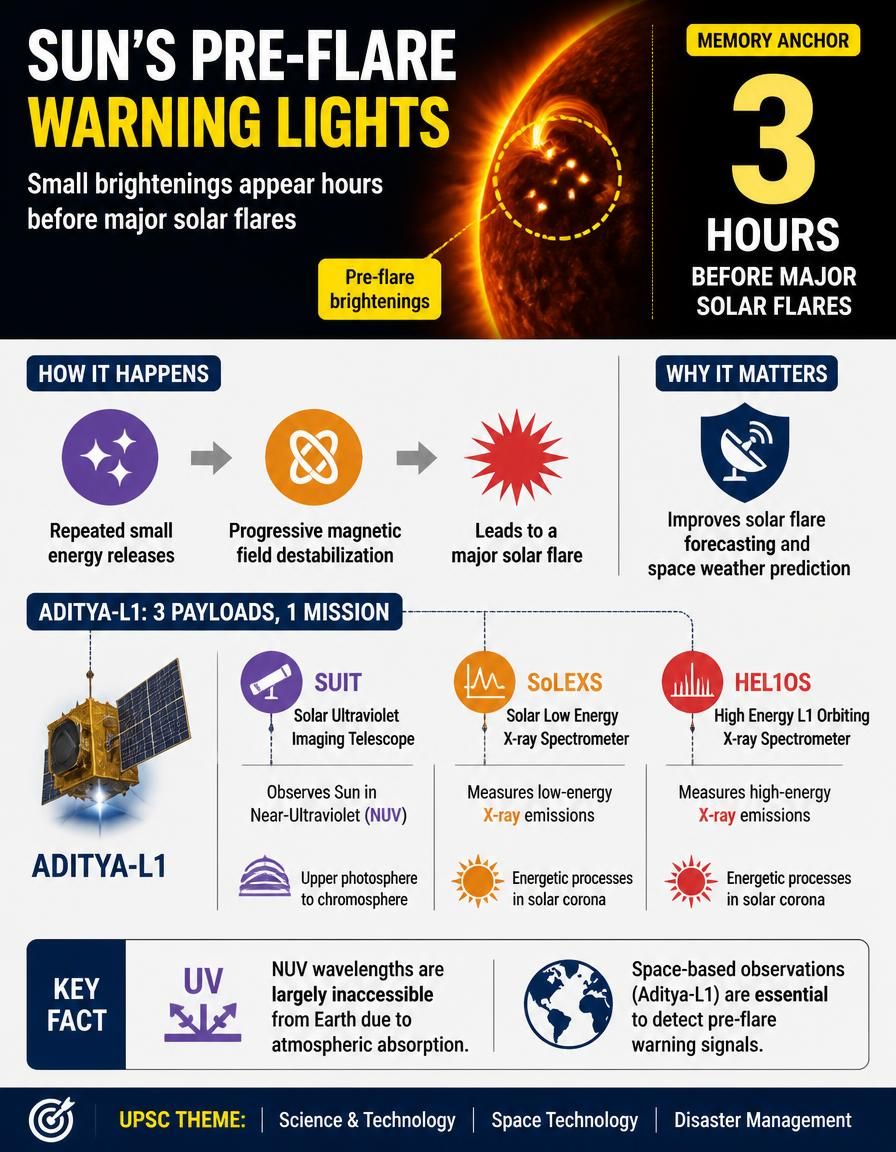
Scientists using Aditya-L1 data discovered small, short-lived brightenings hours before major solar flares, offering crucial early warning signs for space weather prediction.
Practice MCQs
818 Students attempted
Key Highlights:
- A new study identified small, short-lived brightenings in the Sun's atmosphere hours before major solar flares erupt.
- These pre-flare events cluster around the location where the larger flare subsequently occurs.
- The research utilized simultaneous ultraviolet (UV) and X-ray observations from three payloads aboard India's Aditya-L1 mission.
- Scientists from the Manipal Centre for Natural Sciences, Manipal Academy of Higher Education, and Indian Space Research Organisation (ISRO) conducted the study.
- The findings are crucial for improving solar flare forecasting and enhancing space weather prediction capabilities.
Solar Flares.jpg
Detailed Insights:
- The study suggests that repeated small-scale energy releases progressively destabilize the magnetic field in an active region, leading to a large solar flare.
- The Aditya-L1 mission's payloads include the Solar Ultraviolet Imaging Telescope (SUIT), Solar Low Energy X-ray Spectrometer (SoLEXS), and High Energy L1 Orbiting X-ray Spectrometer (HEL1OS).
- SUIT observes the Sun in near-ultraviolet (NUV) filters, providing insights into layers from the upper photosphere to the chromosphere.
- NUV wavelengths are largely inaccessible from Earth due to atmospheric absorption, highlighting the importance of space-based observations.
- SoLEXS and HEL1OS measure X-ray emissions, which indicate energetic processes occurring in the solar corona.
- Better solar flare prediction helps protect critical technologies such as satellites, communication systems, and astronauts from adverse space weather effects.
Scientific/Technical Concepts Involved:
- Solar Flares: Intense bursts of radiation from the Sun's surface, often associated with magnetic energy release.
- Solar Corona: The outermost layer of the Sun's atmosphere, characterized by extremely high temperatures.
- Chromosphere: A layer of the Sun's atmosphere located above the photosphere, visible during total solar eclipses.
- Photosphere: The visible surface of the Sun, where sunlight is emitted.
- Space Weather: Conditions in space, primarily influenced by the Sun, that can affect Earth and its technological systems.

SuperKalam is your personal mentor for UPSC preparation, guiding you at every step of the exam journey.
Download the App


STUDY RESOURCES
CONTACT US
ⓒ Snapstack Technologies Private Limited