GS 2: GovernanceGS 3: Science & TechnologyGS 2: Social JusticePrelimsGS 2: Government policies and interventions for development in various sectors
Can Meta’s safety controls make Facebook and Instagram less addictive for teens?, Pg9
Meta rolls out new safety controls for teens, including default time limits and night mode, following an $18 billion settlement with US states.
Practice MCQs
818 Students attempted
Key Highlights:
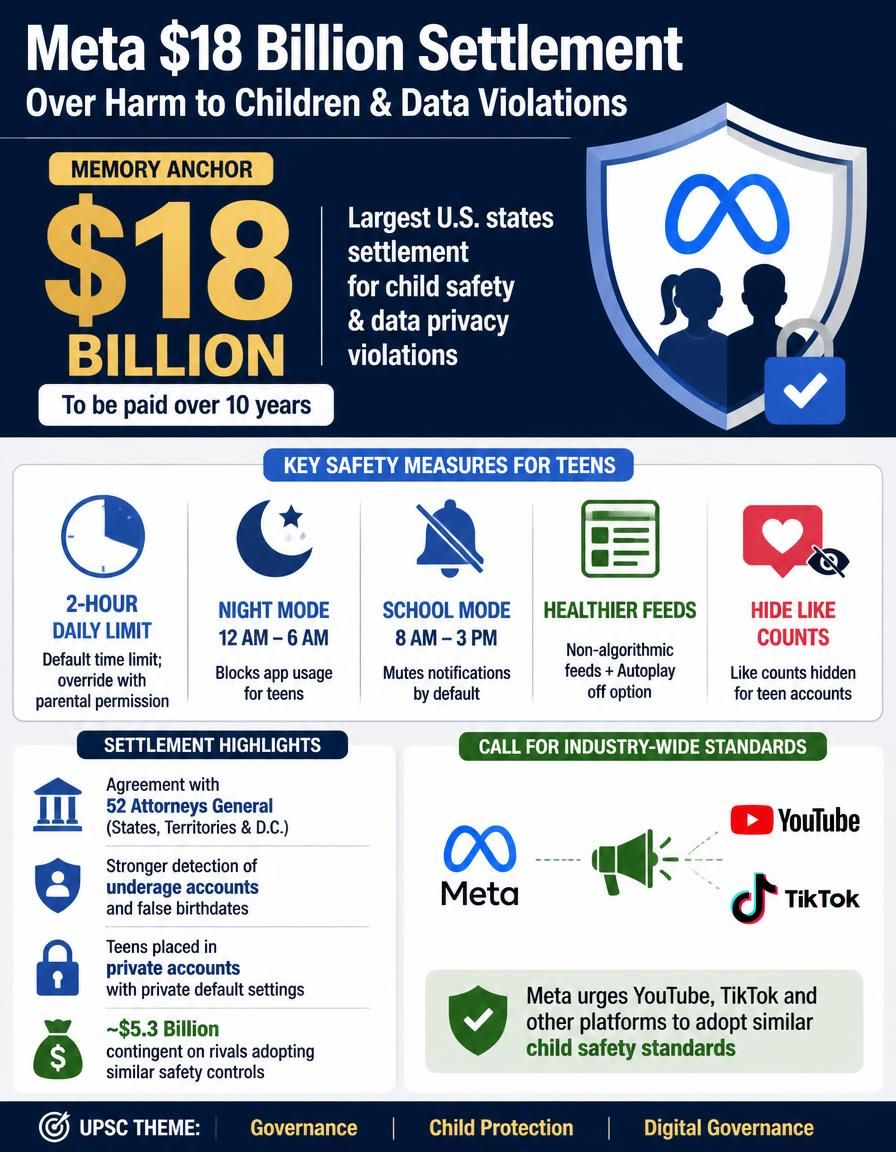
- Meta agreed to an approximately $18 billion settlement with dozens of U.S. states over allegations that its platforms harm children and illegally collect data.
- The settlement, to be paid over 10 years, includes the implementation of stricter safety controls for teen users on Facebook and Instagram.
- New measures include a default two-hour daily time limit and a 'Night Mode' blocking app usage between 12 AM and 6 AM for teens.
- Meta also introduced features like non-algorithmic feeds, the ability to turn off Autoplay, and hiding like counts for teen users.
- The company urged rival social media platforms like YouTube and TikTok to adopt similar safety standards.
Meta Settlement.jpg
Detailed Insights:
- The agreement was reached with 52 attorneys general covering U.S. states, territories, and the District of Columbia.
- The two-hour daily time limit for teens can only be overridden with parental permission.
- A 'School Mode' feature will mute notifications by default between 8 AM and 3 PM, though it does not apply to direct messages.
- Meta is strengthening existing controls to detect underage accounts and prevent teens from falsely entering adult birthdays.
- The company aims to place teens into private accounts on Instagram and activate private default settings on Facebook.
- Approximately $5.3 billion of the settlement is contingent on rival apps implementing similar safety controls.
- Meta supports laws requiring app stores, such as the Apple App Store and Google Play Store, to verify user age and obtain parental approval.
- Enforcement of age verification remains a significant challenge, as children can easily circumvent age restrictions.
Key Concepts Involved:
- Digital Addiction: Compulsive engagement with digital devices or online activities, leading to impaired daily functioning.
- Age Verification: Processes used to confirm the age of users, often for access to age-restricted content or services.
- Algorithmic Feed: Content delivery system that uses algorithms to personalize the user's feed based on their past interactions and preferences.
- Parental Controls: Software or settings that allow parents to monitor and restrict their children's access to digital content and screen time.

SuperKalam is your personal mentor for UPSC preparation, guiding you at every step of the exam journey.
Download the App


STUDY RESOURCES
CONTACT US
ⓒ Snapstack Technologies Private Limited