GS 2: GovernanceGS 3: Science & TechnologyGS 2: Social JusticeGS 3: EconomyPrelims
The next DPI — how India can commoditise AI, Pg10
India aims to commoditise AI, replicating its DPI success with cheap compute, open-source models, and a unified interface to democratize intelligence.
Practice MCQs
811 Students attempted
Key Highlights:
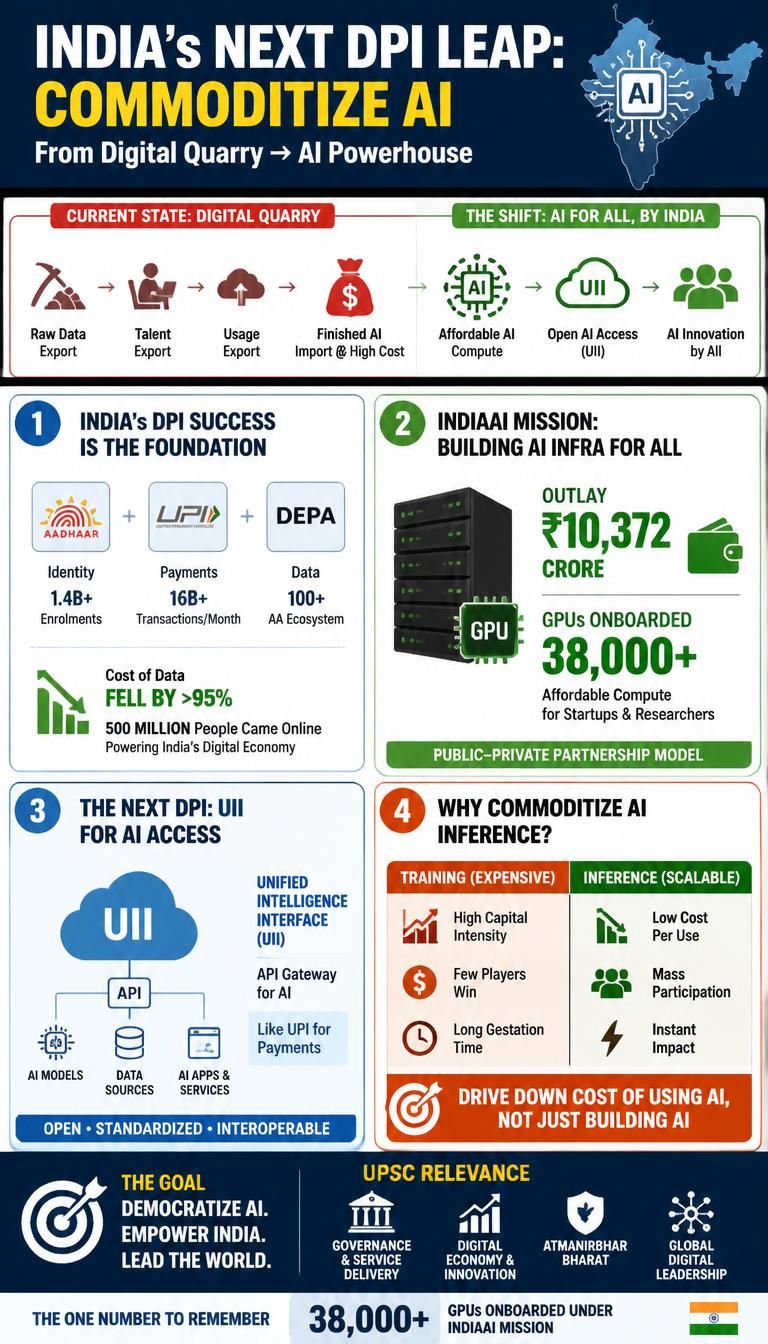
- India aims to replicate its success in Digital Public Infrastructure (DPI) for identity, payments, and data by commoditizing Artificial Intelligence (AI).
- The country's current position in the global AI race is described as a "digital quarry," exporting raw intelligence and importing finished AI at high costs.
- The IndiaAI Mission has been launched with an outlay of approximately ₹10,372 crore to build a public-private partnership model for AI infrastructure.
- Under the mission, over 38,000 GPUs have been onboarded to provide affordable compute access to startups and researchers.
- A Unified Intelligence Interface (UII) is proposed as an API gateway for AI, similar to UPI, to ensure open and standardized access to AI models.
Next DPI.jpg
Detailed Insights:
- India's unique DPI stack integrates Aadhaar for identity, the Unified Payments Interface (UPI) for payments, and DEPA/Account Aggregator for data, enabling widespread digital adoption.
- The cost of data in India significantly decreased, bringing 500 million people online and powering the digital economy.
- The article argues that India should focus on driving down the cost of using AI models (inference) rather than competing in AI training, similar to how it commoditized data.
- The current global AI economic model is extractive, with India supplying talent, data, and usage, then importing AI services at high costs.
- The IndiaAI Mission aims to provide cheap compute power, with eligible entities accessing GPUs at a fraction of global market rates.
- Integrating AI load into the National Electricity Plan and dedicating renewable energy to inference is suggested to ensure cheap and sustainable power for AI.
- India advocates for foundational AI models to become public goods, leveraging anonymized public data (including all 22 official languages) for open-source model development.
- Any AI model developed with state-subsidized compute or public datasets would be released under an open-weights license, shifting economic value to application builders.
- The proposed Unified Intelligence Interface (UII) would provide an open, standardized interface for applications to access various AI models, abstracting complexity.
- A "freemium" model is suggested, offering free API tokens to verified Indian startups and students, subsidized by the state, with commercial tiers for scaling businesses.
- Commoditizing intelligence is expected to transform sectors like healthcare, education, and agriculture by providing affordable AI tools and services.
Key Concepts Involved:
- Digital Public Infrastructure (DPI): Open, interoperable digital systems built by the public sector or in public-private partnerships, enabling essential services at scale.
- Aadhaar: India's unique 12-digit identification number issued to residents, serving as a foundational digital identity.
- Unified Payments Interface (UPI): An instant real-time payment system developed by NPCI, facilitating inter-bank peer-to-peer and person-to-merchant transactions.
- DEPA/Account Aggregator: Data Empowerment and Protection Architecture (DEPA) is a framework that enables consent-based data sharing, with Account Aggregators being RBI-licensed entities facilitating this sharing of financial data.
- IndiaAI Mission: A government initiative with a significant outlay to build a comprehensive AI ecosystem in India, focusing on compute capacity, innovation, and ethical AI.
- Large Language Models (LLMs): Advanced AI models capable of understanding, generating, and processing human language, often used for tasks like translation and content creation.
- Unified Intelligence Interface (UII): A proposed API gateway for AI, designed to provide standardized and open access to various AI models, similar to UPI for payments.

SuperKalam is your personal mentor for UPSC preparation, guiding you at every step of the exam journey.
Download the App


STUDY RESOURCES
CONTACT US
ⓒ Snapstack Technologies Private Limited