GS 3: Science & TechnologyGS 2: International RelationsPrelimsGS 2: Bilateral, Regional and Global Groupings and AgreementsGS 3: Achievements of Indians in Science and Technology
ISRO & Japanese scientists review mission Chandrayaan-5 preparation, Pg8
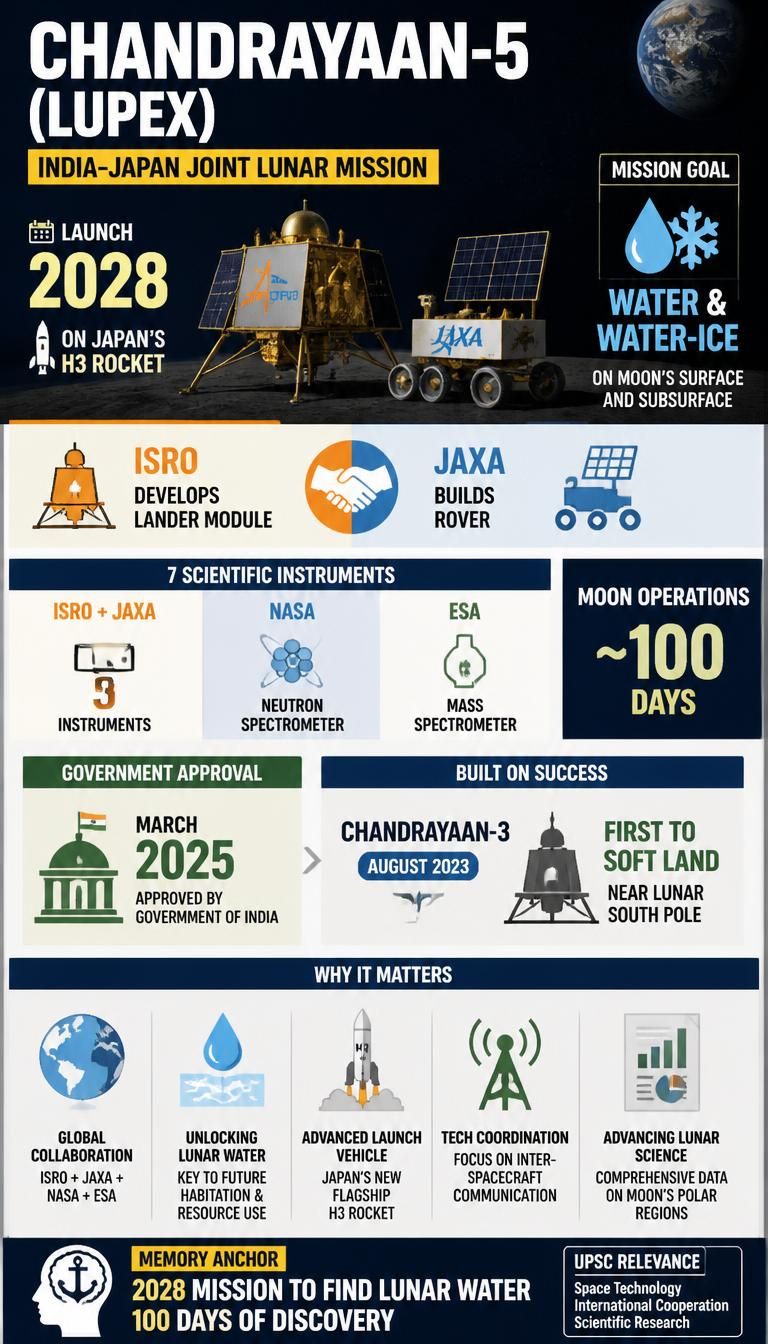
ISRO and JAXA scientists review Chandrayaan-5, a joint lunar polar exploration mission with NASA and ESA, targeting a 2028 launch to study lunar water.
Practice MCQs
811 Students attempted
Key Highlights:
- ISRO and JAXA scientists reviewed preparations for the joint Chandrayaan-5 mission, also known as Lunar Polar Exploration Mission (LUPEX).
- The mission is scheduled for launch in 2028 and aims to study water and water-ice on the Moon's surface and subsurface.
- ISRO is developing the lander module, while JAXA is building the rover for the mission.
- The mission will be launched on Japan's H3 rocket and will carry seven scientific instruments.
- NASA and ESA are also participating, contributing neutron spectrometers and a mass spectrometer, respectively.
- The Indian government approved Chandrayaan-5 in March 2025, following the success of Chandrayaan-3's lunar south pole landing in August 2023.
Chandrayaan 5.jpg
Detailed Insights:
- The joint review meeting took place at the UR Rao Satellite Centre in Bengaluru, focusing on technical coordination and inter-spacecraft communication.
- LUPEX represents a significant international collaboration in lunar exploration, leveraging the expertise of multiple space agencies.
- The mission's focus on lunar water and water-ice is crucial for understanding the Moon's geology and potential for future human habitation and resource utilization.
- The H3 rocket is Japan's new flagship launch vehicle, indicating a reliance on advanced Japanese technology for the mission's deployment.
- The participation of NASA and ESA underscores the global scientific interest in lunar polar regions and the collaborative nature of modern space exploration.
- Chandrayaan-5 is planned to operate on the Moon for approximately 100 days, collecting extensive data.
- The successful Chandrayaan-3 mission provided India with valuable experience in lunar soft landing, paving the way for more complex missions like LUPEX.
Scientific/Technical Concepts Involved:
- Lander Module: A spacecraft component designed to descend and make a soft landing on a celestial body's surface.
- Rover: A robotic vehicle designed to move across the surface of a planet or other celestial body for exploration.
- Mass Spectrometer: An analytical instrument that measures the mass-to-charge ratio of ions, used to identify the composition of a sample.
- Neutron Spectrometer: An instrument used to detect and measure neutrons, often employed in space to detect hydrogen-rich materials like water.

SuperKalam is your personal mentor for UPSC preparation, guiding you at every step of the exam journey.
Download the App


STUDY RESOURCES
CONTACT US
ⓒ Snapstack Technologies Private Limited