GS 1: Indian GeographyGS 2: PolityGS 3: Environment & EcologyPrelimsGS 2: Statutory, Regulatory and Quasi Judicial Bodies
CWMA Upholds Order Directing Release of Cauvery Water to T.N., Pg1
Cauvery Water Management Authority upholds order for Karnataka to release 3,500 cusecs daily to Tamil Nadu, despite Karnataka's distress appeal.
Practice MCQs
811 Students attempted
Key Highlights:
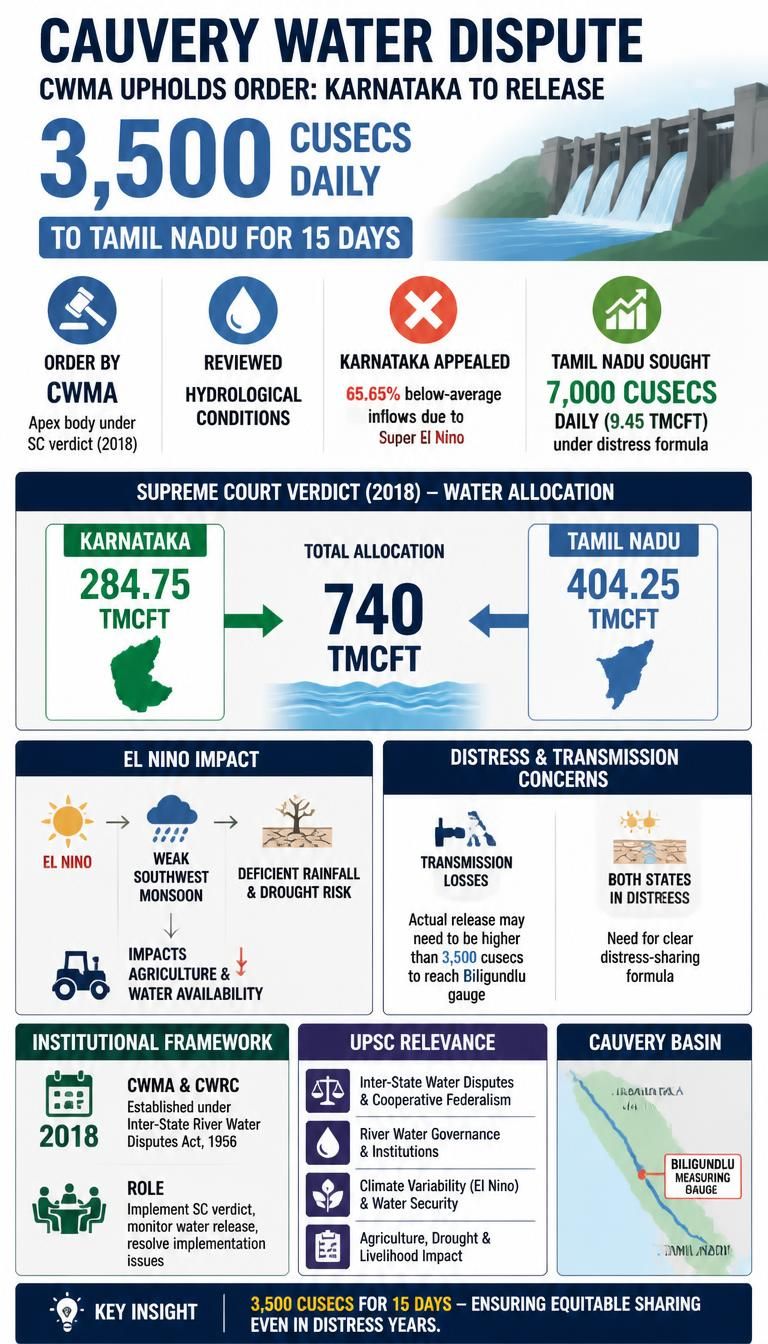
- The Cauvery Water Management Authority (CWMA) upheld the Cauvery Water Regulation Committee’s (CWRC) order directing Karnataka to release 3,500 cusecs of water daily to Tamil Nadu for 15 days.
- Karnataka had appealed against the CWRC order, citing acute hydrological distress due to a super El Nino effect, resulting in 65.65% below-average inflows into its Cauvery basin reservoirs.
- The CWMA, the apex body for monitoring water release as per the Supreme Court’s verdict, endorsed the CWRC order after reviewing hydrological conditions.
- Tamil Nadu, facing its own distress, sought an increased daily release of 7,000 cusecs, totaling 9.45 tmcft, under the distress formula.
Cauvery dispute.jpg
Detailed Insights:
- The CWMA and CWRC were established in 2018 under the Inter-State River Water Disputes Act, 1956, to implement the Supreme Court's 2018 verdict on the Cauvery Water Disputes Tribunal (CWDT) award.
- Karnataka argued that the southwest monsoon is its primary water source, while the northeast monsoon primarily benefits Tamil Nadu.
- The state also highlighted potential transmission losses, suggesting the actual release might need to be higher than 3,500 cusecs to ensure the stipulated quantum reaches the Biligundlu measuring gauge.
- The Supreme Court's 2018 verdict modified the CWDT award, allocating 284.75 tmcft to Karnataka and 404.25 tmcft to Tamil Nadu out of a total of 740 tmcft.
- El Nino typically weakens the Southwest Monsoon in India, leading to deficient rainfall and potential drought conditions, impacting agricultural output.
- The ongoing dispute underscores the challenges of inter-state water sharing, especially during distress years, and the need for a clear distress-sharing formula.
Key Concepts Involved:
- Cauvery Water Management Authority (CWMA): An apex body established to implement the Supreme Court's verdict on the Cauvery water dispute and ensure equitable water distribution.
- Cauvery Water Regulation Committee (CWRC): A subordinate body to the CWMA that monitors daily water levels, inflows, and ensures adherence to the water release schedule.
- El Nino: A climate pattern characterized by the unusual warming of surface waters in the equatorial Pacific Ocean, often leading to weaker Southwest Monsoons in India.
- Cusecs: A unit of flow rate, representing one cubic foot of water per second, commonly used for river flow and irrigation.
- TMCFT: An abbreviation for "thousand million cubic feet," a unit used to measure large volumes of water in reservoirs or river flows.

SuperKalam is your personal mentor for UPSC preparation, guiding you at every step of the exam journey.
Download the App


STUDY RESOURCES
CONTACT US
ⓒ Snapstack Technologies Private Limited