GS 2: GovernanceGS 2: PolityGS 3: Environment & EcologyPrelimsGS 3: Conservation, Pollution and Degradation
Clearance In Reverse, Pg10
Supreme Court's order on post-facto environmental clearances undermines India's EIA regime, converting environmental harm into a mere financial transaction, critics warn.
Practice MCQs
811 Students attempted
Key Highlights:
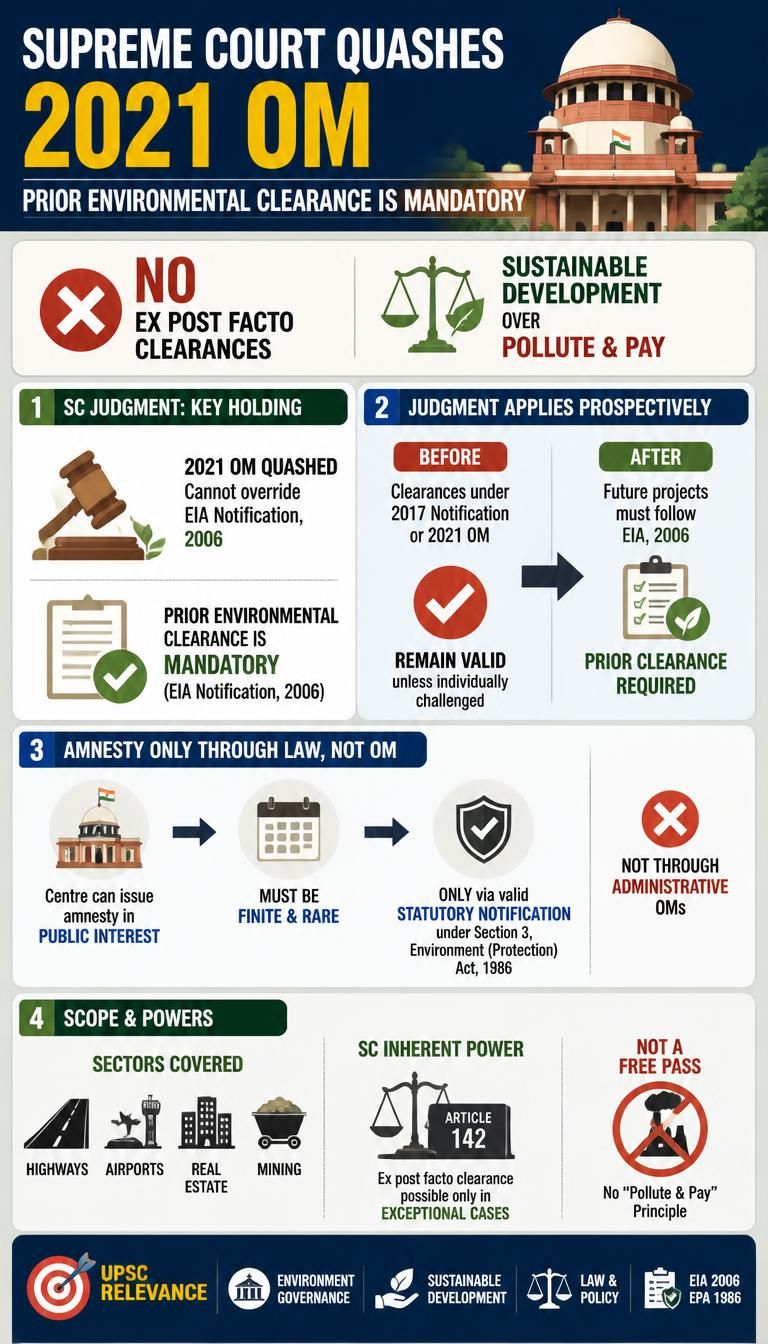
- The Supreme Court of India, in a July 29 order, reaffirmed the rule that environmental appraisal must precede project commencement, not follow it.
- The Court quashed a 2021 Office Memorandum that allowed for post-facto environmental clearances.
- The ruling, however, leaves open the possibility for the Centre to legalize violations through a statutory notification, which critics argue undermines environmental norms.
- The article highlights a growing trend where post-facto clearance has become a common practice for large projects, treating environmental harm as a "cost of doing business."
- The Jan Vishwas (Amendment of Provisions) Act is noted for stripping away the threat of imprisonment for environmental lapses, leaving only monetary penalties.
EP Act.jpg
Detailed Insights:
- India's Environmental Impact Assessment (EIA) regime mandates project appraisal before any ground-breaking activity.
- The Supreme Court's decision is criticized for creating a distinction between administrative orders and statutory notifications, potentially allowing violations to be regularized.
- A significant issue is the disconnect between State-level appraisal mechanisms and central environmental laws, leading to violations being discovered post-construction.
- Projects are often appraised as a 'fait accompli,' where the ecological cost is considered only when demolition becomes more expensive than regularization.
- The article rejects the comparison of environmental amnesty schemes to tax defaults or regularizing unauthorized colonies, emphasizing the unique nature of ecological damage.
- Environmental science underscores the interconnectedness of ecosystems, meaning damage to one component affects the entire system.
- The shift from criminal penalties to civil penalties, facilitated by the Jan Vishwas Act, is seen as weakening the precautionary principle.
- This transactional approach, where environmental harm is priced and settled, is argued to not prevent irreversible damage.
- The article suggests that the Centre should interpret the order as a mandate to reform the environmental clearance system, rather than a license for more amnesty schemes.
Key Concepts Involved:
- Environmental Impact Assessment (EIA): A process of evaluating the likely environmental impacts of a proposed project or development.
- Post-facto Clearance: Environmental approval granted to a project after its construction or operation has already begun.
- Precautionary Principle: A principle stating that if an action or policy has a suspected risk of causing harm to the public or the environment, in the absence of scientific consensus that the action or policy is harmful, the burden of proof that it is not harmful falls on those taking the action.
- Jan Vishwas (Amendment of Provisions) Act: A law that decriminalizes minor offenses across various legislations, including some environmental laws, by replacing imprisonment with monetary penalties.

SuperKalam is your personal mentor for UPSC preparation, guiding you at every step of the exam journey.
Download the App


STUDY RESOURCES
CONTACT US
ⓒ Snapstack Technologies Private Limited