GS 2: GovernanceGS 3: Science & TechnologyPrelimsGS 2: Government policies and interventions for development in various sectorsGS 3: Science and Technology in Everyday Life
How Brain Imaging Offers a Crucial Window to Identify, Assess and Treat Wake-Up Strokes, Pg II
Advanced brain imaging techniques like MRI and CT angiogram are revolutionizing wake-up stroke treatment, enabling crucial interventions despite unknown onset time.
Practice MCQs
825 Students attempted
Key Highlights:
- Wake-up strokes, occurring during sleep, account for 20% of all ischaemic strokes, posing a challenge due to unknown symptom onset time.
- Brain imaging, particularly MRI and CT angiogram, is crucial for identifying salvageable brain tissue in these cases.
- Imaging techniques like diffusion-weighted imaging and FLAIR help determine if brain tissue can still be saved, guiding treatment decisions.
- The Tamil Nadu Accident and Emergency Care Initiative and Stroke Care and Rapid Intervention with Plasminogen activator and Thrombectomy (SCRIPT) programme facilitate treatment for wake-up stroke patients.
- Prompt medical attention is vital, as timely intervention can significantly improve outcomes for stroke patients.
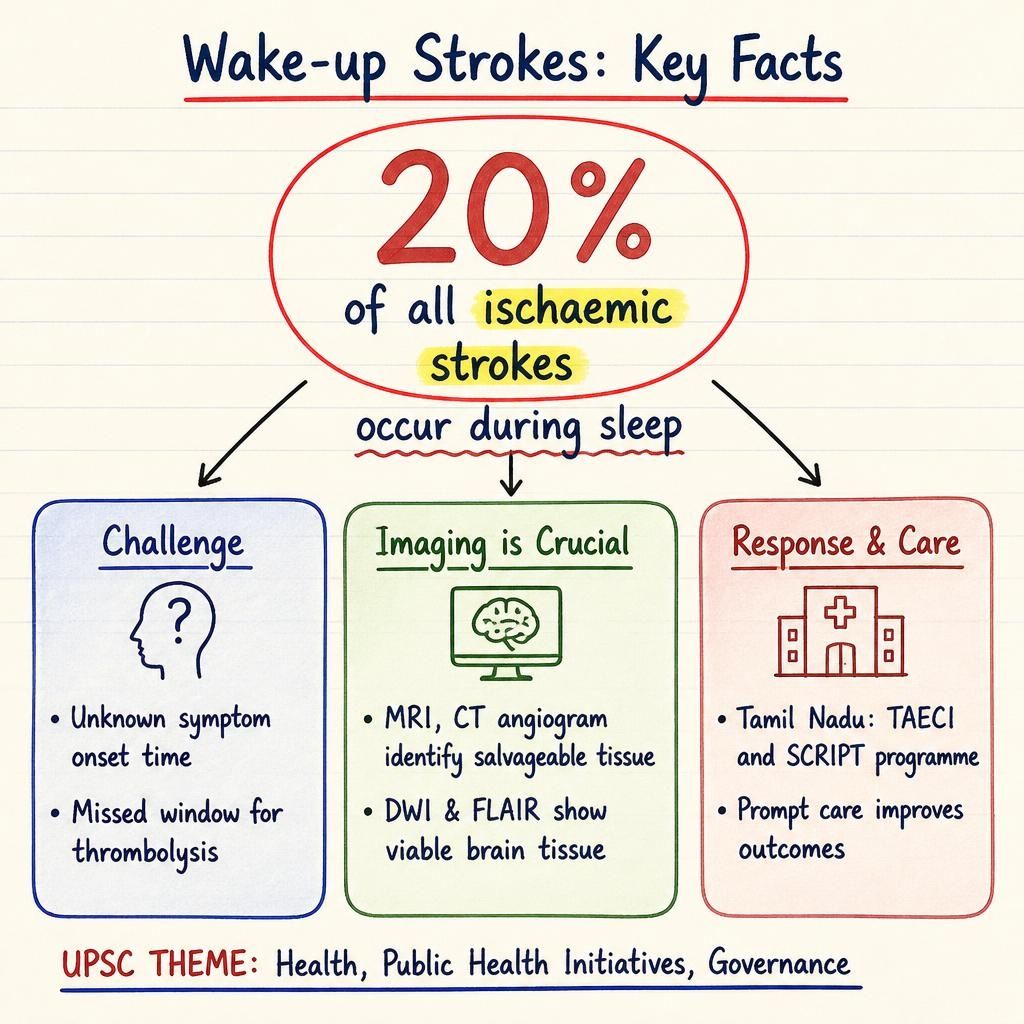
Wake-up Strokes.jpg
Detailed Insights:
- The primary challenge with wake-up strokes is the inability to determine the exact time of symptom onset, which is critical for time-sensitive treatments like thrombolysis.
- Standard thrombolysis is typically effective if administered within 4.5 hours of stroke symptoms, but this window is often missed in wake-up strokes.
- For large vessel occlusions, mechanical thrombectomy can be performed up to 24 hours after symptom onset, depending on patient eligibility.
- Imaging studies, such as MRI perfusion or CT perfusion, help identify a "diffusion-perfusion mismatch," indicating brain tissue that is still viable and can be saved.
- The SCRIPT programme in Tamil Nadu ensures coordinated care, involving emergency, radiology, and neurology departments, to reduce "door-to-needle" time.
- Public awareness campaigns using acronyms like BE FAST (Balance, Eyes, Face, Arm, Speech, Time) are increasing recognition of stroke symptoms and improving referral systems.
Scientific/Technical Concepts Involved:
- Ischaemic Stroke: A type of stroke caused by a blood clot blocking an artery that supplies blood to the brain.
- Thrombolysis: A medical procedure using drugs to dissolve blood clots, typically administered within a narrow time window after stroke onset.
- Mechanical Thrombectomy: A surgical procedure to physically remove a blood clot from a large artery in the brain using a catheter.
- Diffusion-Perfusion Mismatch: An imaging finding where the area of brain tissue with reduced blood flow (perfusion deficit) is larger than the area of already damaged tissue (diffusion restriction), indicating salvageable brain.

SuperKalam is your personal mentor for UPSC preparation, guiding you at every step of the exam journey.
Download the App


STUDY RESOURCES
CONTACT US
ⓒ Snapstack Technologies Private Limited