GS 2: GovernanceGS 2: International RelationsGS 3: EconomyPrelimsGS 3: Changes in Industrial Policy and Effects on Industrial Growth
Govt Raises FY27 Growth Forecast to 7.3%, Flags Risks From Crude Oil Prices, Pg15
Finance Ministry raises India's FY27 growth forecast to 7.3%, driven by domestic demand, yet warns of significant risks from elevated crude oil prices.
Practice MCQs
825 Students attempted
Key Highlights:
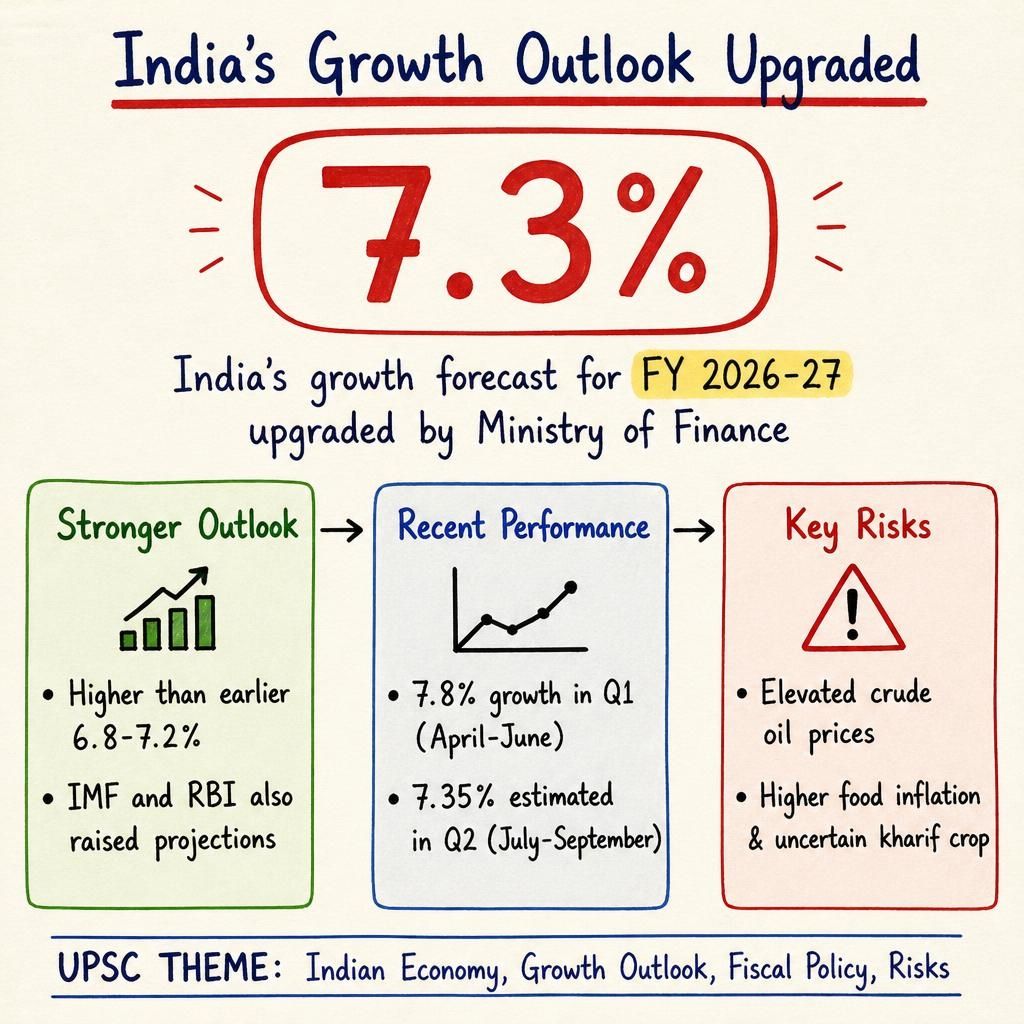
- The Ministry of Finance upgraded India's growth forecast for the ongoing financial year 2026-27 to 7.3%.
- This revised projection is an increase from the earlier 6.8-7.2% estimated in the Economic Survey in February.
- The International Monetary Fund (IMF) and the Reserve Bank of India (RBI) have also raised their growth projections for India.
- The economy registered a 7.8% growth in Q1 (April-June) and an estimated 7.35% in Q2 (July-September) of FY27.
- Key risks to growth include elevated crude oil prices, higher food inflation, and an uncertain outlook for the kharif crop.
India's Growth Outlook.jpg
Detailed Insights:
- India's economic resilience is underpinned by robust domestic demand, sustained investment activity, a resilient financial sector, and effective supply-side management.
- High-frequency indicators such as industrial output, energy consumption, GST collections, and automobile sales showed stronger growth in the second quarter.
- Policy initiatives, investments, and firm-level developments are actively promoting manufacturing, localization, and technological advancements.
- Recent GST process reforms are expected to simplify compliance and alleviate working capital constraints for businesses.
- Healthy credit growth and new trade agreements are anticipated to further boost consumption, investment, and exports.
- Challenges include global energy price volatility, supply-chain disruptions, and geopolitical developments impacting manufacturing costs and investment decisions.
- The RBI has implemented measures, including providing direct dollar liquidity to Public Sector OMCs, to buffer extreme exchange rate volatility and mitigate imported inflation.
Key Concepts Involved:
- Economic Survey: An annual document presented by the Ministry of Finance, detailing the state of the Indian economy and outlining policy recommendations.
- Nowcasting Model: A statistical technique used to predict the current or very near future state of an economy using real-time, high-frequency data.
- Kharif Crop: Agricultural crops sown during the monsoon season (typically June-July) and harvested in autumn (September-October), such as rice, maize, and cotton.
- Public Sector OMCs (Oil Marketing Companies): Government-owned corporations primarily engaged in the refining, distribution, and marketing of petroleum products in India.

SuperKalam is your personal mentor for UPSC preparation, guiding you at every step of the exam journey.
Download the App


STUDY RESOURCES
CONTACT US
ⓒ Snapstack Technologies Private Limited