GS 2: GovernanceGS 2: PolityPrelimsGS 2: Important Aspects of Governance, Transparency and AccountabilityGS 2: Comparison of Indian Constitution with Other Countries
Concerns over the collegium system, Pg10
Retired SC judge raises concerns over CJI seeking government 'pre-approval' for judicial appointments, sparking debate on collegium system's autonomy and transparency.
Practice MCQs
825 Students attempted
Key Highlights:
- Former Supreme Court Justice Sanjay Kaul expressed concern that ex-CJI D.Y. Chandrachud may have sought the Union Government's 'pre-approval' for judicial appointments before collegium meetings.
- This alleged practice is seen as undermining the judiciary's autonomy and independence.
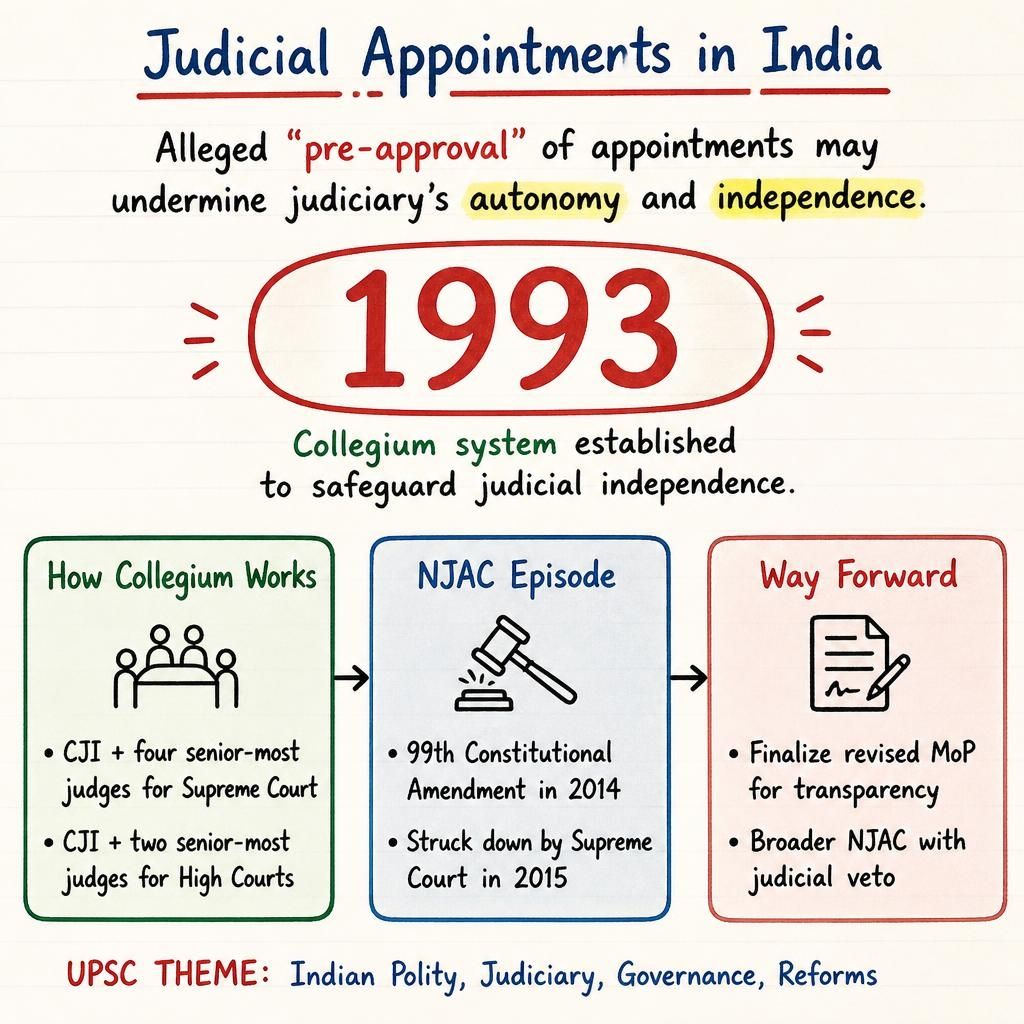
- The collegium system, established in 1993, is responsible for appointing judges to the higher judiciary in India.
- The National Judicial Appointments Commission (NJAC), introduced by the 99th Constitutional Amendment in 2014, was struck down by the Supreme Court in 2015.
Judicial Appointments.jpg
Detailed Insights:
- Article 124 and Article 217 of the Constitution mandate the President to appoint Supreme Court and High Court judges, respectively, after consulting the Chief Justice of India (CJI).
- The First Judges case (1981) initially affirmed the executive's primacy in judicial appointments, stating that 'consultation' did not mean 'concurrence'.
- The Second Judges case (1993) established the collegium system to safeguard judicial independence, ruling that 'consultation' implies 'concurrence' of the CJI.
- This system was further reaffirmed and its composition clarified in the Third Judges case (1998).
- The Supreme Court collegium consists of the CJI and four senior-most judges, while High Court collegiums comprise the CJI and two senior-most judges.
- The Memorandum of Procedure (MoP), drafted in 1998, outlines the detailed process for judicial appointments, allowing the government to return recommendations once.
- The NJAC aimed to replace the collegium with a six-member body including the CJI, two senior judges, the Union Law Minister, and two eminent persons.
- The Supreme Court declared the NJAC unconstitutional in 2015, asserting that it violated the basic structure of judicial independence.
- India's collegium system is unique, as other democracies like the U.S., UK, and South Africa employ executive nominations or independent commissions for judicial appointments.
- Proposed reforms include finalizing the revised MoP to enhance transparency and potentially reintroducing a broader NJAC with a judicial veto to ensure inclusivity and protect independence.
Key Concepts Involved:
- Collegium System: A system where the Chief Justice of India and a panel of senior Supreme Court judges recommend appointments and transfers of judges to the higher judiciary.
- Judicial Independence: The principle that the judiciary should be free from influence and control by the executive and legislative branches of government.
- Basic Structure Doctrine: A judicial principle that certain fundamental features of the Indian Constitution cannot be altered or amended by the Parliament.
- Memorandum of Procedure (MoP): A document detailing the process and guidelines for the appointment and transfer of judges to the Supreme Court and High Courts.

SuperKalam is your personal mentor for UPSC preparation, guiding you at every step of the exam journey.
Download the App


STUDY RESOURCES
CONTACT US
ⓒ Snapstack Technologies Private Limited