GS 2: GovernanceGS 2: PolityGS 2: International RelationsGS 3: EconomyPrelims
What an infrastructure of innovation depends on — a responsive legal system, Pg17
A responsive legal system, exemplified by Delhi High Court's IP Division, is vital for India's innovation ecosystem and attracting investment, ensuring justice delivery.
Practice MCQs
818 Students attempted
Key Highlights:
- India's legal system is crucial for fostering an innovation ecosystem and attracting investment, aligning with the vision of Viksit Bharat by 2047.
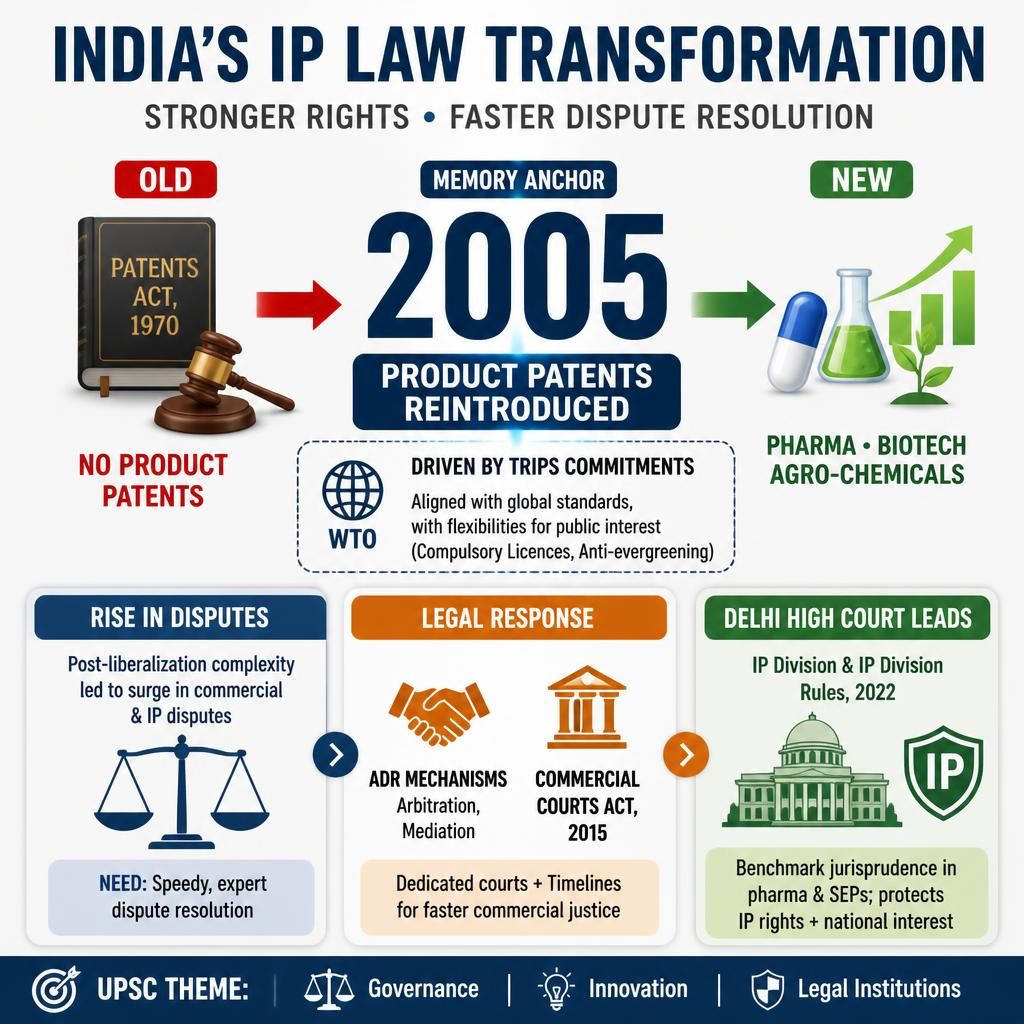
- The Patents Act, 1970 underwent significant amendments between 1999 and 2005, notably reintroducing product patents in 2005, which boosted interest in Intellectual Property (IP).
- These changes were primarily driven by India's obligations as a member of the World Trade Organisation (WTO) and its Trade-Related Aspects of Intellectual Property Rights (TRIPS) agreement.
- The Indian legal system responded to a rise in commercial and IP disputes by promoting Alternative Dispute Resolution (ADR) mechanisms and enacting the Commercial Courts Act, 2015.
- The Delhi High Court has become a leading example, establishing an Intellectual Property Division and framing IP Division Rules 2022 to streamline IP dispute resolution.
IP Law.jpg
Detailed Insights:
- The 2005 amendment to the Patents Act, 1970 reintroduced product patents for chemical substances, impacting the pharmaceutical, biotechnology, and agro-chemical sectors.
- TRIPS obligations required member countries to adopt common minimum definitions and conditions for IPR protection, while allowing flexibilities for national interest, such as public health.
- National IP laws were revamped to align with TRIPS commitments, incorporating public-interest carveouts like Compulsory Licences and checks against evergreening of patent rights.
- The post-liberalization era in India led to increased complexity in commercial models, resulting in a sharp rise in commercial and IP disputes.
- ADR mechanisms, including arbitration and mediation, were promoted to decongest civil courts and ensure speedy, nuanced disposal of time-sensitive commercial disputes.
- The Commercial Courts Act, 2015 empowered state governments to establish dedicated commercial courts and introduced provisions to expedite commercial dispute resolution.
- The Delhi High Court leveraged its original side jurisdiction to handle high-end commercial disputes directly, developing significant expertise in complex IP matters.
- Its jurisprudence, particularly in pharmaceutical drugs and Standard Essential Patents, has served as a benchmark for IP rights treatment and national interest protection globally.
- The creation of the Intellectual Property Division in July 2021, following the abolition of the Intellectual Property Appellate Board (IPAB), and the subsequent IP Division Rules 2022 further enhanced the Delhi High Court's capacity and stakeholder confidence.
- A responsive legal system is integral to achieving the vision of Viksit Bharat by 2047 by fostering a culture and ecosystem of innovation and entrepreneurship.
Key Concepts Involved:
- Intellectual Property Rights (IPRs): Legal rights granted to creators for their original works, inventions, or designs, providing exclusive control over their use.
- Trade-Related Aspects of Intellectual Property Rights (TRIPS): An international agreement under the World Trade Organisation (WTO) that sets minimum standards for IP regulation among member countries.
- Alternative Dispute Resolution (ADR): Methods like arbitration, mediation, and conciliation used to resolve disputes outside traditional court litigation, aiming for faster and more cost-effective solutions.
- Compulsory Licences: Government-granted authorization to a third party to produce a patented product without the patent holder's consent, typically for public interest or welfare.

SuperKalam is your personal mentor for UPSC preparation, guiding you at every step of the exam journey.
Download the App


STUDY RESOURCES
CONTACT US
ⓒ Snapstack Technologies Private Limited