GS 3: Internal SecurityGS 2: International RelationsPrelimsGS 2: Bilateral, Regional and Global Groupings and AgreementsGS 2: Effect of Policies and Politics of Developed and Developing Countries on India's Interests
US Forces Set to Exit Iraq After 2 Decades, Pg18
US forces complete two-decade Iraq exit, sparking concerns over Iran's rising influence and potential resurgence of Islamic State.
Practice MCQs
818 Students attempted
Key Highlights:
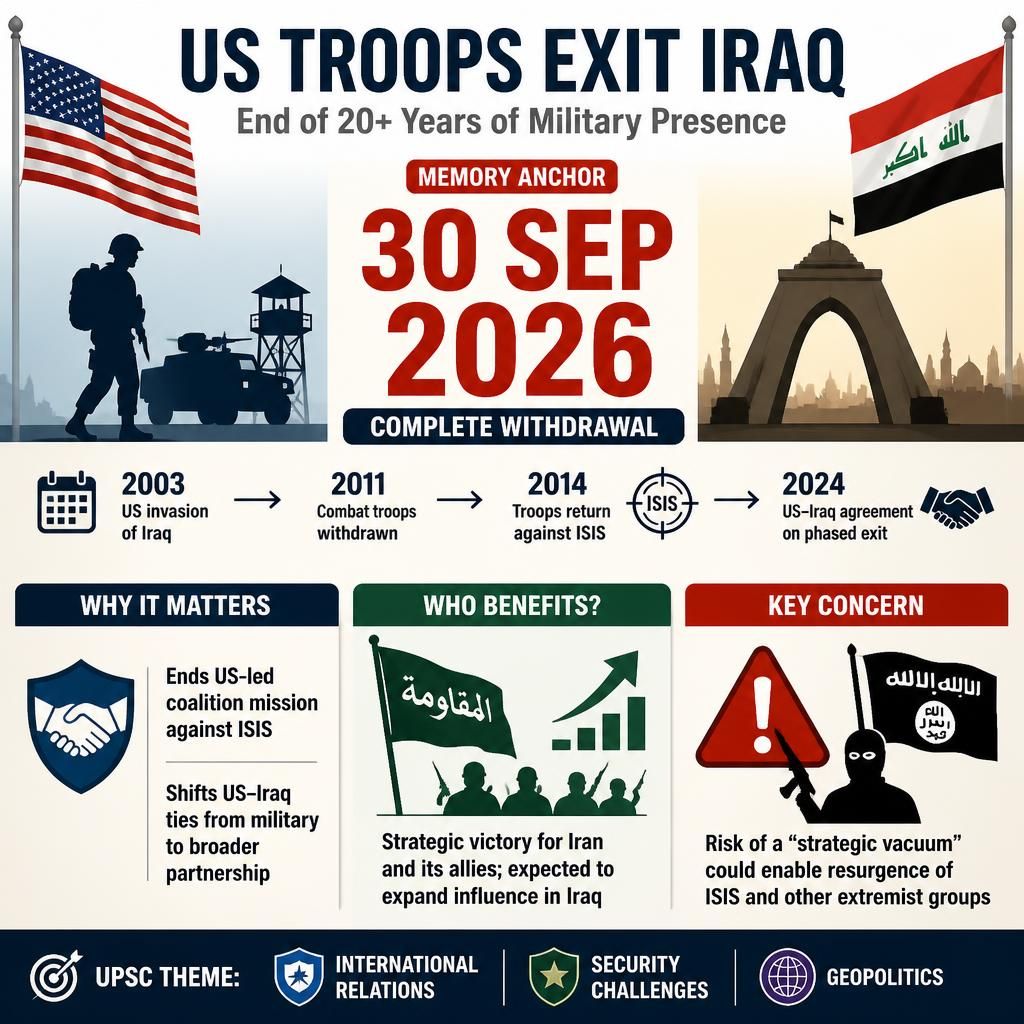
- US forces are set to complete their withdrawal from Iraq by September 30, 2026, marking the end of over two decades of military presence.
- The departure follows a 2024 agreement between the US and Iraq to conclude the US-led coalition's military mission against the Islamic State.
- The withdrawal is seen as a strategic victory by Iran and its allies, who anticipate increased influence in Iraq.
- Concerns have been raised by Iraqi security experts that the withdrawal could lead to a resurgence of groups like the Islamic State.
US Troops.jpg
Detailed Insights:
- The US military presence in Iraq began with the 2003 invasion, which led to the removal of Saddam Hussein.
- American combat forces initially withdrew in December 2011 but returned in 2014 at Iraq's request to combat the rise of the Islamic State.
- The 2024 agreement established a two-stage transition, ending the coalition's military mission in federal Iraq and allowing support for counter-Islamic State operations in Syria from northern Iraq until September 2026.
- The withdrawal is celebrated by pro-Iranian militia groups, such as the Islamic Resistance in Iraq, who view it as a defeat for the "American project" and a validation of their resistance.
- The departure of US forces is expected to redefine the US-Iraq relationship, shifting from direct security cooperation to broader geopolitical challenges.
- Some analysts warn that the withdrawal could create a "strategic vacuum" that regional and international powers, particularly Iran, may exploit.
- Despite the territorial defeat of the Islamic State in 2017, the group continues to operate through sleeper cells, and its resurgence remains a significant security concern.
Key Concepts Involved:
- Islamic State (IS/ISIS/Daesh): A Sunni jihadist militant group that rose to prominence in 2014, establishing a self-proclaimed caliphate across parts of Iraq and Syria.
- Islamic Resistance in Iraq: An umbrella term for various Iran-backed Shia Islamist factions in Iraq, often used when claiming attacks against US forces or allies.
Previous12/12

SuperKalam is your personal mentor for UPSC preparation, guiding you at every step of the exam journey.
Download the App


STUDY RESOURCES
CONTACT US
ⓒ Snapstack Technologies Private Limited