GS 3: Internal SecurityGS 3: Environment & EcologyPrelimsGS 3: Conservation, Pollution and DegradationGS 2: Government policies and interventions for development in various sectors
To save tigers, follow crime beyond the reserve, Pg16
TRAFFIC report reveals 3,808 tigers seized in 25 years, urging intelligence-led, landscape-scale approach to combat sophisticated wildlife crime networks.
Practice MCQs
818 Students attempted
Key Highlights:
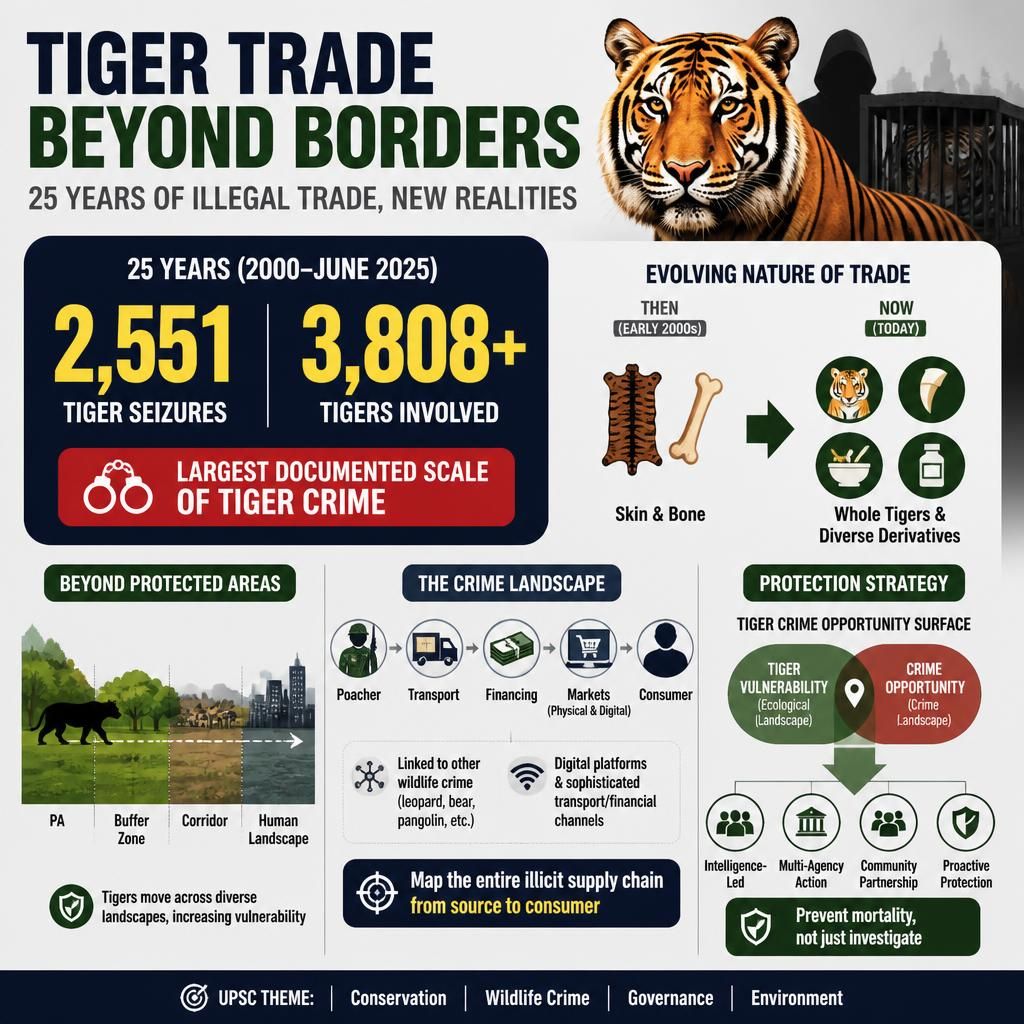
- A global non-profit, TRAFFIC, analyzed 25 years of data, documenting 2,551 tiger seizures involving at least 3,808 tigers until June 2025.
- The nature of tiger trafficking has evolved from primarily skin and bone to include whole animals and a wider range of derivatives.
- Traditional wildlife crime focused on Protected Areas (PAs), but tigers now move through diverse landscapes, increasing their vulnerability.
- The article highlights two critical frameworks: the "ecological landscape" and the "crime landscape."
- Effective tiger protection requires moving beyond PA boundaries to an intelligence-led, multi-agency approach involving local communities and various enforcement bodies.
Tiger Trade.jpg
Detailed Insights:
- TRAFFIC's assessment reveals the extensive scale of illegal tiger trade over a quarter-century.
- The shift in trafficking patterns indicates a broader demand for tiger parts and products in illegal markets.
- Tigers often disperse through buffer zones, corridors, and human-dominated areas, making them susceptible to poaching outside PAs.
- Traffickers frequently have connections to networks dealing in other high-value wildlife like leopards, bears, and pangolins.
- Digital platforms and sophisticated transport/financial channels are increasingly utilized by wildlife criminals.
- The "ecological landscape" encompasses PAs, buffer zones, corridors, and human-animal interfaces where tigers exist.
- The "crime landscape" maps the entire illicit supply chain from poacher to consumer, including physical and digital markets.
- The concept of a "Tiger Crime Opportunity Surface" helps identify areas where tiger vulnerability and criminal opportunities intersect.
- Protection strategies must be proactive, aiming to prevent mortality rather than merely investigating incidents afterward.
- Dismantling wildlife crime networks necessitates financial investigations and targeting higher-level organizers, not just low-level actors.
Key Concepts Involved:
- TRAFFIC: A global non-governmental organization working on trade in wild animals and plants.
- Protected Area (PA): A geographically defined area designated to achieve specific conservation objectives.
- Ecological Landscape: The interconnected natural and human-modified areas through which tigers move and interact.
- Crime Landscape: The network of individuals, systems, and markets involved in illegal wildlife trade.
- Tiger Crime Opportunity Surface: A dynamic analytical tool that identifies areas where tiger vulnerability and criminal opportunities converge.

SuperKalam is your personal mentor for UPSC preparation, guiding you at every step of the exam journey.
Download the App


STUDY RESOURCES
CONTACT US
ⓒ Snapstack Technologies Private Limited