GS 2: GovernanceGS 2: PolityGS 3: Science & TechnologyGS 2: Social JusticePrelims
Surveillance is not the only privacy issue, Pg9
Article highlights how state surveillance, private data handling, and online threats like doxxing and deepfakes create complex privacy issues for citizens, lacking clear accountability.
Practice MCQs
818 Students attempted
Key Highlights:
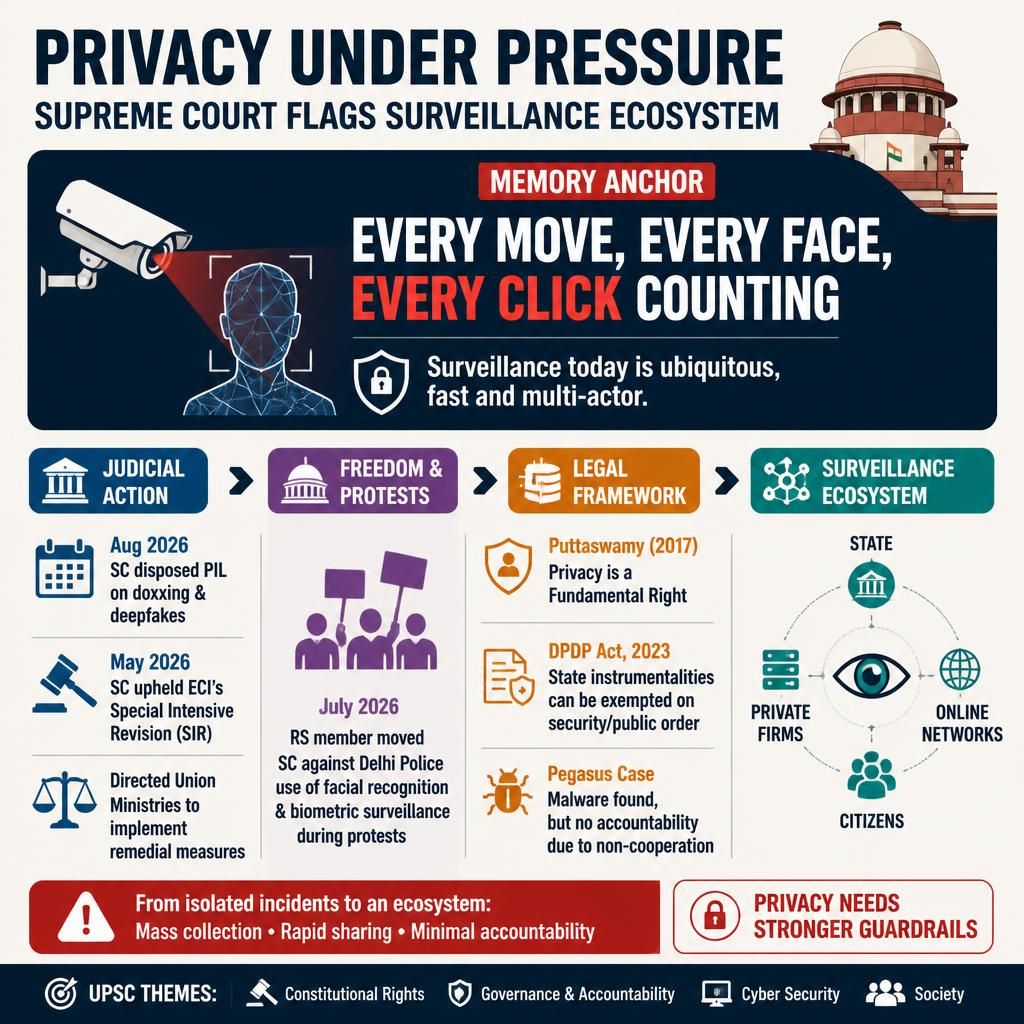
- In August 2026, the Supreme Court disposed of a Public Interest Litigation on doxxing and deepfakes, directing Union Ministries to implement remedial measures.
- A Rajya Sabha member petitioned the Supreme Court in July 2026 against the Delhi Police's use of facial recognition and biometric surveillance during the Cockroach Janta Party protests.
- The Supreme Court upheld the Election Commission's Special Intensive Revision (SIR) of electoral rolls in May 2026, despite concerns regarding potential exclusion of eligible voters.
- The article highlights an interconnected pattern of surveillance involving the state, private firms, online networks, and citizens.
Privacy.jpg
Detailed Insights:
- The K.S. Puttaswamy vs. Union of India (2017) judgment established privacy as a constitutionally protected right, but its application primarily focuses on state actions.
- The Digital Personal Data Protection Act, 2023, permits the Union government to exempt state instrumentalities from its provisions based on grounds like state security or public order.
- The Pegasus spyware case demonstrated challenges in accountability, as an independent expert committee found malware but could not confirm Pegasus due to government non-cooperation.
- Public identification of protesters, as seen during the Citizenship Amendment Act protests in 2020, was deemed an "unwarranted interference in privacy" by the Allahabad High Court.
- The article argues that the current scale and speed of data collection and dissemination by various actors necessitate a re-evaluation of privacy frameworks.
- It advocates for a new perspective that views surveillance not as isolated acts but as a diffuse phenomenon spread across states, companies, and foreign vendors.
Key Concepts Involved:
- Doxxing: Publishing private or identifying information about an individual on the internet, often with malicious intent.
- Deepfakes: Synthetic media where a person's likeness is replaced with another's using artificial intelligence, typically in images or videos.
- Facial Recognition: A technology that identifies or verifies individuals by analyzing patterns based on their facial features from digital images or video.
- Public Interest Litigation (PIL): A legal action initiated in a court of law for the protection of public interest, rather than private interest.
- Special Intensive Revision (SIR): A process conducted by the Election Commission to update and verify electoral rolls, often involving house-to-house surveys.

SuperKalam is your personal mentor for UPSC preparation, guiding you at every step of the exam journey.
Download the App


STUDY RESOURCES
CONTACT US
ⓒ Snapstack Technologies Private Limited