GS 3: Science & TechnologyPrelimsGS 3: Science and Technology in Everyday LifeGS 3: Space Technology
Famous Supergiant Star Betelgeuse May Not Be Alone, Pg11
Astronomers find strong evidence of Betelgeuse B, a companion star 2.6-3.1 times heavier than Sun, explaining Betelgeuse's six-year brightness cycle.
Practice MCQs
811 Students attempted
Key Highlights:
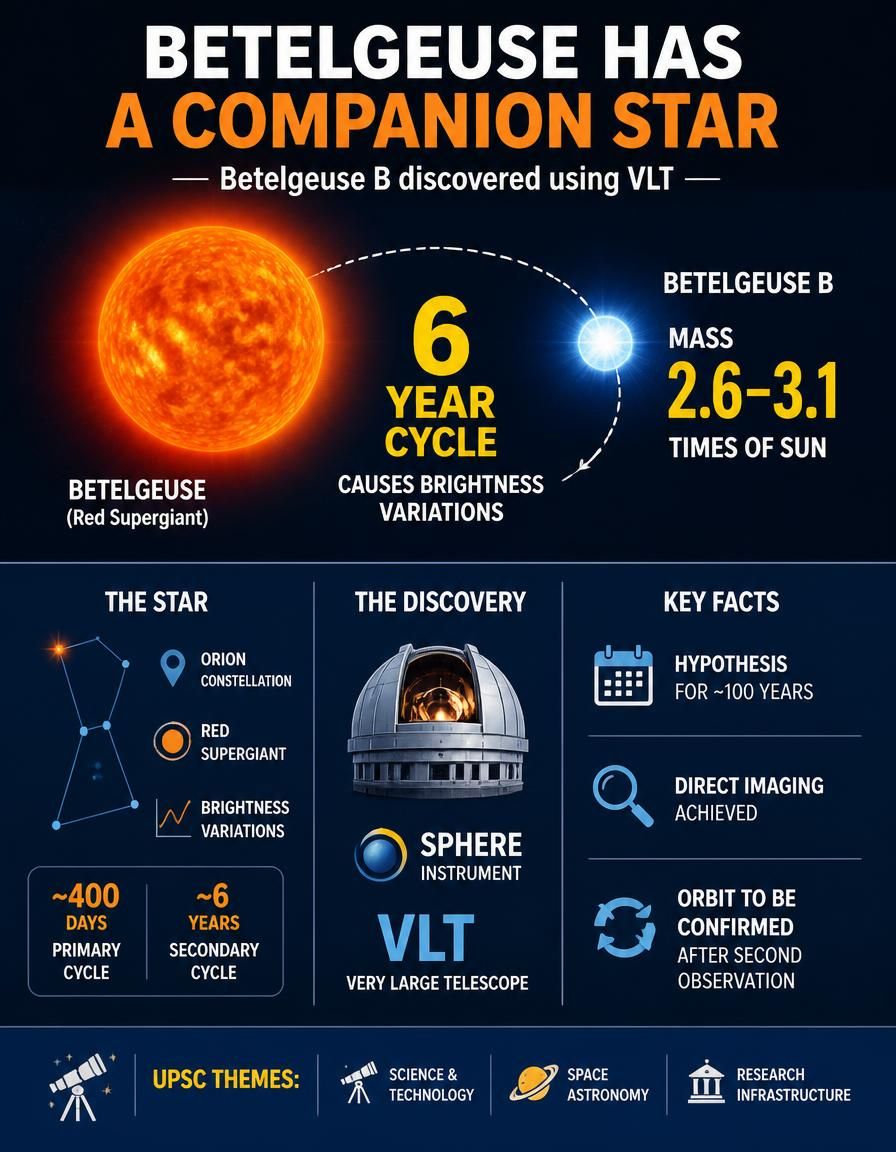
- Astronomers have found strong evidence for a close companion star, now named Betelgeuse B, orbiting the famous red supergiant Betelgeuse.
- The discovery was made using the Very Large Telescope (VLT).
- Betelgeuse B is estimated to be 2.6 to 3.1 times as massive as our Sun.
- This companion star is believed to be responsible for the six-year cycle of brightness variations observed in Betelgeuse.
Star.jpg
Detailed Insights:
- Betelgeuse is a prominent red supergiant star located in the Orion constellation, known for its distinct reddish hue and variability in brightness.
- The star exhibits both a primary brightness variation period of approximately 400 days and a longer, secondary period of around six years.
- The existence of a companion star to explain Betelgeuse's brightness changes has been a hypothesis among astronomers for about a century.
- The direct imaging of Betelgeuse B was achieved using the SPHERE instrument on the VLT.
- Confirmation of the companion's orbital path is pending a second observation.
- The Very Large Telescope (VLT) is an advanced astronomical facility operated by the European Southern Observatory (ESO), located in Chile's Atacama Desert.
Scientific/Technical Concepts Involved:
- Red Supergiant: A star in the late stages of its life cycle, characterized by its immense size, relatively cool surface temperature, and reddish appearance.
- Binary Star System: A system of two stars gravitationally bound to each other, orbiting a common center of mass.
- Very Large Telescope (VLT): A ground-based astronomical observatory comprising four large optical telescopes that can operate individually or together as an interferometer.

SuperKalam is your personal mentor for UPSC preparation, guiding you at every step of the exam journey.
Download the App


STUDY RESOURCES
CONTACT US
ⓒ Snapstack Technologies Private Limited