GS 2: GovernanceGS 2: PolityPrelimsGS 2: Government policies and interventions for development in various sectorsGS 2: Important Aspects of Governance, Transparency and Accountability
Can an accused be denied a copy of the FIR?, Pg12
Supreme Court mandates police to provide FIR copy to accused, reinforcing fair trial rights and transparency amidst new criminal procedure laws.
Practice MCQs
811 Students attempted
Key Highlights:
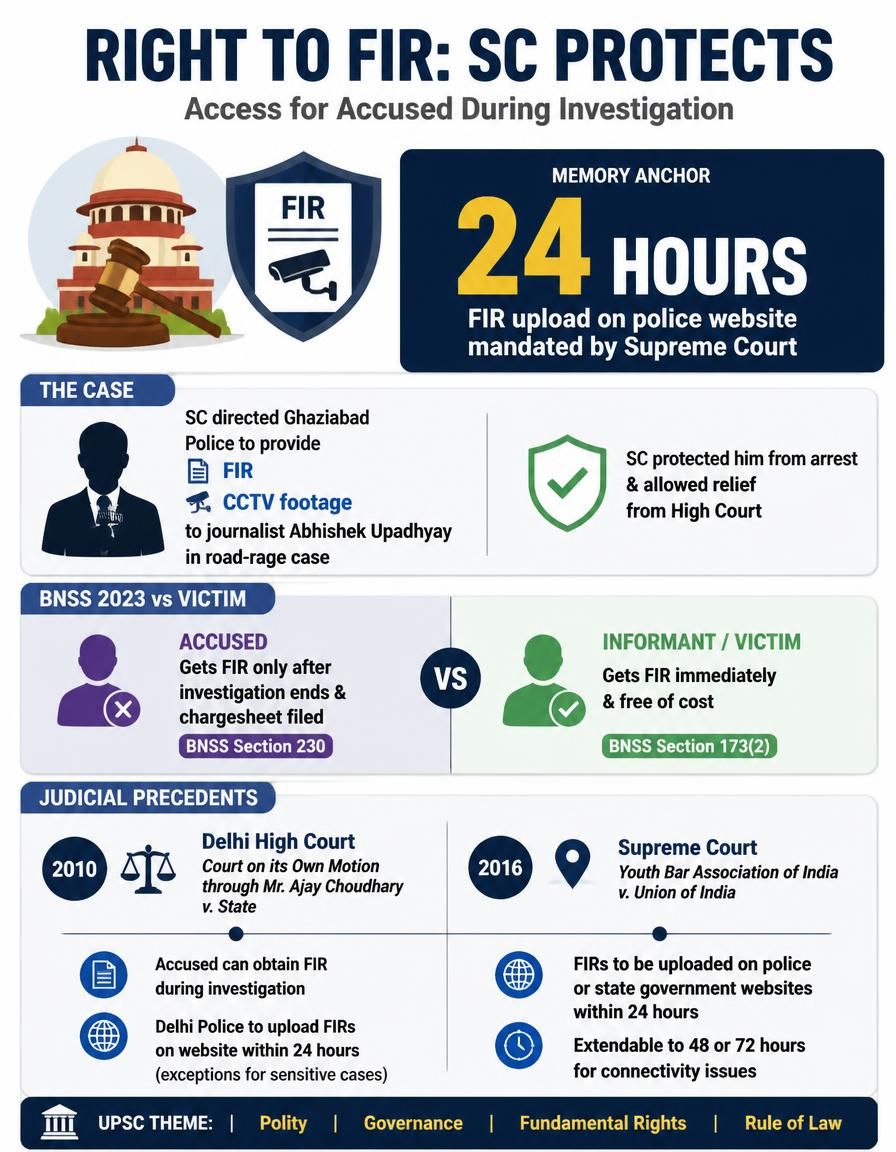
- The Supreme Court recently directed Ghaziabad Police to provide independent journalist Abhishek Upadhyay with a copy of the First Information Report (FIR) and CCTV footage in a road-rage case.
- Upadhyay alleged false implication due to his reportage on Ram Mandir donations and denial of the FIR copy.
- The Court's intervention protected him from arrest and allowed him to seek further relief from the High Court.
- The Bharatiya Nagarik Suraksha Sanhita, 2023 (BNSS), which replaced the Code of Criminal Procedure, 1973 (CrPC), does not explicitly mandate immediate FIR provision to the accused.
- Judicial precedents, however, affirm the right of an accused to access the FIR soon after its registration.
Right to FIR.jpg
Detailed Insights:
- The BNSS stipulates that an accused receives the FIR only after the investigation concludes and a chargesheet is filed, specifically under Section 230.
- This contrasts with Section 173(2) of the BNSS, which requires immediate and free provision of the FIR to the informant or victim.
- The Delhi High Court, in Court on its Own Motion through Mr. Ajay Choudhary v. State (2010), established a mechanism for accused persons to obtain FIRs during investigation.
- This ruling also directed the Delhi Police to upload FIRs on their website within 24 hours, with exceptions for sensitive cases.
- The Supreme Court, in Youth Bar Association of India v. Union of India (2016), extended these directives nationwide.
- This landmark judgment mandated uploading FIRs on police or state government websites within 24 hours, extendable to 48 or 72 hours for connectivity issues.
- Exceptions for online publication include "sensitive offences" like sexual offenses, cases under the Protection of Children from Sexual Offences Act, 2012, and terror offenses.
- Decisions to withhold FIRs due to sensitivity must be made by an officer not below the rank of Deputy Superintendent of Police.
- Access to the FIR is crucial for an accused to pursue pre-trial remedies such as quashing of the FIR or anticipatory bail, upholding the right to a fair trial.
Key Concepts Involved:
- First Information Report (FIR): A written document prepared by police when they receive information about the commission of a cognizable offense.
- Bharatiya Nagarik Suraksha Sanhita, 2023 (BNSS): The new procedural law for criminal justice in India, replacing the Code of Criminal Procedure, 1973 (CrPC).
- Quashing of the FIR: A legal remedy where a High Court can annul an FIR, stopping criminal proceedings if it finds no prima facie case or abuse of process.
- Anticipatory Bail: A pre-arrest bail granted by a court to a person who apprehends arrest on accusation of having committed a non-bailable offense.
- Right to Fair Trial: A fundamental right ensuring that every individual accused of a crime receives a just and impartial legal process.
Previous12/12

SuperKalam is your personal mentor for UPSC preparation, guiding you at every step of the exam journey.
Download the App


STUDY RESOURCES
CONTACT US
ⓒ Snapstack Technologies Private Limited