GS 2: PolityGS 2: International RelationsGS 3: EconomyPrelimsGS 2: Bilateral, Regional and Global Groupings and Agreements
Ten years and 7 PMs later, did Brexit make a difference?, Pg7
Brexit's decade-long impact reveals UK's political instability, increased non-EU migration, and widened trade deficit, contrary to initial objectives.
Practice MCQs
804 Students attempted
Key Highlights:
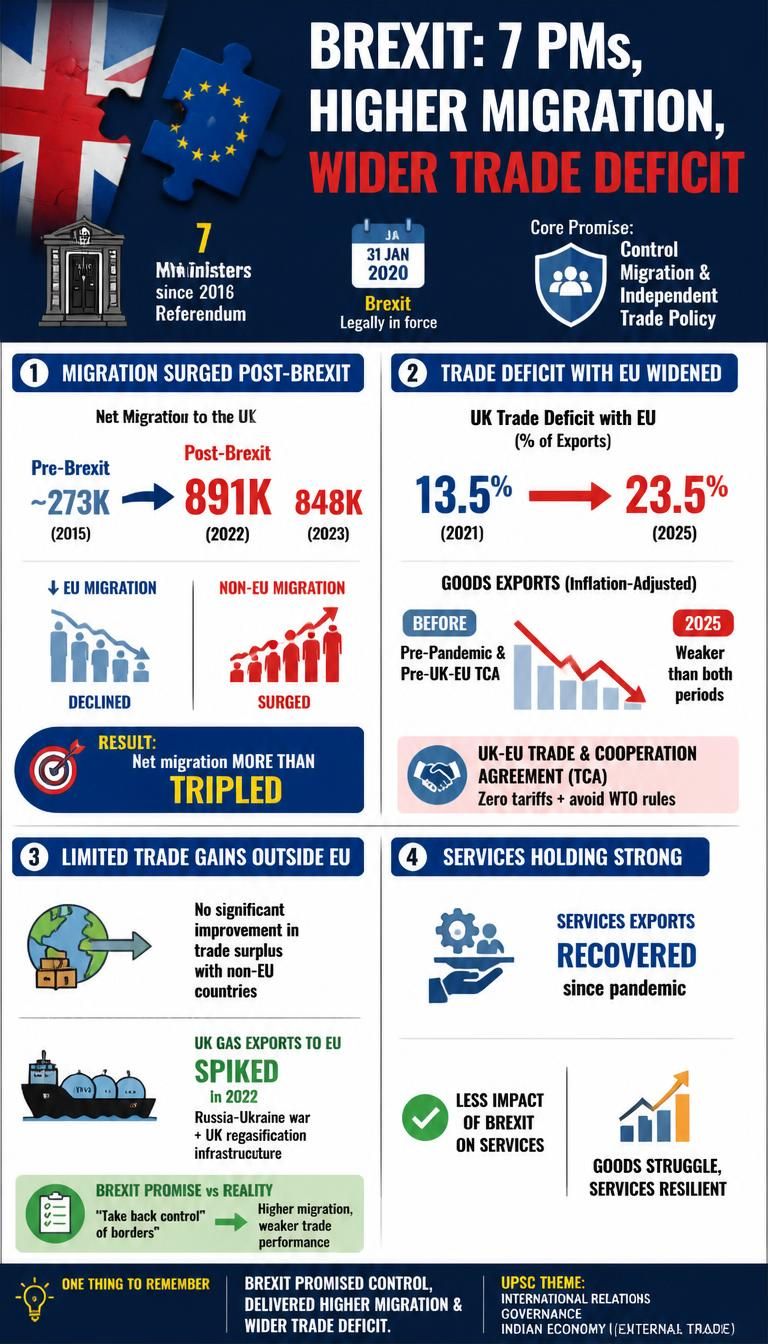
- The United Kingdom has experienced seven Prime Ministers since the Brexit referendum in June 2016, indicating significant political volatility.
- Brexit legally came into force in January 2020, with primary objectives to control migration and establish an independent trade policy.
- Net migration to the UK more than tripled post-Brexit, reaching 891,000 in 2022 and 848,000 in 2023, despite a decrease in migration from European Union countries.
- The UK's trade deficit with the European Union widened from 13.5% of its exports in 2021 to 23.5% in 2025.
- Inflation-adjusted goods exports in 2025 remained weaker than pre-pandemic and pre-U.K.-EU Trade and Cooperation Agreement levels.
BREXIT.jpg
Detailed Insights:
- The Vote Leave campaign in the 2016 referendum promised to "take back control" of borders by ending the EU's free movement programme.
- Post-Brexit, the composition of migrants shifted, with a decline in EU migration and a significant increase in non-EU migration.
- The U.K.-EU Trade and Cooperation Agreement was established to maintain zero tariffs and avoid reverting to World Trade Organization rules.
- Despite the agreement, the UK has not significantly improved its trade surplus with non-EU countries, limiting the perceived trade benefits of Brexit.
- The Office for National Statistics reported a temporary surge in UK gas exports to the EU in 2022, driven by the Russia-Ukraine conflict and UK's regasification infrastructure.
- While goods exports struggled, the UK's services exports have recovered since the pandemic, suggesting less impact from Brexit on this sector.
Key Concepts Involved:
- Brexit: The withdrawal of the United Kingdom from the European Union, following a national referendum in 2016.
- European Union (EU): A political and economic union of 27 member states primarily located in Europe.
- U.K.-EU Trade and Cooperation Agreement: A free trade agreement that governs the relationship between the UK and the EU after Brexit.
- Free movement programme: An EU policy allowing citizens of member states to live and work freely across other member countries.
- World Trade Organization (WTO): An intergovernmental organization that regulates and facilitates international trade.

SuperKalam is your personal mentor for UPSC preparation, guiding you at every step of the exam journey.
Download the App


STUDY RESOURCES
CONTACT US
ⓒ Snapstack Technologies Private Limited