GS 2: GovernanceGS 2: PolityGS 3: Environment & EcologyPrelimsGS 3: Environmental Impact Assessment
Retrospective green nod: SC strikes down Centre's order, opens window for exception, Pg1
Supreme Court strikes down Centre's 2021 order on retrospective environmental clearance, affirming government's power to grant exceptions under 1986 Act for public interest.
Practice MCQs
804 Students attempted
Key Highlights:
- The Supreme Court ruled that the Centre can grant retrospective environmental clearance for projects in "public interest" under the Environment (Protection) Act, 1986, but not through administrative office memorandums.
- The bench, led by Chief Justice of India Surya Kant, struck down the Centre’s 2021 Office Memorandum which provided a perpetual regime for post-facto environmental approvals.
- The ruling clarified that the Centre retains the power to issue "narrowly tailored amnesty notifications" as an exception to the 2006 Environmental Impact Assessment (EIA) Notification.
- The Court's decision will apply prospectively, meaning existing retrospective clearances granted under the 2017 Notification or 2021 Office Memorandum will remain valid unless individually challenged.
- This judgment followed a recall of an earlier 2025 verdict in Vanashakti vs Union of India that had struck down the 2017 Notification and 2021 Office Memorandum.
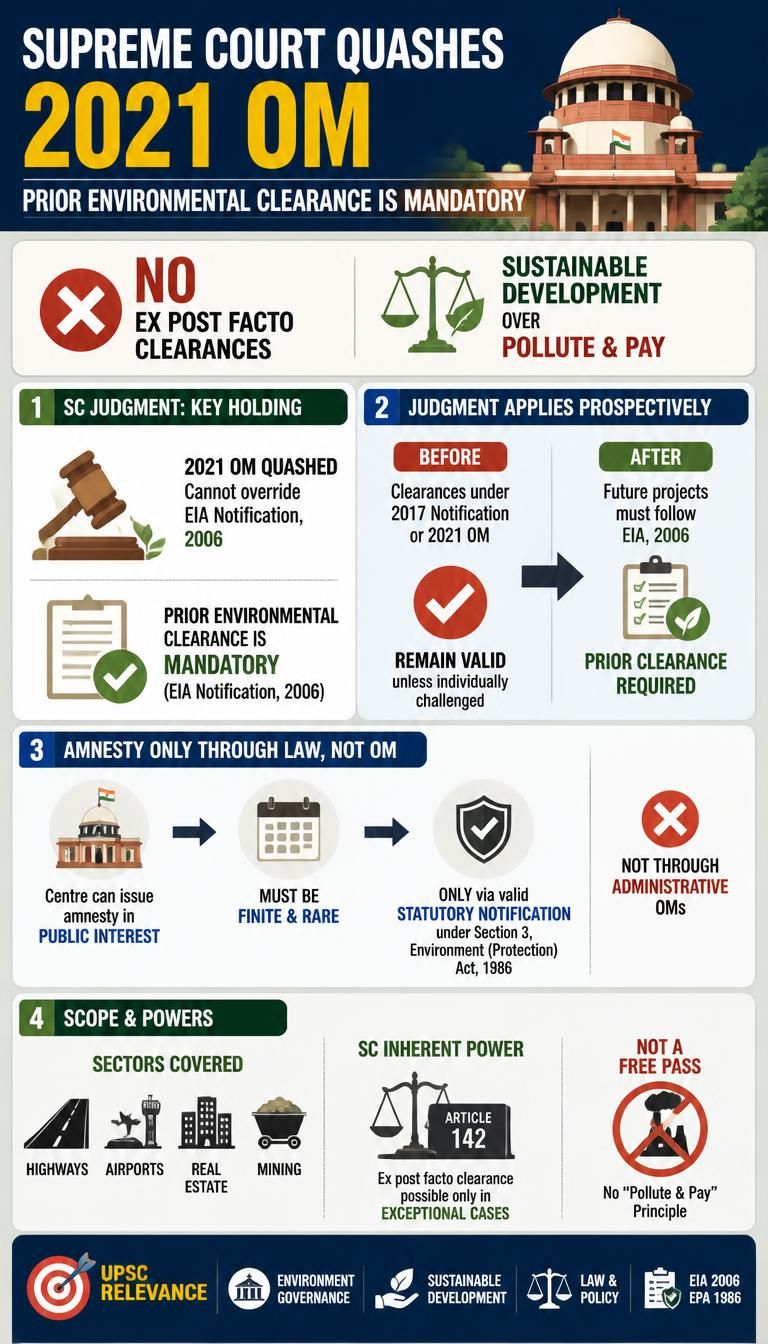
EP Act.jpg
Detailed Insights:
- The Supreme Court emphasized that the 2021 Office Memorandum was an administrative order that impermissibly supplanted delegated legislation and failed the test of proportionality and reasonableness.
- The Court linked the invalidation of the 2021 Office Memorandum to violations of Articles 14 (equality before law) and 21 (right to life and personal liberty) of the Constitution.
- The ruling referenced the Jan Vishwas Act 2023, noting that its decriminalization of regulatory contraventions reinforces the Central government's power under Section 3 of the Environment (Protection) Act, 1986, to formulate conditional amnesty schemes.
- Previous Supreme Court decisions in Common Cause (2017) and Alembic Pharmaceuticals (2020) had held that ex-post facto clearances were alien to environmental jurisprudence, but the current bench clarified these were in specific statutory contexts.
- The Vanashakti vs Union of India case initially struck down the 2017 Notification and 2021 Office Memorandum, but this was later recalled by a 2-1 majority, citing public interest and legal flaws.
- Justice Ujjal Bhuyan dissented in the recall of the Vanashakti judgment, stating it overlooked fundamentals of environmental jurisprudence.
Key Concepts Involved:
- Environment (Protection) Act, 1986: Umbrella legislation empowering the Central Government to protect and improve the environment, enacted after the Bhopal Gas Tragedy.
- Office Memorandum (OM): An administrative instruction or order issued by government departments for internal communication, policy clarification, or procedural changes.
- Retrospective Environmental Clearance (Ex-post facto EC): Environmental approval granted after a project has already commenced construction or operation without prior mandatory clearance.
- Jan Vishwas Act 2023: Legislation aimed at decriminalizing minor offenses across various Central Acts by replacing imprisonment with monetary penalties to promote ease of living and doing business.
- Articles 14 and 21 of the Constitution: Article 14 guarantees equality before the law, while Article 21 protects the right to life and personal liberty, which includes the right to a healthy environment.

SuperKalam is your personal mentor for UPSC preparation, guiding you at every step of the exam journey.
Download the App


STUDY RESOURCES
CONTACT US
ⓒ Snapstack Technologies Private Limited