GS 2: GovernanceGS 3: EconomyPrelimsGS 3: Government BudgetingGS 3: Indian Economy, Planning, Mobilization of Resources, Growth, Development and Employment
‘Oil price surge could be a strain for financing fiscal deficit & current account’, Pg9
Finance Ministry warns rising global crude oil prices could strain India's fiscal and current account deficits, and fuel inflation, despite resilient economic fundamentals.
Practice MCQs
804 Students attempted
Key Highlights:
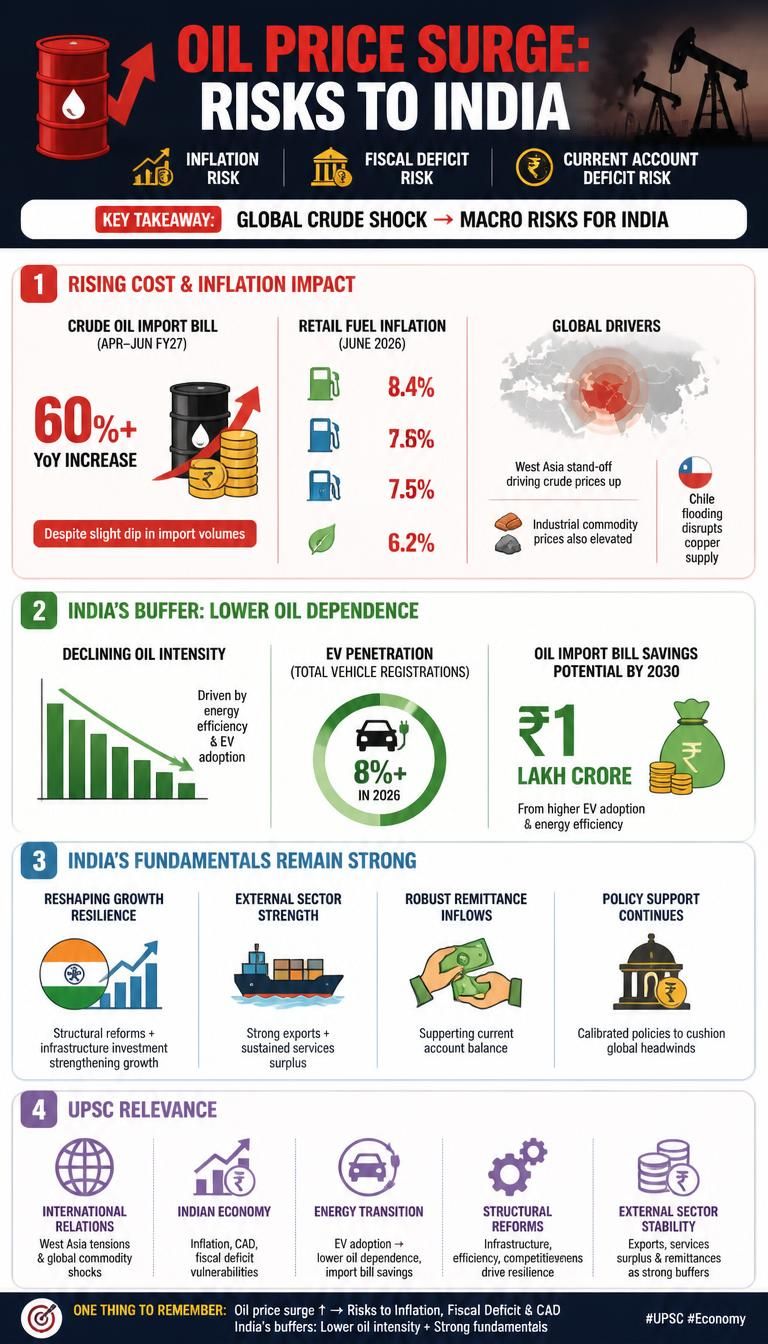
- The Ministry of Finance warned that a sustained surge in global crude oil prices, driven by the West Asia stand-off, poses an upside risk to India's inflation, fiscal deficit, and current account deficit.
- India's crude oil import bill increased by over 60% year-on-year in April-June FY27, despite a slight dip in import volumes.
- Retail fuel prices in India saw increased inflation in June 2026, with diesel at 8.4%, petrol at 7.5%, and CNG at 6.2%.
- The Ministry highlighted India's declining oil intensity, partly due to accelerating EV adoption and energy efficiency gains.
- EV penetration has crossed 8% of total vehicle registrations in 2026, with potential to reduce India's annual oil import bill by approximately Rs 1 lakh crore by 2030.
Oil Price Surge.jpg
Detailed Insights:
- The persistent geopolitical tensions in West Asia are identified as the primary driver behind the recent resurgence in global crude oil prices.
- Elevated prices of industrial commodities, including critical minerals and rare earth elements, also contribute to economic pressures, exemplified by supply chain risks like flooding in Chile affecting copper.
- Despite global uncertainties, India's economic outlook is supported by resilient domestic fundamentals, ongoing policy support, and strengthening structural growth drivers.
- Structural reforms implemented over the last decade and significant infrastructure investments are enhancing India's growth resilience.
- A strong export performance, sustained services surplus, and robust remittance inflows are crucial in supporting India's current account balance.
- Recent policy measures are anticipated to attract further capital inflows, complementing comfortable foreign exchange reserves to maintain external sector stability.
- The Strait of Hormuz is mentioned as a critical choke point, with stifled energy flows contributing to supply tightness and elevated oil prices.
- India's oil consumption-to-GDP ratio and crude oil imports-to-GDP ratio have declined from FY14 to FY26, indicating a structural shift towards reduced oil dependence.
- The Ministry cited an SBI Research note, emphasizing the significant role of EV adoption in mitigating India's oil import dependency.
- Higher commodity prices globally are expected to disrupt the ongoing process of disinflation, posing a challenge to global economic stability.
Key Concepts Involved:
- Fiscal Deficit: The difference between the government's total expenditure and its total revenue (excluding borrowings), indicating the government's borrowing requirement.
- Current Account Deficit (CAD): Occurs when a country's total value of imports of goods, services, and transfers is greater than its total value of exports of goods, services, and transfers.
- Inflation: The rate at which the general level of prices for goods and services is rising, and subsequently, purchasing power is falling.
- EV Adoption: The increasing rate at which electric vehicles are being purchased and used by consumers, contributing to reduced fossil fuel consumption.

SuperKalam is your personal mentor for UPSC preparation, guiding you at every step of the exam journey.
Download the App


STUDY RESOURCES
CONTACT US
ⓒ Snapstack Technologies Private Limited