GS 2: GovernanceGS 3: Internal SecurityGS 2: International RelationsPrelimsGS 2: Government policies and interventions for development in various sectors
India’s theatre reform needs a readiness framework, Pg6
India's theatre command reform risks short-term operational readiness, necessitating a robust military readiness framework to mitigate transitional challenges.
Practice MCQs
804 Students attempted
Key Highlights:
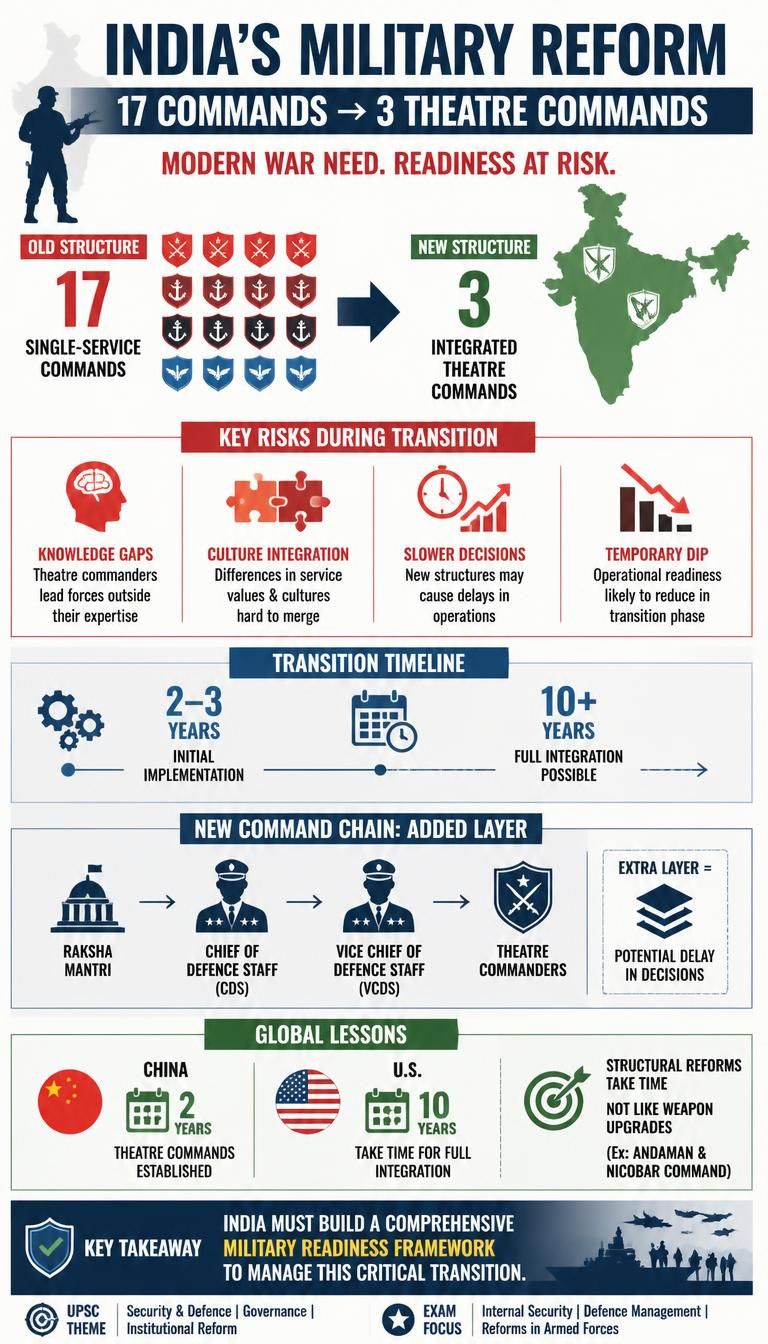
- India is undergoing a significant military reform, transitioning from 17 single-service commands to three integrated theatre commands.
- This shift, while necessary for modern conflict, is expected to temporarily reduce operational readiness.
- Key risks include knowledge gaps for theatre commanders, challenges in integrating diverse service cultures, and potentially slower decision-making processes.
- The transition could take 2-3 years for initial implementation, with full integration potentially extending over a decade.
- The article emphasizes the urgent need for India to develop a comprehensive military readiness framework to manage this transition effectively.
Theatre Command.jpg
Detailed Insights:
- The merger of 17 single-service commands into three integrated theatres poses challenges in command and control, as theatre commanders will lead forces from services they haven't specialized in.
- Integrating the unique values and cultures of each service is difficult and could impact career progression, morale, and motivation within the joint force.
- The proposed structure, with a Vice Chief of Defence Staff (VCDS) alongside the Chief of Defence Staff (CDS), could add an extra layer between theatre commanders and the Raksha Mantri.
- Structural reforms like theatre-isation typically take longer to yield results compared to changes in weapon platforms, as seen with the Andaman and Nicobar Command.
- China established its theatre commands in two years, while the U.S. took a decade, demonstrating varied timelines for such complex military reorganizations.
- India's current focus on "defence preparedness" (measuring inputs like Money, Manpower, Machines, and Material - 4Ms) needs to evolve into "military readiness" (actual operational capability).
- A robust military readiness framework should include clear metrics, standards to measure force structures against operational demands, and oversight mechanisms.
- Proposed oversight mechanisms include a Defence Readiness Council at the ministry level and a Military Readiness Committee under the CDS.
- To mitigate risks during transition, the article suggests maintaining a reserve force outside the new structure and utilizing diplomacy with nations like China and Pakistan to buy time.
Key Concepts Involved:
- Theatre-isation: Reorganization of military forces into integrated commands covering specific geographical or operational areas, combining elements from all services.
- Operational Readiness: The ability of military forces to perform assigned missions and tasks effectively and efficiently at any given time.
- Single-service commands: Military commands structured around individual branches like the Army, Navy, or Air Force, operating independently.
- Integrated theatre commands: Unified commands comprising elements from all three services (Army, Navy, Air Force) for a specific theatre of operations, promoting jointness.
- Goldwater-Nichols Act (1986): A landmark U.S. law that reorganized the Department of Defense, strengthening the authority of the Chairman of the Joint Chiefs of Staff and promoting joint military operations.

SuperKalam is your personal mentor for UPSC preparation, guiding you at every step of the exam journey.
Download the App


STUDY RESOURCES
CONTACT US
ⓒ Snapstack Technologies Private Limited