GS 3: Science & TechnologyGS 2: International RelationsGS 3: EconomyPrelimsGS 2: Government policies and interventions for development in various sectors
Behind China’s AI gift, a constraint, Pg8
China offers open-weight AI models globally, leveraging its compute constraints and projecting soft power amidst US tech restrictions.
Practice MCQs
804 Students attempted
Key Highlights:
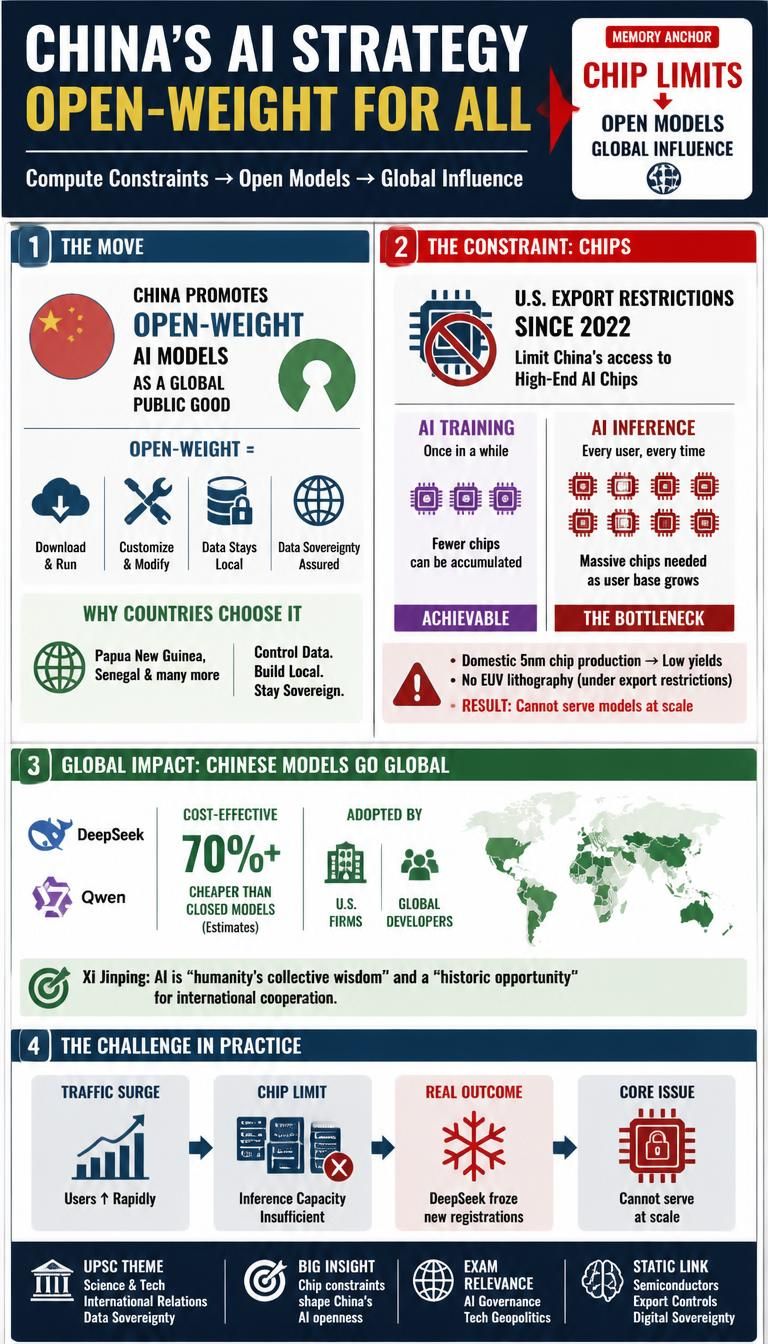
- China is promoting its Artificial Intelligence (AI) models as a global public good, offering open-weight models unlike the proprietary closed-source models from the U.S.
- This strategy is largely driven by China's significant compute constraints, particularly for AI inference, due to U.S. export restrictions on high-end chips.
- Since 2022, the U.S. administration has imposed export restrictions on China, limiting its access to advanced semiconductor chips.
- Chinese President Xi Jinping framed AI as "humanity’s collective wisdom" and a "historic opportunity" for international cooperation.
- Despite chip limitations, Chinese models like those from DeepSeek and Qwen are gaining popularity globally, even among U.S. firms, due to their cost-effectiveness.
China AI Strategy.jpg
Detailed Insights:
- Open-weight models allow users to download, customize, modify, and further train the AI models without subscriptions or terms of service.
- This approach ensures data remains within national borders, addressing data sovereignty concerns for countries like Papua New Guinea or Senegal.
- The U.S. export controls have made it difficult for China to acquire the vast number of chips needed for AI inference, which scales with user base.
- While China can accumulate enough chips for AI training through various means, serving models to a mass consumer base requires significantly more chips.
- Domestic chip production in China faces hurdles, such as low yields for 5nm chips without Extreme Ultraviolet (EUV) lithography tools, which are also under export restrictions.
- The inability to serve models at scale has led to issues like DeepSeek freezing new registrations due to traffic surges.
- American firms are increasingly using Chinese open-weight models, with their share reaching 60% on platforms like OpenRouter, due to comparable performance at lower costs.
- China's "openness" is thus a strategic necessity, allowing it to outsource the compute burden to users while still advancing its AI capabilities.
Key Concepts Involved:
- Open-weight models: AI models where the underlying parameters (weights) are publicly available for download and modification.
- Closed-source models: AI models where the underlying parameters are proprietary and not publicly shared, typically accessed via Application Programming Interfaces (APIs).
- AI Inference: The process of using a trained AI model to make predictions or generate outputs based on new data.
- AI Training: The process of teaching an AI model using large datasets to learn patterns and make decisions.
- Export Controls: Government regulations restricting the trade of certain goods or technologies to specific countries, often for national security reasons.

SuperKalam is your personal mentor for UPSC preparation, guiding you at every step of the exam journey.
Download the App


STUDY RESOURCES
CONTACT US
ⓒ Snapstack Technologies Private Limited