GS 2: GovernanceGS 3: Science & TechnologyGS 3: Environment & EcologyGS 3: EconomyPrelims
Tackling Food Loss And Waste — India’s Opportunity, Pg6
India tackles massive food loss and waste across its value chain, aiming for food security, reduced emissions, and improved incomes through data, technology, and policy integration.
Practice MCQs
811 Students attempted
Key Highlights:
- Food loss and waste present significant challenges globally, impacting climate, food security, and natural resources.
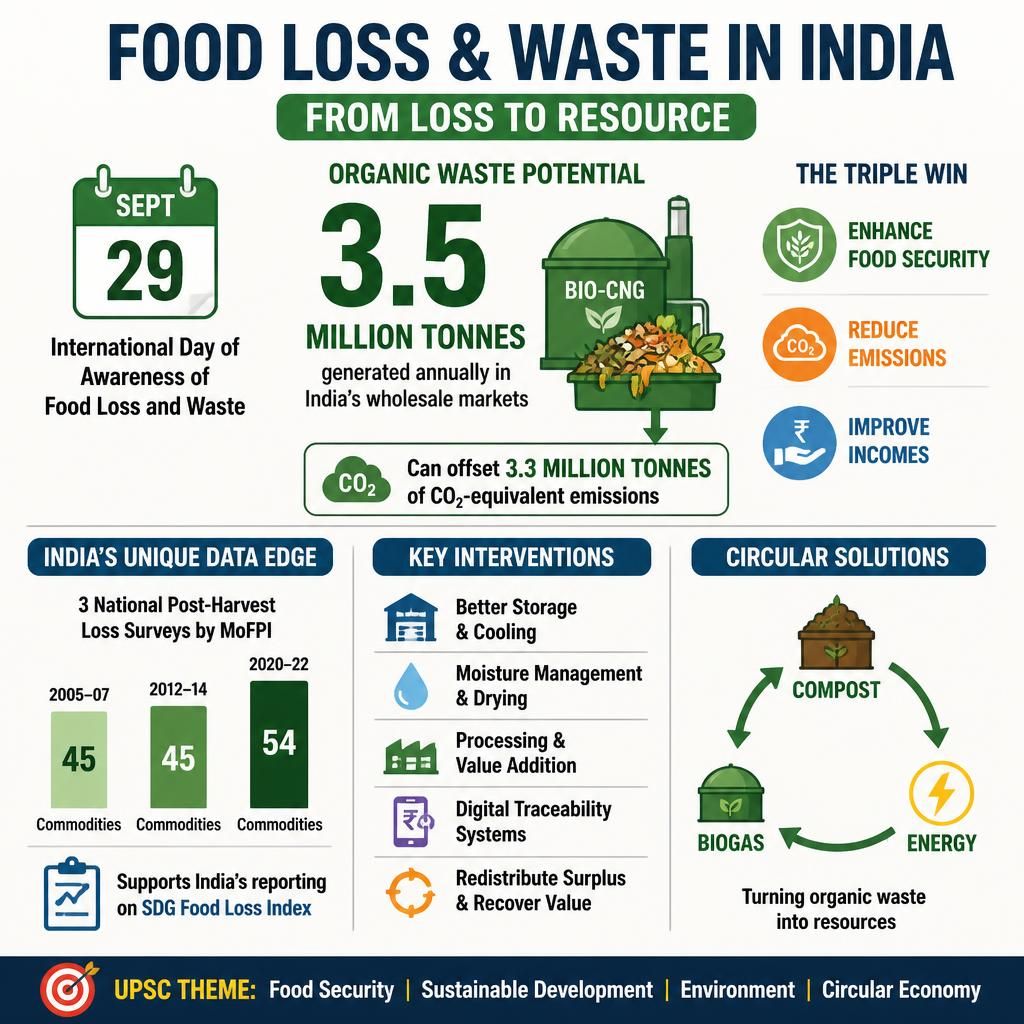
- India observes the International Day of Awareness of Food Loss and Waste annually on September 29.
- India is unique in having conducted three national post-harvest loss surveys through the Ministry of Food Processing Industries.
- Reducing food loss and waste offers a "triple win" by enhancing food security, reducing emissions, and improving incomes.
- Wholesale markets in India generate substantial organic waste, which can be converted into valuable resources like bio-CNG.
Food Loss and Waste.jpg
Detailed Insights:
- Despite producing enough food for its 1.4 billion population, India experiences considerable food loss across its value chain.
- The Ministry of Food Processing Industries conducted surveys in 2005-07, 2012-14, and 2020-22, covering 45, 45, and 54 commodities respectively.
- These national surveys contribute to India's reporting on the Food Loss Index under the Sustainable Development Goals.
- Data on food waste in retail, hotels, restaurants, and households is less developed compared to post-harvest loss data.
- The Food and Agriculture Organization of the United Nations (FAO) is collaborating with Indian institutions to implement solutions for food loss and waste.
- Key interventions include improved storage, drying, cooling, moisture management, processing, and digital traceability systems.
- Circular approaches involve redistributing surplus food and converting organic residues into compost, biogas, or energy.
- Assessments by FAO and the National Council of Agriculture Marketing Boards (COSAMB) indicate wholesale markets can produce up to 100 tonnes of organic waste daily.
- Nationally, this organic waste amounts to an estimated 3.5 million tonnes annually, capable of offsetting 3.3 million tonnes of CO2-equivalent emissions.
- A 50-tonne-a-day bio-CNG plant in Surat, Gujarat, exemplifies a successful private-sector partnership in waste conversion.
- The FAO and the Small Industries Development Bank of India (SIDBI) are facilitating finance for climate-resilient technologies in food-loss hotspots.
- The FAO is also developing a "Package of Practices" to assist Indian municipalities in managing urban food loss and waste.
Key Concepts Involved:
- Food Loss: Decrease in the quantity or quality of food resulting from decisions and actions by food suppliers in the food chain, excluding retail and consumption.
- Food Waste: Decrease in the quantity or quality of food resulting from decisions and actions by retailers, food service providers, and consumers.
- Circular Economy: An economic system aimed at eliminating waste and the continual use of resources.
- Bio-CNG: Compressed natural gas produced from biomass sources like agricultural waste or organic municipal waste.

SuperKalam is your personal mentor for UPSC preparation, guiding you at every step of the exam journey.
Download the App


STUDY RESOURCES
CONTACT US
ⓒ Snapstack Technologies Private Limited