GS 2: GovernanceGS 3: Science & TechnologyGS 2: Social JusticeGS 3: EconomyPrelims
Rare-disease drugs can be India’s next pharma frontier, Pg II
India poised to become global hub for rare-disease drug development and manufacturing, leveraging its pharma prowess and patient base for accessible, affordable treatments.
Practice MCQs
811 Students attempted
Key Highlights:
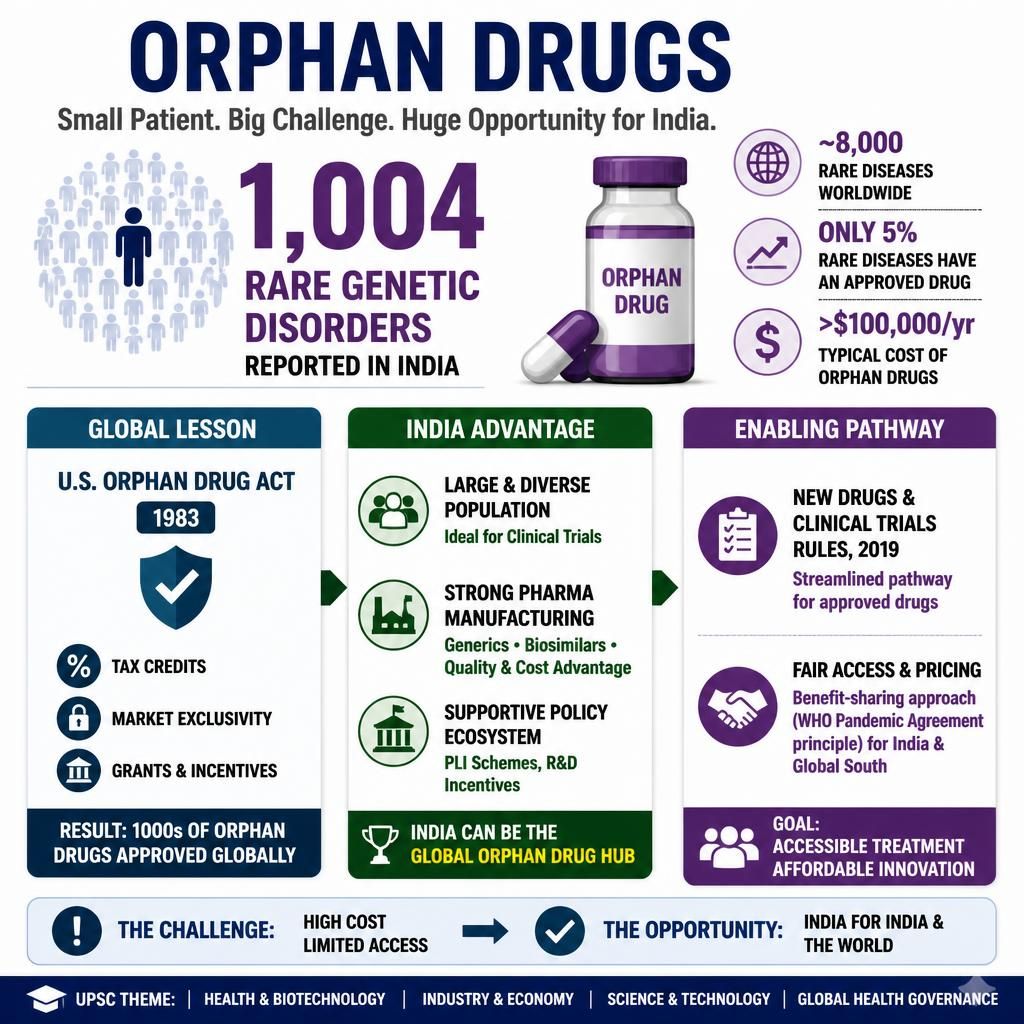
- Rare diseases, though individually rare, cumulatively affect hundreds of millions globally, with 1,004 rare genetic disorders reported in India.
- Historically, limited patient numbers led to pharmaceutical disinterest, terming such drugs orphan drugs.
- The U.S. Orphan Drug Act of 1983 incentivized development, significantly increasing approved treatments.
- India faces challenges with high drug costs, often exceeding the government's support, necessitating crowdfunding for patients.
- India possesses significant potential for clinical trials due to its large and diverse population and for manufacturing high-quality, low-cost orphan drugs.
- The New Drugs and Clinical Trials Rules 2019 offers a streamlined regulatory pathway for certain approved drugs.
- Government policies like Production-Linked Incentive (PLI) schemes could further boost domestic manufacturing and accessibility of these drugs.
Orphan Drugs.jpg
Detailed Insights:
- Globally, approximately 8,000 rare diseases exist, impacting a substantial portion of the world's population.
- The Orphan Drug Act provided incentives such as tax credits, market exclusivity, and grants to encourage pharmaceutical development.
- Despite advancements, drugs are available for only about 5% of rare diseases, leaving the majority of patients without treatment options.
- High drug prices, often exceeding $100,000 annually, render treatments inaccessible without robust health insurance or government coverage.
- India's large population and specific ethnic groups provide suitable patient cohorts for clinical trials, particularly for diseases with higher prevalence.
- The concept of benefit-sharing, discussed in the context of the WHO Pandemic Agreement, could guide fair pricing for orphan drugs in India and the Global South.
- India's established pharmaceutical manufacturing capabilities, including generics and biosimilars, position it as a potential global hub for orphan drug production.
- Rule 101 of the New Drugs and Clinical Trials Rules 2019 allows for faster approval of drugs already sanctioned in six specified countries, reducing regulatory hurdles.
- Government initiatives like Advanced Market Commitments (AMCs) and distribution through Pradhan Mantri Bhartiya Jan Aushadhi Kendras can ensure market stability and accessibility.
- De-risking initial investments through financial incentives is crucial to make orphan drug manufacturing commercially viable in India.
Key Concepts Involved:
- Orphan Drugs: Pharmaceutical drugs developed to treat rare diseases, often with limited commercial viability without government incentives.
- Orphan Drug Act (U.S.): Legislation providing incentives like tax credits and market exclusivity to encourage orphan drug development.
- Production-Linked Incentive (PLI) Scheme: Government scheme offering incentives on incremental sales for products manufactured in India.
- Advanced Market Commitments (AMCs): Government pledges to purchase a certain quantity of a product at a pre-agreed price, stimulating investment.
- Benefit-Sharing: A principle ensuring equitable distribution of benefits arising from the use of genetic resources or research outcomes.
- Pharmacovigilance: The science and activities relating to the detection, assessment, understanding, and prevention of adverse effects or any other drug-related problem.

SuperKalam is your personal mentor for UPSC preparation, guiding you at every step of the exam journey.
Download the App


STUDY RESOURCES
CONTACT US
ⓒ Snapstack Technologies Private Limited