GS 1: Indian GeographyGS 2: PolityGS 3: Environment & EcologyPrelimsGS 3: Major Crops, Cropping Patterns and Irrigation Systems
THE SYL CANAL SAGA: Why Punjab won't yield, and Haryana cannot let go, Pg8
Supreme Court urges resolution in the 30-year-old Satluj-Yamuna Link canal dispute, highlighting Punjab's water scarcity and Haryana's entitlement claims.
Practice MCQs
804 Students attempted
Key Highlights:
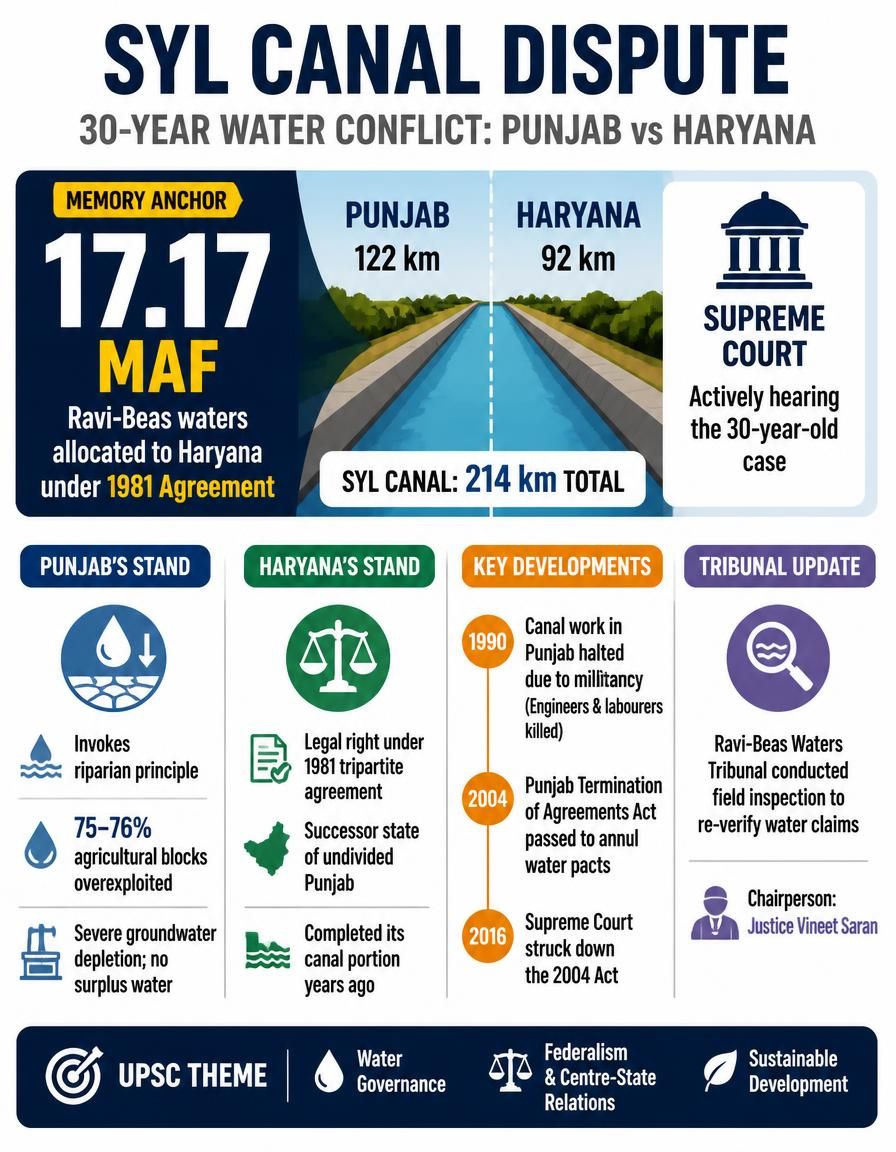
- The Satluj-Yamuna Link (SYL) canal dispute involves water sharing between Punjab and Haryana, with the Supreme Court actively hearing the 30-year-old case.
- Punjab invokes the riparian principle and cites severe groundwater depletion, arguing it has no surplus water to share.
- Haryana asserts its legal right based on the 1981 tripartite agreement and its status as a successor state of undivided Punjab.
- The Punjab Termination of Agreements Act, 2004, passed by Punjab to annul water-sharing pacts, was struck down by the Supreme Court in 2016.
- The Ravi-Beas Waters Tribunal, currently headed by Justice Vineet Saran, recently conducted a field inspection to re-verify water claims.
SYL Canal.jpg
Detailed Insights:
- The SYL canal was designed as a 214-km link, with 122 km in Punjab and 92 km in Haryana, to transfer surplus Ravi-Beas waters.
- Haryana completed its portion of the canal years ago and relies on Supreme Court rulings directing Punjab to complete its part.
- The 1981 tripartite agreement, brokered by then Prime Minister Indira Gandhi, reallocated 17.17 MAF (million acre feet) of Ravi-Beas waters.
- Work on the canal in Punjab was halted in 1990 due to militancy, which included the killing of engineers and labourers.
- Punjab's resistance is rooted in the fact that roughly 75-76% of its agricultural blocks are overexploited, leading to deep groundwater depletion.
- The Ravi-Beas Waters Tribunal was originally set up in 1986, commonly known as the Eradi Tribunal, to re-verify water claims.
- Haryana faces water stress in its southern and south-western districts, where the water table has significantly dipped.
Key Concepts Involved:
- Riparian Principle: A legal doctrine granting states or landowners through which a river flows primary rights to its waters.
- Million Acre Feet (MAF): A unit of volume used to measure large quantities of water, equivalent to one million acres covered to a depth of one foot.
- Tripartite Agreement: An agreement involving three parties, in this context, the central government and two or more states for water sharing.

SuperKalam is your personal mentor for UPSC preparation, guiding you at every step of the exam journey.
Download the App


STUDY RESOURCES
CONTACT US
ⓒ Snapstack Technologies Private Limited