GS 2: GovernanceGS 3: Environment & EcologyGS 3: EconomyPrelimsGS 3: Buffer Stocks and Food Security
Problem with ethanol blending isn't sugar — it's reliance on grains; the way forward, Pg11
India's ethanol blending program faces sustainability challenges due to increasing reliance on grain feedstock, raising concerns over food security and water usage.
Practice MCQs
804 Students attempted
Key Highlights:
- India's Ethanol Blended Petrol (EBP) programme was initially designed to support the sugar industry and cane farmers.
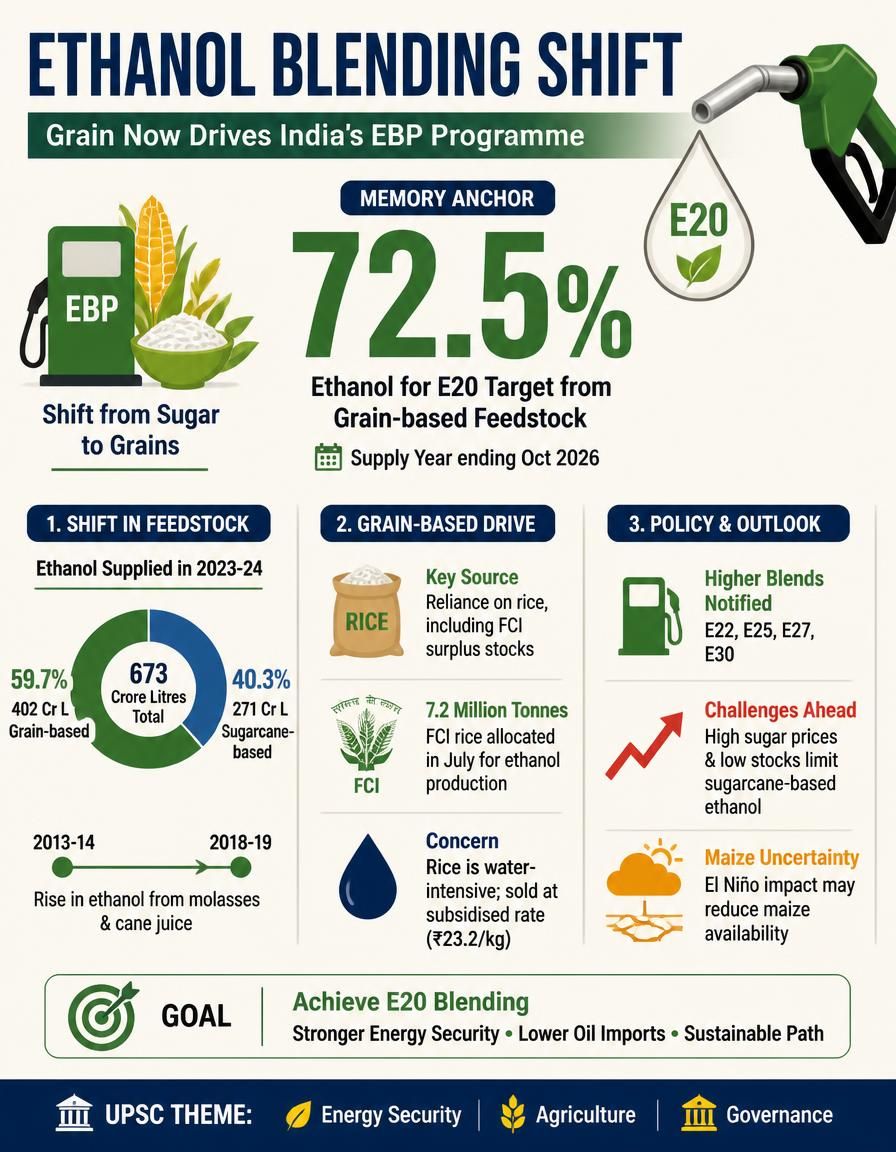
- The program has seen a significant shift in feedstock, with grain-based ethanol now dominating over sugarcane-based sources.
- In 2023-24, grain-based feedstock contributed 59.7% (402 crore litres) of the total 673 crore litres of ethanol supplied, achieving a 14.6% blending level.
- For the current supply year ending October 2026, grain-based feedstock is projected to supply 72.5% of the ethanol required for the E20 blending target.
- High sugar prices and low stock projections are expected to restrict ethanol production from direct cane juice or B-heavy molasses in the coming 2026-27 supply year.
- The program's increasing reliance is on rice, particularly surplus stocks from the Food Corporation of India (FCI), with 7.2 million tonnes allocated in July for ethanol production.
- The government has notified standards for higher ethanol blends, including E22, E25, E27, and E30, driven by increased distillery capacity.
Ethanol Blending.jpg
Detailed Insights:
- The EBP programme aimed to create an additional revenue stream for sugar mills, enabling them to make timely payments to cane farmers.
- Initially, ethanol was primarily produced from C-heavy molasses, a final byproduct of sugar processing.
- Incentives for ethanol from B-heavy molasses and direct cane juice/syrup led to an increase in ethanol supplies and blending levels between 2013-14 and 2018-19.
- The shift to grain-based ethanol, utilizing maize and rice (including FCI stocks), has become the mainstay of the program.
- The use of FCI rice for ethanol production raises concerns due to rice being a water-intensive crop and its sale at subsidized rates (Rs 23.2/kg to distilleries).
- Potential challenges in maize availability due to El Niño effects are expected to further increase reliance on rice for ethanol production.
- The original purpose of supporting sugarcane growers and providing demand for maize farmers is being overshadowed by the program's current trajectory.
- Suggested solutions include discouraging ethanol supplies from standalone grain-based distilleries reliant on FCI rice and promoting alternative crops like bajra and jowar.
- Another recommendation is to reconsider aggressive blending targets, with some experts suggesting a return to E10 petrol.
Key Concepts Involved:
- Ethanol Blended Petrol (EBP) Programme: A government initiative to blend ethanol with petrol to reduce crude oil imports, enhance energy security, and support the agricultural sector.
- C-heavy molasses: A thick, dark brown final byproduct of cane-juice processing, containing sucrose that mills cannot economically recover as sugar.
- B-heavy molasses: An intermediate-stage byproduct of cane-juice processing, from which some sugar can still be recovered, but is diverted for ethanol production with incentives.
- Food Corporation of India (FCI): A government agency responsible for the procurement, storage, and distribution of food grains in India.
- E20: A fuel blend consisting of 20% ethanol and 80% petrol, aimed at reducing fossil fuel consumption and emissions.
- El Niño: A climate pattern characterized by the unusual warming of surface waters in the eastern tropical Pacific Ocean, impacting global weather patterns, including rainfall.

SuperKalam is your personal mentor for UPSC preparation, guiding you at every step of the exam journey.
Download the App


STUDY RESOURCES
CONTACT US
ⓒ Snapstack Technologies Private Limited