GS 2: International RelationsGS 3: EconomyPrelimsGS 2: Bilateral, Regional and Global Groupings and AgreementsGS 2: Effect of Policies and Politics of Developed and Developing Countries on India's Interests
PM Visit to Uzbekistan, Kyrgyz Republic: Why Central Asia Matters for India, Pg16
PM Modi visits Uzbekistan and Kyrgyz Republic for bilateral talks and SCO Summit, reinforcing India's strategic engagement with resource-rich Central Asia.
Practice MCQs
804 Students attempted
Key Highlights:
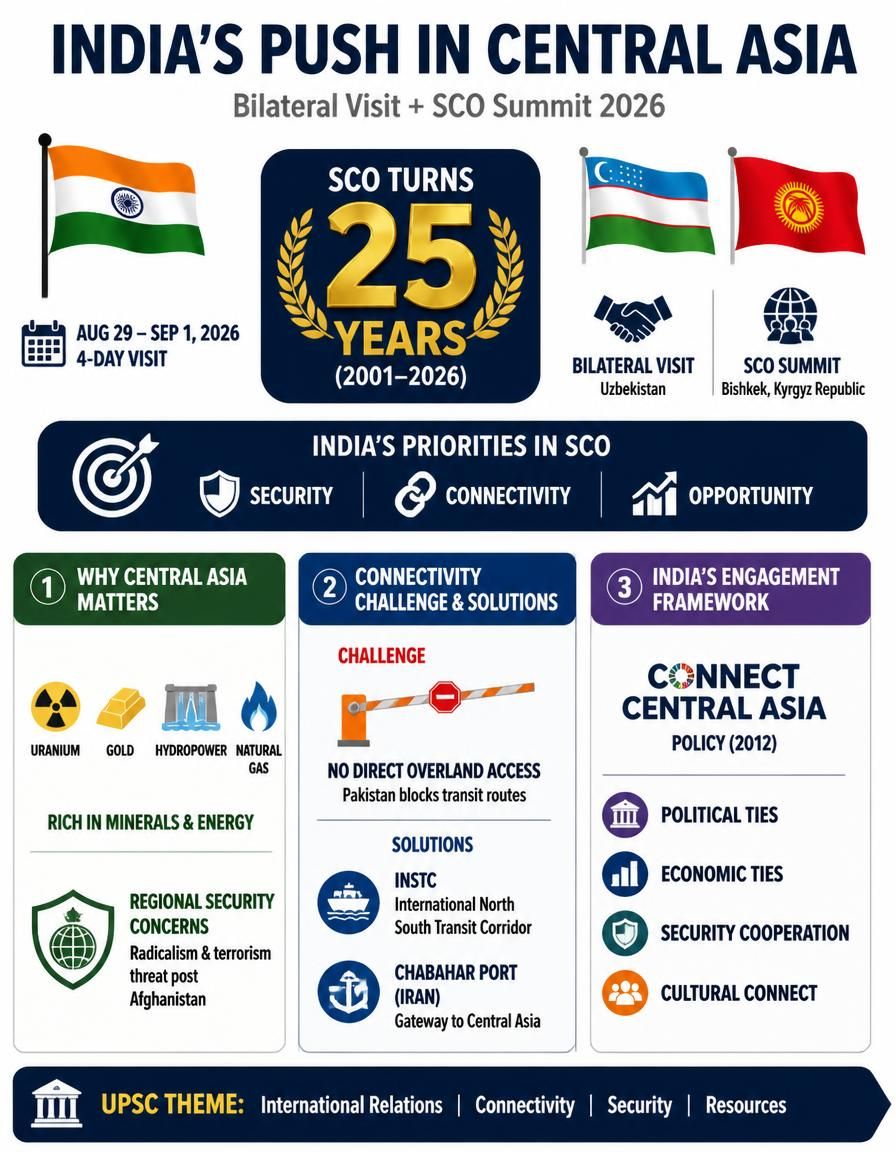
- Prime Minister Narendra Modi undertook a four-day visit to Uzbekistan and the Kyrgyz Republic from August 29 to September 1, 2026.
- The visit included a bilateral state visit to Uzbekistan and participation in the 26th Shanghai Cooperation Organisation (SCO) Summit in Bishkek, Kyrgyz Republic.
- The SCO Summit marked the 25th anniversary of the organization, which India joined as a full member in 2017.
- India's engagement with Central Asia is guided by its Connect Central Asia policy, launched in 2012.
- The region is strategically important for its rich mineral and natural resources, including uranium, gold, hydropower, and natural gas.
India-Central Asia.jpg
Detailed Insights:
- The bilateral visit to Uzbekistan focused on strengthening strategic partnership across trade, investment, defense, digital connectivity, and energy.
- PM Modi's participation in the SCO Summit aimed to highlight India's priorities of Security, Connectivity, and Opportunity within the forum.
- The Connect Central Asia policy seeks to deepen India's political, economic, security, and cultural ties with the five Central Asian republics.
- A major challenge for India's engagement is the lack of direct overland access, primarily due to Pakistan blocking transit routes.
- India aims to overcome connectivity challenges through projects like the International North South Transit Corridor (INSTC) and the Chabahar Port in Iran.
- Central Asia's strategic significance is also linked to security concerns, including the threat of radicalism and terrorism following the Taliban's rise in Afghanistan.
- China's extensive investments in the region through its Belt and Road Initiative (BRI) present a geopolitical dynamic that India seeks to balance.
- The SCO currently comprises 10 member states: India, Belarus, China, Iran, Kazakhstan, Kyrgyzstan, Pakistan, Russia, Tajikistan, and Uzbekistan.
Key Concepts Involved:
- Connect Central Asia Policy: India's foreign policy framework launched in 2012 to enhance engagement with Central Asian countries across various sectors.
- Shanghai Cooperation Organisation (SCO): A Eurasian political, economic, and security organization established in 2001, with India becoming a full member in 2017.
- International North South Transit Corridor (INSTC): A 7,200 km multi-modal network of ship, rail, and road routes connecting India, Iran, Central Asia, Russia, and Europe.
- Chabahar Port: A deep-water port in southeastern Iran, developed with Indian assistance, providing India with an alternative trade route to Afghanistan and Central Asia, bypassing Pakistan.
- Belt and Road Initiative (BRI): China's global infrastructure development strategy launched in 2013, aiming to connect Asia, Africa, and Europe through land and sea networks.

SuperKalam is your personal mentor for UPSC preparation, guiding you at every step of the exam journey.
Download the App


STUDY RESOURCES
CONTACT US
ⓒ Snapstack Technologies Private Limited