GS 1: Physical GeographyGS 3: Science & TechnologyGS 3: Disaster ManagementGS 3: Environment & EcologyPrelims
Fresh Glacial Lakes Form At Source Of Nepal’s Avalanche, Pg11
New glacial lakes, up to 20 hectares, form in Nepal near avalanche source, raising fears of potential Glacial Lake Outburst Floods (GLOFs) downstream.
Practice MCQs
804 Students attempted
Key Highlights:
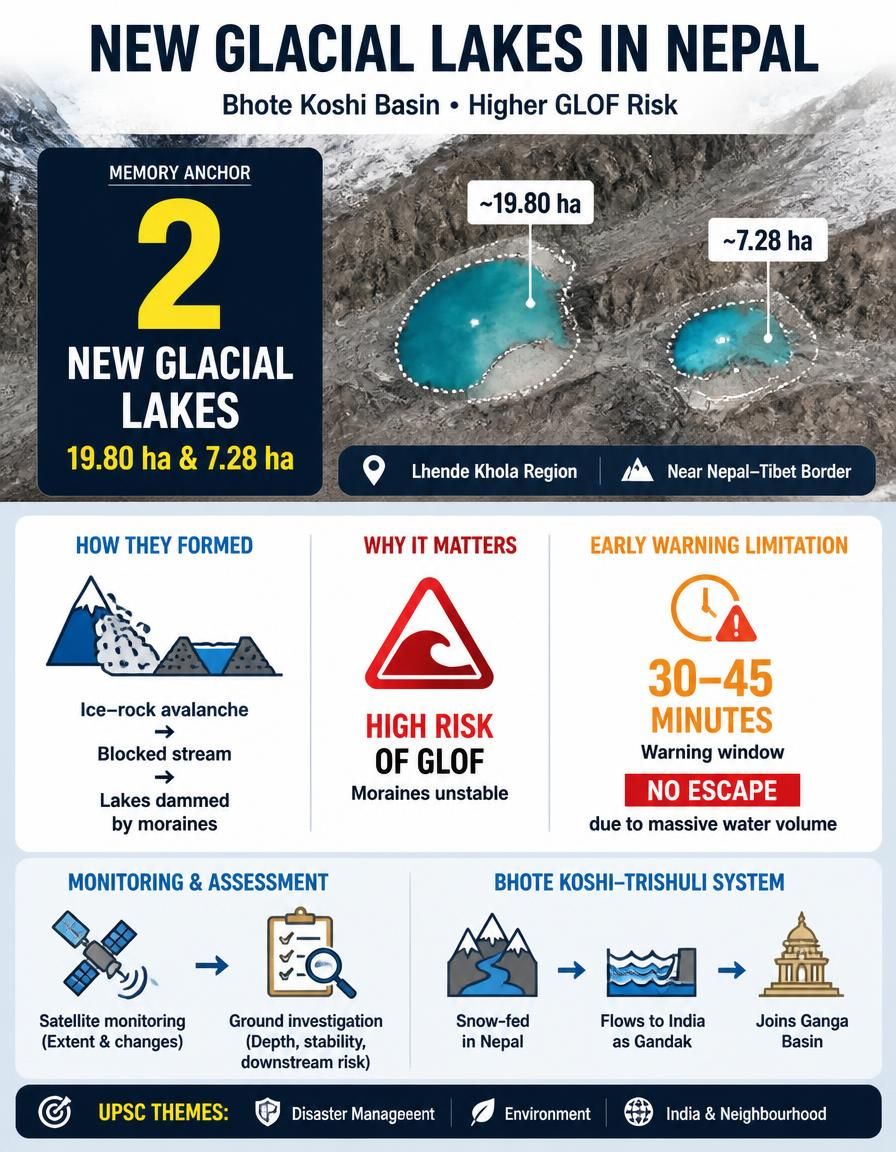
- Two new glacial lakes have formed in Nepal, near the source of an ice-rock avalanche that caused flooding in the Bhote Koshi-Trishuli river system.
- The lakes measure approximately 19.80 hectares and 7.28 hectares respectively, with their water volume currently unknown.
- The formation was independently confirmed by Suhora Technologies using high-resolution satellite imagery, identifying one lake spanning 20.25 hectares in the Lhende Khola region near the Nepal-Tibet border.
- India's National Disaster Management Authority (NDMA) acknowledges limitations in early warning systems, stating that while warnings can be given 30-45 minutes in advance, the sheer volume of water in such events leaves "no escape".
New Glacial Lakes.jpg
Detailed Insights:
- The Bhote Koshi-Trishuli river system is a transboundary, snow-fed Himalayan river system crucial for Nepal and eventually flowing into India as part of the Gandak River and then the Ganga basin.
- The recent flooding was triggered by an ice-rock avalanche on August 26, which likely created a temporary dam, leading to water accumulation and subsequent flash floods.
- The newly formed lakes are dammed by moraines, which are unstable piles of glacial debris, increasing the risk of a Glacial Lake Outburst Flood (GLOF).
- Satellite monitoring is a key tool for tracking the extent and stability of these lakes, but ground-based investigation is essential for assessing their origin, depth, and potential downstream risks.
- The incident highlights the vulnerability of Himalayan regions to climate-induced disasters, with rising temperatures accelerating glacier retreat and glacial lake expansion.
- India has a National GLOF Risk Mitigation Programme with an allocated ₹150 crore for four Himalayan states, focusing on assessment, monitoring, and mitigation strategies for high-risk glacial lakes.
Scientific/Technical Concepts Involved:
- Glacial Lake: A body of water formed when a glacier erodes land, and the resulting depression fills with meltwater.
- Moraine: An accumulation of unconsolidated glacial debris (rock, gravel, sand) deposited by a glacier, often forming natural dams for glacial lakes.
- Ice-rock avalanche: A rapid downslope movement of rock and ice, often triggered by the collapse of a rock mass near a glacier, which can transform into destructive debris flows.
- Glacial Lake Outburst Flood (GLOF): A sudden release of a large volume of water from a glacial lake due to the failure of its natural dam, causing devastating floods downstream.

SuperKalam is your personal mentor for UPSC preparation, guiding you at every step of the exam journey.
Download the App


STUDY RESOURCES
CONTACT US
ⓒ Snapstack Technologies Private Limited