EthicsGS 2: GovernanceGS 3: Science & TechnologyGS 2: Social JusticePrelims
'Viruses don't respect borders; world must ensure timely, fair access to vaccines', Pg16
Global health experts warn rising zoonotic outbreaks demand urgent public-private vaccine development, equitable access, and global preparedness to combat future pandemics effectively.
Practice MCQs
796 Students attempted
Key Highlights:
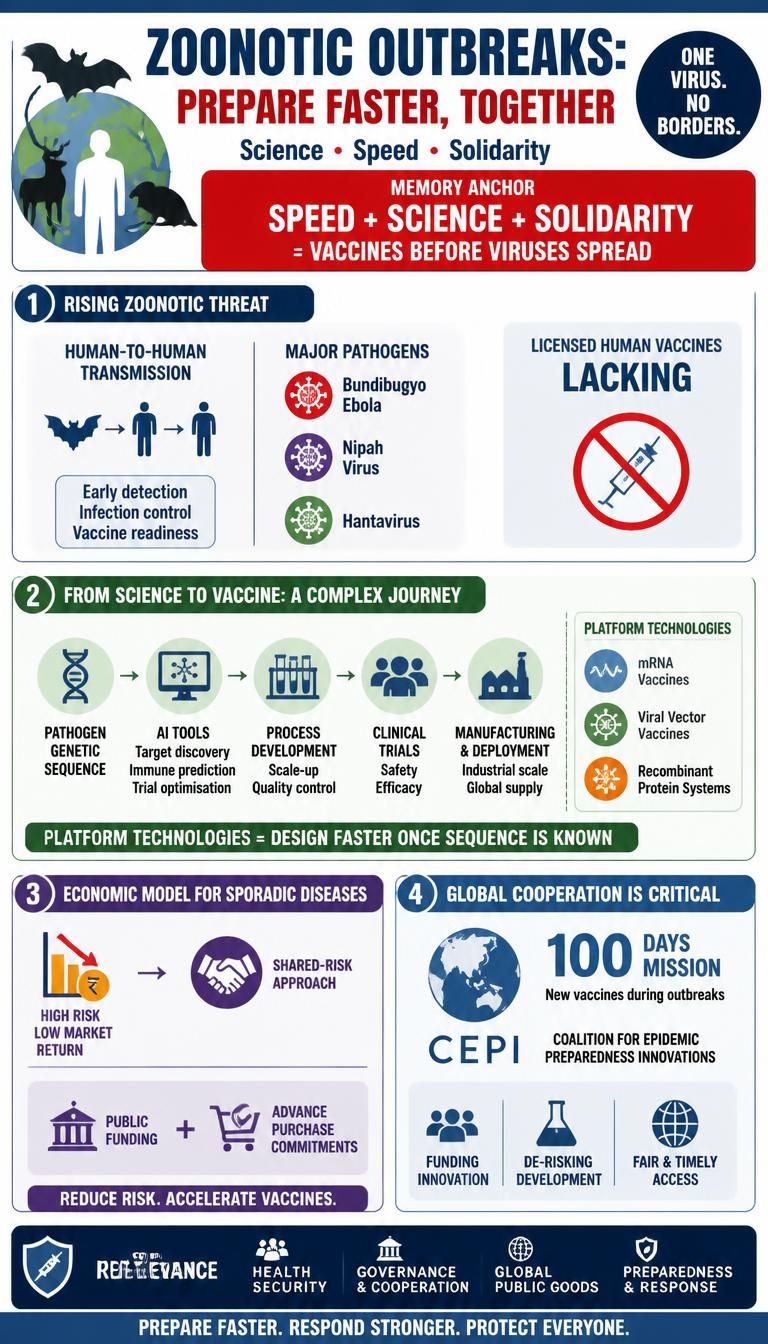
- Recent outbreaks of Ebola, Hantavirus, and Nipah virus highlight the increasing regularity of zoonotic infections at the human-animal-environment interface.
- These infections can involve human-to-human transmission, necessitating early detection, infection control, and vaccine preparedness.
- Despite advances, licensed human vaccines are still lacking for several major pathogens, including Bundibugyo Ebola, Nipah virus, and Hantavirus.
- Rapid vaccine development requires strong academia-industry partnerships, leveraging scientific research with industrial-scale capacity.
- The economic model for vaccine development for sporadic diseases is challenging, requiring a shared-risk approach with public funding and advance purchase commitments.
- Global cooperation is crucial to ensure timely and fair access to vaccines, as viruses do not respect national borders.
Zoonotic Outbreaks.jpg
Detailed Insights:
- The ability of diseases like Ebola, Nipah, and Andes Hantavirus to spread human-to-human underscores the urgency for robust public health responses.
- Converting scientific knowledge into deployable vaccines involves complex stages like process development, quality control, clinical trials, and manufacturing.
- Artificial Intelligence (AI) tools are increasingly used to identify vaccine targets, predict immune responses, and optimize trial planning, accelerating development.
- Vaccine platform technologies, such as mRNA vaccines, viral vector vaccines, and recombinant protein systems, can significantly speed up vaccine design once a pathogen's genetic sequence is known.
- The Coalition for Epidemic Preparedness Innovations (CEPI) plays a vital role in funding vaccine development for priority pathogens and aims for a 100 Days Mission to develop new vaccines during outbreaks.
- Conventional large clinical trials are often not feasible for unpredictable outbreaks, necessitating emergency trial designs like ring vaccination studies.
- The lack of commercial incentive for vaccines against rare or geographically limited diseases highlights the need for public responsibility and global stockpiles.
- Addressing vaccine hesitancy through community confidence and accurate information is as critical as scientific advancements for effective outbreak control.
- The WHO Pandemic Agreement aims to enhance global coordination, surveillance, and equitable access to vaccines and treatments during future pandemics.
Key Concepts Involved:
- Zoonotic Infections: Diseases transmitted from animals to humans, often emerging at the interface of human, animal, and environmental health.
- Vaccine Platform Technologies: Methods like mRNA, viral vector, or recombinant protein that allow for rapid vaccine development by adapting a core technology to different pathogens.
- One Health Approach: An integrated, unifying approach recognizing the interconnectedness of human, animal, and environmental health for better public health outcomes.
- Ring Vaccination: A strategy where contacts of an infected individual, and their contacts, are vaccinated to form a protective ring around the case.

SuperKalam is your personal mentor for UPSC preparation, guiding you at every step of the exam journey.
Download the App


STUDY RESOURCES
CONTACT US
ⓒ Snapstack Technologies Private Limited