GS 2: International RelationsGS 3: EconomyPrelims
The rupee's journey: From overvalued to undervalued, Pg16
Indian Rupee plunges to undervalued status, now more competitive than Yuan, driven by global oil shocks and West Asia tensions.
Practice MCQs
796 Students attempted
Key Highlights:
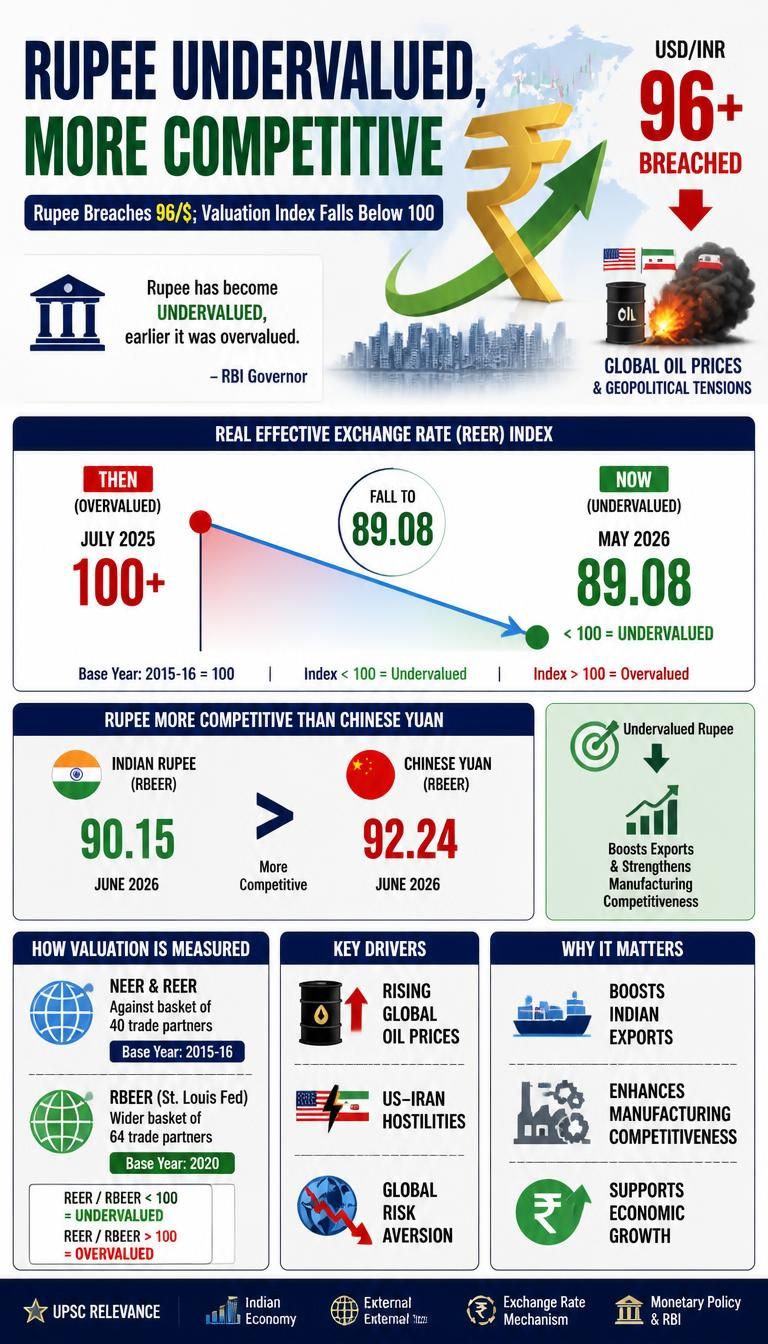
- The Indian Rupee recently breached the 96-to-the-dollar mark due to hardening global oil prices and geopolitical tensions.
- The Reserve Bank of India (RBI) Governor stated that the rupee has become undervalued, contrary to its previous overvalued status.
- The Real Effective Exchange Rate (REER) index, a key measure of currency valuation, fell to 89.08 in May 2026 from over 100 in July 2025.
- The rupee is now considered more competitive than the Chinese Yuan, with its Real Broad Effective Exchange Rate (RBEER) at 90.15 in June 2026 compared to the Yuan's 92.24.
Rupee undevalued.jpg
Detailed Insights:
- The rupee's depreciation is significantly influenced by global oil price fluctuations and hostilities between the US and Iran.
- The Nominal Effective Exchange Rate (NEER) and REER indices measure the rupee's movement against a basket of 40 currencies of India's key trade partners.
- The base year for calculating India's NEER and REER is 2015-16, with a value set at 100 for comparison.
- An REER below 100 indicates undervaluation, while above 100 signifies overvaluation, reflecting the currency's real effective exchange value.
- The Federal Reserve Bank of St. Louis also calculates a similar metric, the Real Broad Effective Exchange Rate (RBEER), using a wider basket of 64 trade partners and a 2020 base year.
- An undervalued rupee can potentially boost Indian exports and enhance the competitiveness of domestic manufacturing.
Key Concepts Involved:
- Nominal Effective Exchange Rate (NEER): A weighted average of a country's currency against a basket of foreign currencies, without adjusting for inflation.
- Real Effective Exchange Rate (REER): The NEER adjusted for inflation differentials between the home country and its trading partners, indicating true competitiveness.
- Federal Reserve Bank of St. Louis: One of the 12 regional Federal Reserve Banks in the United States, providing economic research and data.
- Real Broad Effective Exchange Rate (RBEER): A measure similar to REER, calculated by the Federal Reserve Bank of St. Louis, using a broader set of trade partners.

SuperKalam is your personal mentor for UPSC preparation, guiding you at every step of the exam journey.
Download the App


STUDY RESOURCES
CONTACT US
ⓒ Snapstack Technologies Private Limited