GS 2: GovernanceGS 1: Indian GeographyGS 2: Social JusticeGS 3: Environment & EcologyPrelims
Centre declares 56,825 sq km of Western Ghats as eco-sensitive area, Pg11
Centre declares 56,825 sq km of Western Ghats as Eco-Sensitive Area in seventh draft, banning mining and polluting industries amidst state deadlock.
Practice MCQs
796 Students attempted
Key Highlights:
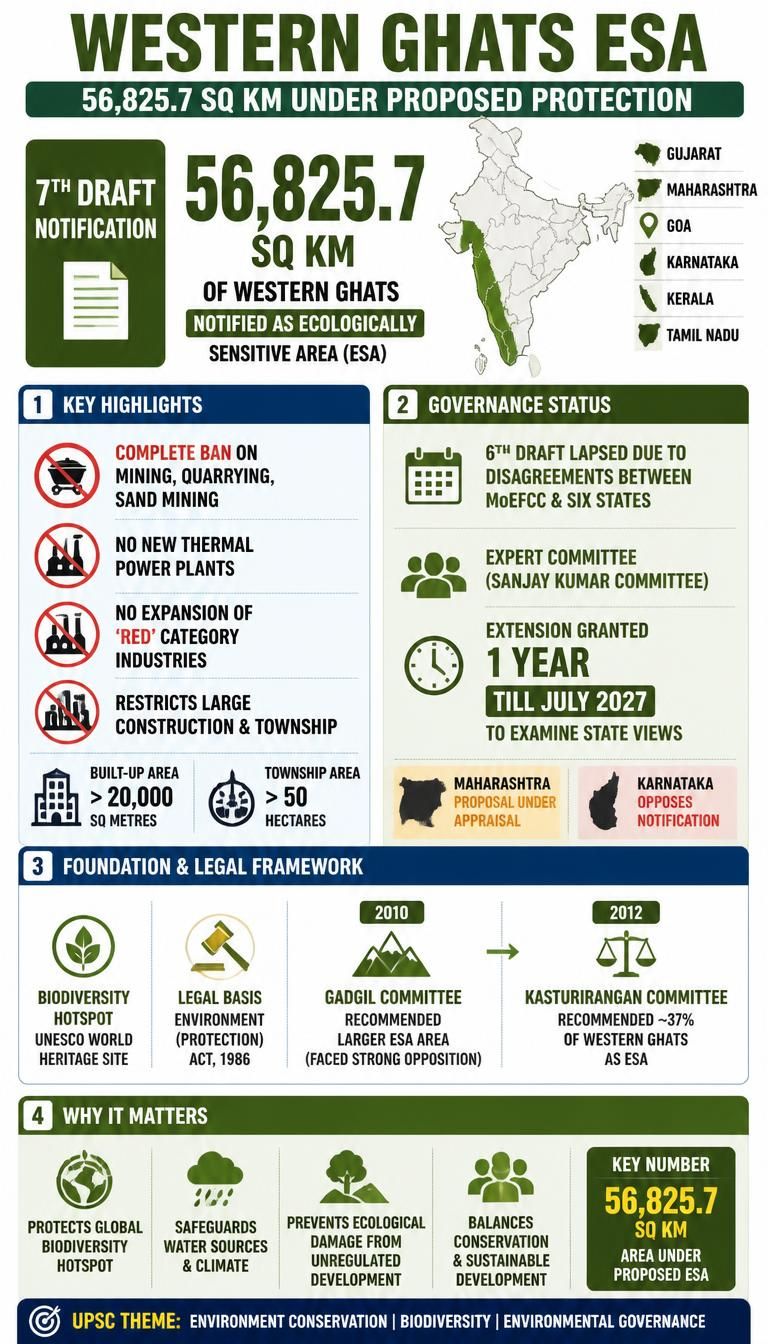
- The Centre has issued the seventh draft notification declaring 56,825.7 square kilometres of the Western Ghats as an Ecologically Sensitive Area (ESA).
- This latest draft follows the lapse of the sixth iteration due to ongoing disagreements between the Ministry of Environment, Forest and Climate Change (MoEFCC) and the six concerned states.
- The proposed ESA spans Gujarat, Maharashtra, Goa, Karnataka, Kerala, and Tamil Nadu, with Maharashtra's proposal under appraisal and Karnataka opposing the notification.
- The draft recommends a complete ban on mining, quarrying, sand mining, new thermal power plants, and expansion of 'red' category industries within these ESAs.
- An expert committee, led by Sanjay Kumar, has been granted a one-year extension until July 2027 to continue examining the views of the stakeholder states.
Western Ghats.jpg
Detailed Insights:
- The Western Ghats is a globally recognized biodiversity hotspot and a UNESCO World Heritage Site, necessitating special conservation efforts.
- The declaration of ESAs is a measure taken under the Environment (Protection) Act, 1986, which empowers the Central Government to protect and improve environmental quality.
- The concept of ESA for the Western Ghats was first extensively studied by the Madhav Gadgil Committee in 2010.
- The Gadgil Committee recommended a much larger area for protection, which faced strong opposition from states due to concerns over development restrictions.
- Subsequently, the Kasturirangan Committee was formed in 2012 to review the Gadgil report, proposing a more balanced approach by recommending approximately 37% of the Western Ghats as ESA.
- The current draft also prohibits new and expansion projects for building and construction with built-up areas exceeding 20,000 sq metres, and township projects over 50 hectares.
Key Concepts Involved:
- Ecologically Sensitive Area (ESA): Designated regions around Protected Areas, notified under the Environment (Protection) Act, 1986, to regulate activities and minimize environmental degradation.
- Western Ghats: A mountain range along India's western coast, recognized as one of the world's eight hottest biodiversity hotspots and a UNESCO World Heritage Site.
- Environment (Protection) Act, 1986: An umbrella legislation enacted by the Indian Parliament to provide for the protection and improvement of the environment.
- Gadgil Committee: The Western Ghats Ecology Expert Panel (WGEEP), formed in 2010, recommended declaring almost the entire Western Ghats as ESA with a bottom-up approach.
- Kasturirangan Committee: A High-Level Working Group formed in 2012 to review the Gadgil report, which recommended declaring about 37% of the Western Ghats as ESA.

SuperKalam is your personal mentor for UPSC preparation, guiding you at every step of the exam journey.
Download the App


STUDY RESOURCES
CONTACT US
ⓒ Snapstack Technologies Private Limited