GS 2: International RelationsGS 3: EconomyPrelims
Avg US tariff 11.1%, India's effective rate 12%, Pg17
US average tariff dips to 11.1% post-Section 122 expiry, yet India's effective rate stands higher at 12%, signaling trade challenges.
Practice MCQs
796 Students attempted
Key Highlights:
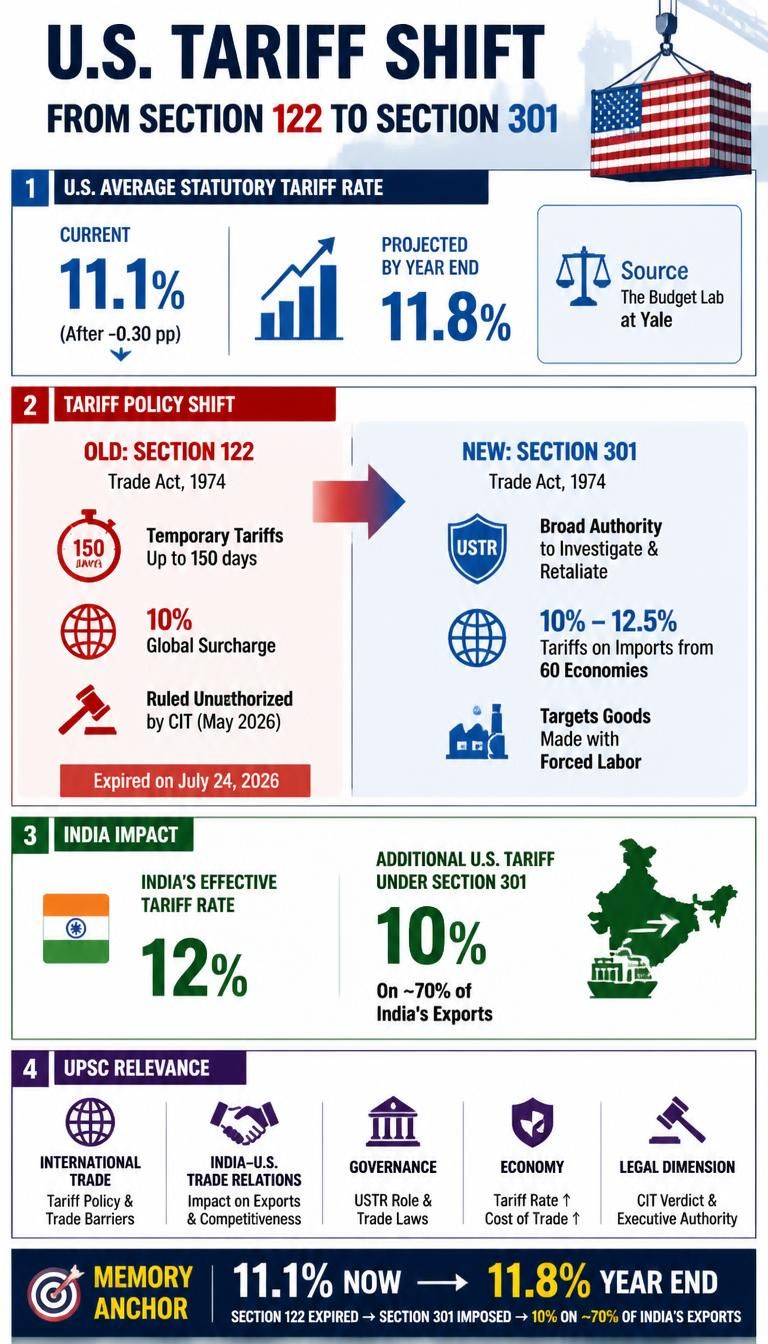
- The average statutory tariff rate in the U.S. currently stands at 11.1%, as reported by The Budget Lab at Yale.
- This rate decreased by 30 basis points following the expiration of Section 122 tariffs, which were subsequently replaced by new tariffs under Section 301.
- The U.S. average statutory tariff rate is projected to increase to 11.8% by the end of the year.
- India's effective tariff rate is noted at 12%, while the U.S. has imposed an additional 10% tariff on approximately 70% of India's exports under the new Section 301 measures.
US Tariffs.jpg
Detailed Insights:
- The recent shift in U.S. tariff policy involves the transition from temporary Section 122 tariffs to more permanent Section 301 tariffs.
- Section 122 of the Trade Act of 1974 allowed the U.S. President to impose temporary tariffs for up to 150 days to address balance-of-payments issues.
- These Section 122 tariffs, which were a 10% global surcharge, expired on July 24, 2026, and were ruled unauthorized by the Court of International Trade (CIT) in May 2026.
- Section 301 of the Trade Act of 1974 grants the Office of the United States Trade Representative (USTR) broad authority to investigate and retaliate against foreign trade practices deemed unfair or discriminatory.
- The new Section 301 tariffs, ranging from 10% to 12.5%, were imposed on imports from 60 economies, primarily targeting goods made with forced labor.
- India was placed in the lower 10% tariff category under Section 301 after discussions with the U.S. on labor standards, a more favorable outcome compared to the initially proposed 12.5%.
- Unlike some other trading partners, the 10% Section 301 tariff for India is added to its existing Most-Favoured-Nation (MFN) duties, rather than being part of a combined ceiling.
- The Budget Lab at Yale is a key institution providing ongoing analysis of U.S. tariff policies and their economic impacts.
Key Concepts Involved:
- Statutory Tariff Rate: The official tariff rate specified in law or regulation, applied to imported goods.
- Effective Tariff Rate: The actual average tariff burden on imports, considering exemptions, specific product mixes, and trade volumes.
- Section 301 Tariffs: A provision of the Trade Act of 1974 allowing the U.S. to unilaterally impose tariffs or other trade restrictions against countries engaging in unfair trade practices.
- Section 122 Tariffs: A provision of the Trade Act of 1974 that authorized the U.S. President to impose temporary tariffs for up to 150 days to address balance-of-payments deficits.

SuperKalam is your personal mentor for UPSC preparation, guiding you at every step of the exam journey.
Download the App


STUDY RESOURCES
CONTACT US
ⓒ Snapstack Technologies Private Limited