GS 2: International RelationsGS 3: Environment & EcologyGS 3: EconomyPrelimsGS 3: Infrastructure: Energy, Ports, Roads, Airports, Railways etc.
India's Strategic Position in the Evolving Global Energy Landscape
Rising demand and import reliance drive India to accelerate clean energy transition and bolster energy security against global supply disruptions.
Source: The Hindu (Pg. 6)
Practice MCQs
818 Students attempted
Key Highlights:
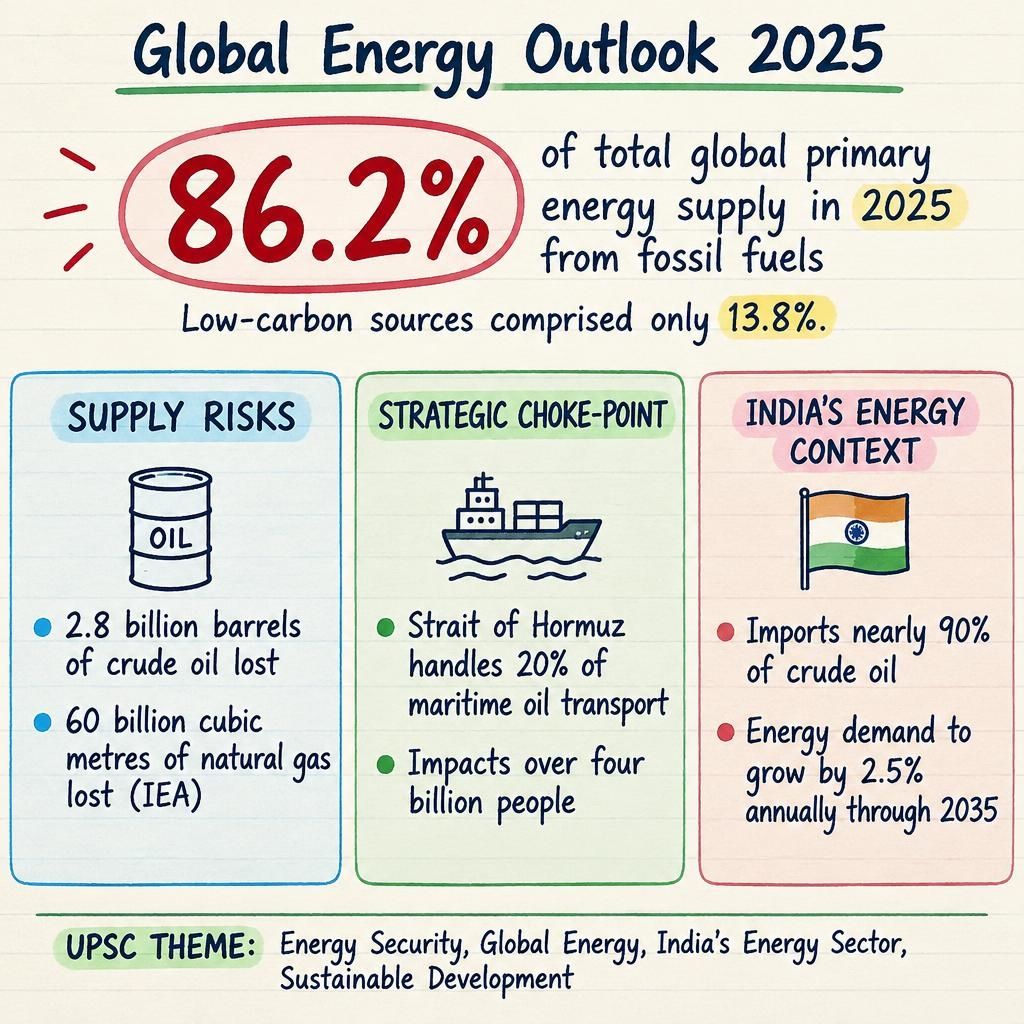
- Fossil fuels accounted for 86.2% of total global primary energy supply in 2025, while low-carbon sources comprised only 13.8%.
- The International Energy Agency reported that recent geopolitical conflicts have resulted in a cumulative loss of 2.8 billion barrels of crude oil and 60 billion cubic metres of natural gas.
- The Strait of Hormuz handles roughly 20% of maritime oil transport, impacting over four billion people living in import-dependent nations.
- India is the world's third-largest primary energy consumer, accounting for a 6.1% global share, but per capita power use remains one-third of the global average.
- India's energy demand is projected to grow by 2.5% annually through 2035, driven by rapid industrialisation, urban expansion, and transport growth.
- The International Energy Agency projects that global oil demand will peak by 2035 as renewable generation expands to half of total electricity.
Global Energy Outlook
Detailed Insights:
- India currently relies on imports for nearly 90% of crude oil and 50% of natural gas, posing critical macroeconomic risks.
- Fossil fuels still generate roughly 70% of India's electricity, despite installed non-fossil capacity surpassing non-fossil milestone goals under Nationally Determined Contributions.
- The Energy Conservation Act and national efficiency measures seek to limit industrial intensity while expanding domestic grid infrastructure.
- Achieving the national target of energy self-reliance by 2047 requires accelerating renewable integration under the National Green Hydrogen Mission.
- Global energy systems face severe supply bottlenecks from choke-point disruptions in West Asia, compelling the Global South to fast-track domestic decarbonisation.
- Expanding electricity distribution globally will require 25 million kilometres of new power lines and upgrading 15 million kilometres of existing grids.
Key Concepts Involved:
- Primary Energy Supply: The initial, unrefined energy input extracted from natural resources before conversion into secondary fuels or electricity.
- Energy Intensity: A metric measuring the amount of energy required to produce one unit of economic gross domestic product.
- Resource Curse: The economic paradox where countries rich in non-renewable natural resources experience slower growth and institutional instability.
- Energy Transition: The structural shift in global energy systems from fossil fuel-dominated supply to low-carbon and renewable sources.

SuperKalam is your personal mentor for UPSC preparation, guiding you at every step of the exam journey.
Download the App


STUDY RESOURCES
CONTACT US
ⓒ Snapstack Technologies Private Limited