GS 2: International RelationsGS 3: EconomyPrelimsGS 3: Effects of Liberalization on the EconomyGS 2: Bilateral, Regional and Global Groupings and Agreements
India and United States Move Close to Finalizing Landmark Bilateral Trade Deal
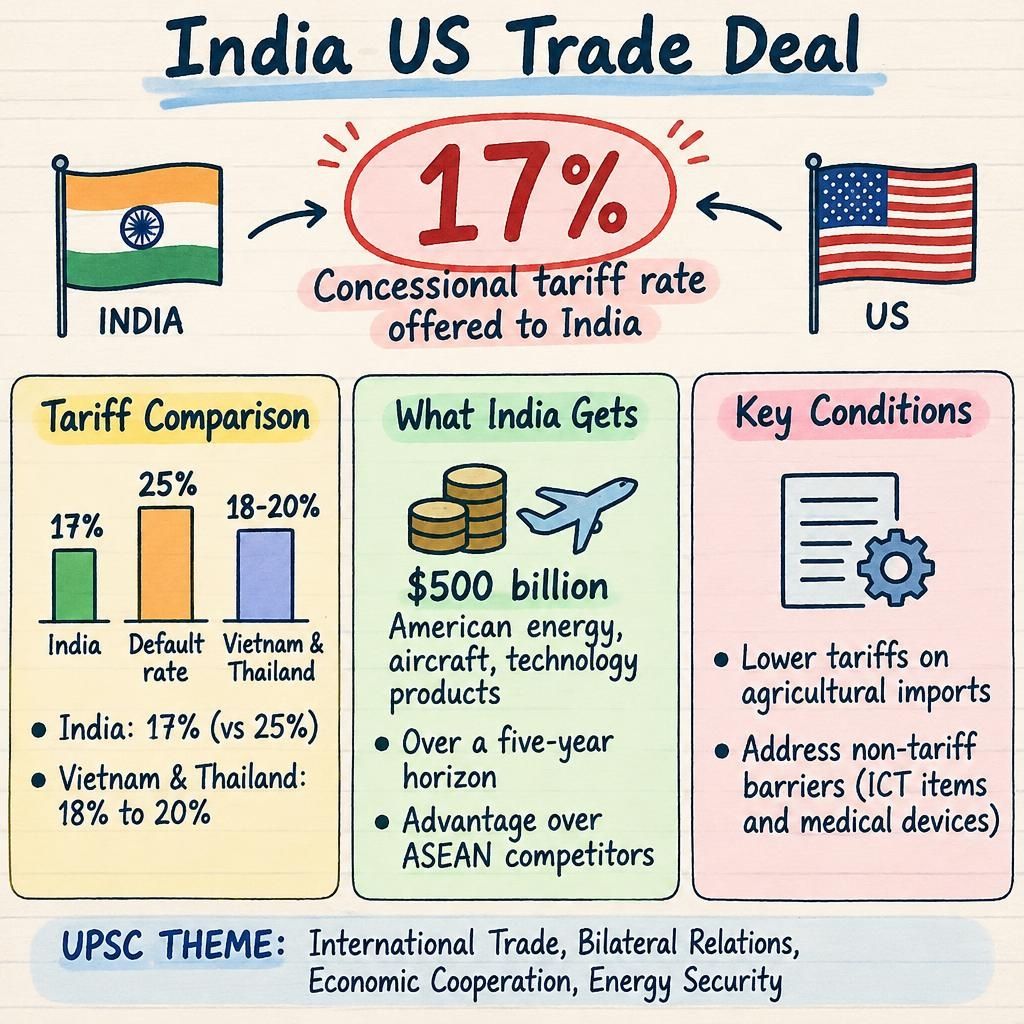
India secures a 17% concessional tariff under an emerging US trade pact, targeting $500 billion in American goods over five years.
Source: Indian Express (Pg. 15)
Practice MCQs
818 Students attempted
Key Highlights:
- The Ministry of Commerce and Industry announced that negotiations for a bilateral India-US trade deal are near completion.
- Under the proposed trade architecture, India is offered a concessional tariff rate of 17%, compared to a default rate of 25%.
- India’s negotiated rate offers an advantage over Association of Southeast Asian Nations competitors like Vietnam and Thailand, which face 18% to 20% tariffs.
- The deal follows tariff investigations concluded under Section 301 of the Trade Act of 1974 by the United States.
- The US holds trade leverage via the Lindsey O. Graham Sanctioning Russia and Iran Act of 2026, which permits punitive tariffs up to 100% on Russian energy buyers.
- The framework envisions India purchasing $500 billion worth of American energy, aircraft, and technology products over a five-year horizon.
India-US Trade Deal
Detailed Insights:
- The agreement requires India to lower tariffs on agricultural imports such as dried distillers' grains, tree nuts, and soybean oil.
- India must address regulatory non-tariff barriers, particularly restrictive import licensing on Information and Communication Technology items and medical devices.
- Enhanced bilateral technology cooperation focuses on high-performance computing hardware, including graphical processing units used in domestic data centers.
- The Ministry of External Affairs balances US trade demands against national energy security considerations regarding crude oil imports from Russia.
- Bilateral concessions are designed to secure supply chain resilience and counter regional export competition across Indo-Pacific markets.
Key Concepts Involved:
- Section 301: A provision under the Trade Act of 1974 authorizing unilateral US retaliatory actions against unfair trade practices.
- Quantitative Restrictions: Explicit non-tariff limits imposed by a state on the volume or value of goods imported.
- Comparative Advantage: An economic principle where a nation produces goods at a lower opportunity cost relative to trade partners.
Previous9/9

SuperKalam is your personal mentor for UPSC preparation, guiding you at every step of the exam journey.
Download the App


STUDY RESOURCES
CONTACT US
ⓒ Snapstack Technologies Private Limited