GS 2: GovernanceGS 2: PolityPrelimsGS 2: Indian Constitutional Evolution, Features, Amendments, Basic Structure DoctrineGS 2: Parliament and State Legislatures
Cabinet Proposes Fifty Percent Lok Sabha Expansion With Seat Freeze Until 2051
The Union Cabinet approves a fifty percent expansion of Lok Sabha seats, freezing inter-State allocation ratios until 2051 to protect federal representation.
Sources: The Hindu (Pg. 1) | Indian Express (Pg. 1)
Practice MCQs
818 Students attempted
Key Highlights:
- The Union Cabinet cleared the Constitution (One Hundred and Thirty-Second Amendment) Bill, 2026 to raise Lok Sabha and Legislative Assembly seats by 50%.
- The legislation increases the maximum sanctioned strength of the Lok Sabha from 550 to 850 members.
- Inter-State seat allocation ratios are frozen until the first Census published after 2051, altering provisions in Article 81 and Article 82 of the Constitution of India.
- The Bill amends Article 334A to operationalise the 33% reservation for women under the Constitution (One Hundred and Sixth Amendment) Act, 2023 before the 2029 general elections.
- Internal constituency boundaries will be redrawn by a statutory Delimitation Commission on the basis of the 2011 Census data.
- The government will withdraw the pending Constitution (One Hundred and Thirty-First Amendment) Bill, 2026 and the Delimitation Bill, 2026 following federal concerns over seat redistribution.
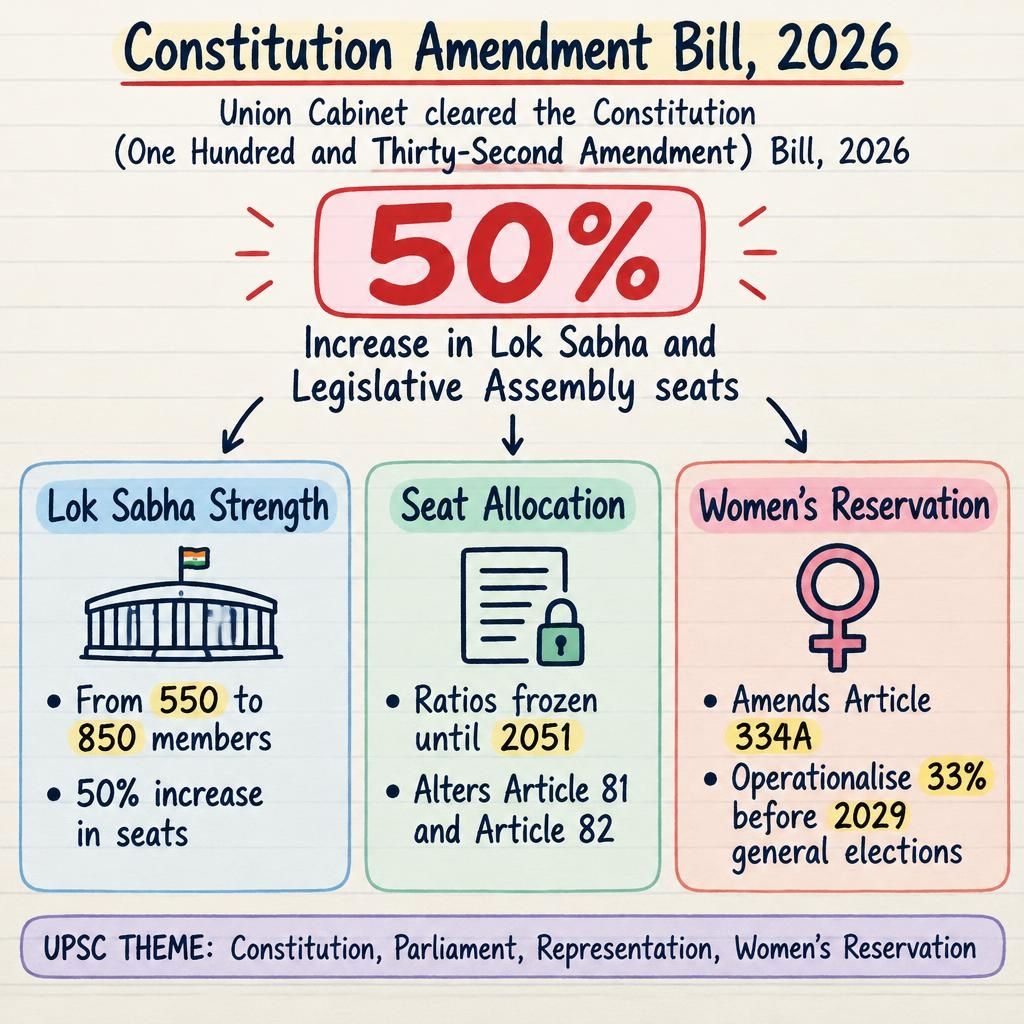
Constitution Amendment Bill
Detailed Insights:
- Inter-State seat distribution remained unchanged since the Constitution (Forty-second Amendment) Act, 1976 and Constitution (Eighty-fourth Amendment) Act, 2002 to incentivise population control.
- A uniform 50% seat increase protects the political voice of southern States that successfully curtailed fertility rates.
- Expanding the Lok Sabha preserves 544 open seats for general candidates even after carving out the one-third legislative quota for women.
- Relying on 2011 Census data allows constituency redrawing to finish before 2029, avoiding delays linked to the upcoming digital Census enumeration.
- Enforcing a flat 50% expansion across States tests the principle of proportional voter representation established under Article 81(2)(a) of the Constitution of India.
- Redrawing internal boundaries via 2011 metrics risks underrepresenting rapidly expanding urban corridors and post-2011 demographic migrations within States.
Key Concepts Involved:
- Delimitation: The statutory redrawing of territorial constituency boundaries to reflect demographic changes and ensure equitable voter strength.
- Article 81: The constitutional provision defining the composition of the Lok Sabha and seat allotment proportional to State population.
- Article 334A: The constitutional article providing for a 15-year women's quota in legislative bodies operationalised following delimitation.
- Delimitation Commission: A high-power statutory body appointed by the President to determine constituency boundaries whose orders carry the force of law.

SuperKalam is your personal mentor for UPSC preparation, guiding you at every step of the exam journey.
Download the App


STUDY RESOURCES
CONTACT US
ⓒ Snapstack Technologies Private Limited