GS 3: Science & TechnologyPrelimsGS 3: Achievements of Indians in Science and TechnologyGS 3: BiotechnologyGS 3: Science and Technology in Everyday Life
Your DNA Says Less About Your Personality Than a Short Online Quiz, Pg II
New genetic analysis reveals complex architecture of personality traits, linking DNA variations to health outcomes, but individual prediction remains weak.
Practice MCQs
811 Students attempted
Key Highlights:
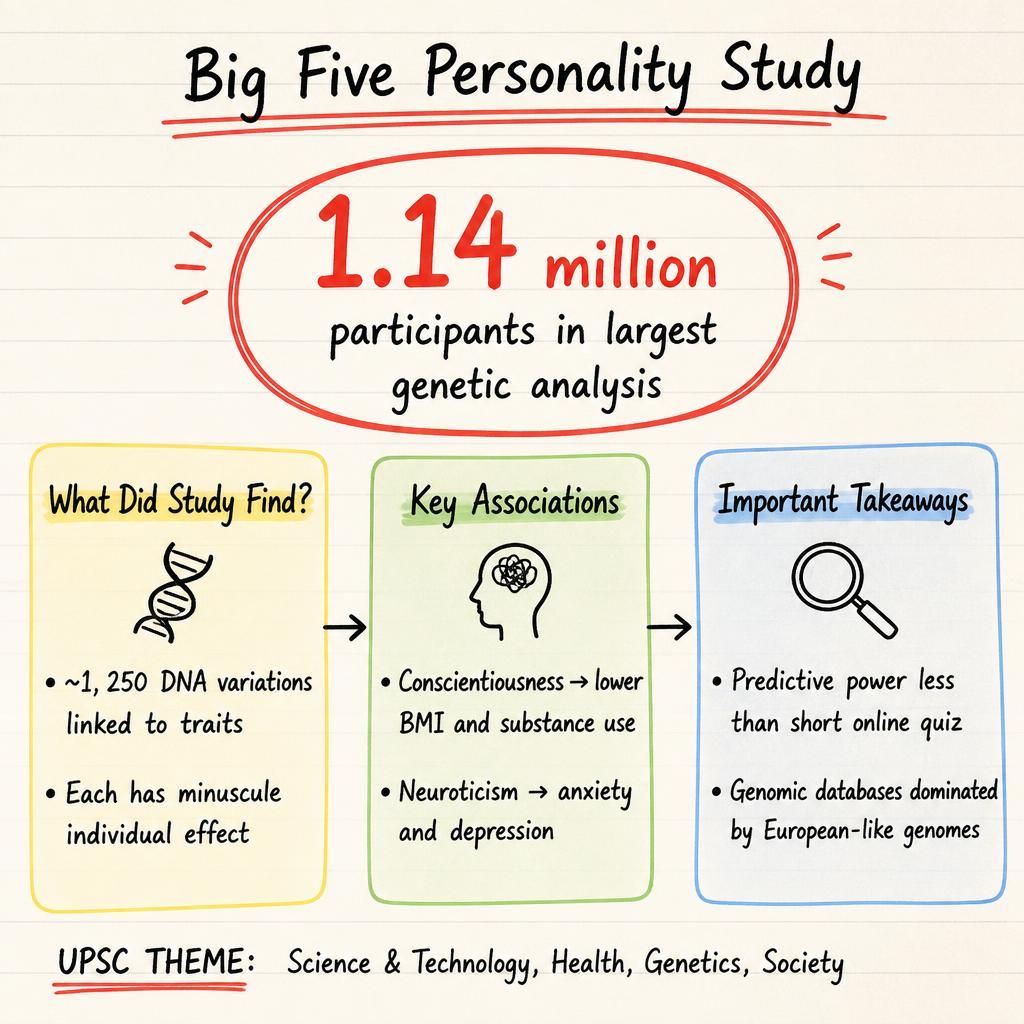
- A new study published in Nature conducted one of the largest genetic analyses of the "Big Five" personality traits, involving up to 1.14 million participants.
- Researchers identified approximately 1,250 DNA variations associated with personality traits, each having a minuscule individual effect.
- The study reinforced that personality is influenced by many genes, not a single one, and challenged older theories linking traits to specific brain chemicals.
- Genetic patterns linked to conscientiousness were associated with lower BMI and substance use, while neuroticism showed links to anxiety and depression.
- The findings suggest that while genetics have a biological basis for personality, their predictive power for an individual is less than a short online quiz.
- The research highlighted the limitation of genomic databases being dominated by European-like genomes, affecting applicability to diverse populations.
DNA Studies.jpg
Detailed Insights:
- The "Big Five" personality traits include openness, conscientiousness, extraversion, agreeableness, and neuroticism.
- The study utilized Genome-Wide Association Study (GWAS) to identify tiny genetic differences correlated with personality scores.
- Researchers combined the effects of multiple genetic variants into a single score called a polygenic index.
- Genetic correlations extended to social behaviors, with openness linked to cosmopolitan areas and conscientiousness to affluent suburban communities.
- Analysis of siblings helped isolate genetic impacts by controlling for shared childhood environments, suggesting environmental transfer of personality is not straightforward.
- The study emphasizes that observed genetic links are correlations, and it remains unresolved whether personality causally drives downstream health or social outcomes.
- Future research aims to focus on DNA sequencing within families exhibiting extreme behavioral variants for better insights.
- India is pioneering family-based sequencing for psychiatric conditions through joint efforts by National Centre for Biological Sciences (NCBS) and National Institute of Mental Health and Neurosciences (NIMHANS).
Scientific/Technical Concepts Involved:
- Big Five Personality Traits: A widely accepted model categorizing human personality into five broad dimensions: openness, conscientiousness, extraversion, agreeableness, and neuroticism.
- Genome-Wide Association Study (GWAS): A research method that scans the entire genome of many individuals to find genetic variations associated with a particular trait or disease.
- Polygenic Index: A single score that combines the effects of many genetic variants across the genome, each contributing a small amount to a complex trait.

SuperKalam is your personal mentor for UPSC preparation, guiding you at every step of the exam journey.
Download the App


STUDY RESOURCES
CONTACT US
ⓒ Snapstack Technologies Private Limited