GS 2: GovernanceGS 2: PolityGS 2: Social JusticePrelimsGS 2: Government policies and interventions for development in various sectors
Punishment and pendency: Need for, role of a sentencing council, Pg17
India faces significant sentencing disparity due to unguided judicial discretion; Supreme Court and Law Commission advocate for a national sentencing policy and council.
Practice MCQs
811 Students attempted
Key Highlights:
- India faces significant sentencing disparity, where individuals convicted of the same crime receive varied sentences due to judicial discretion.
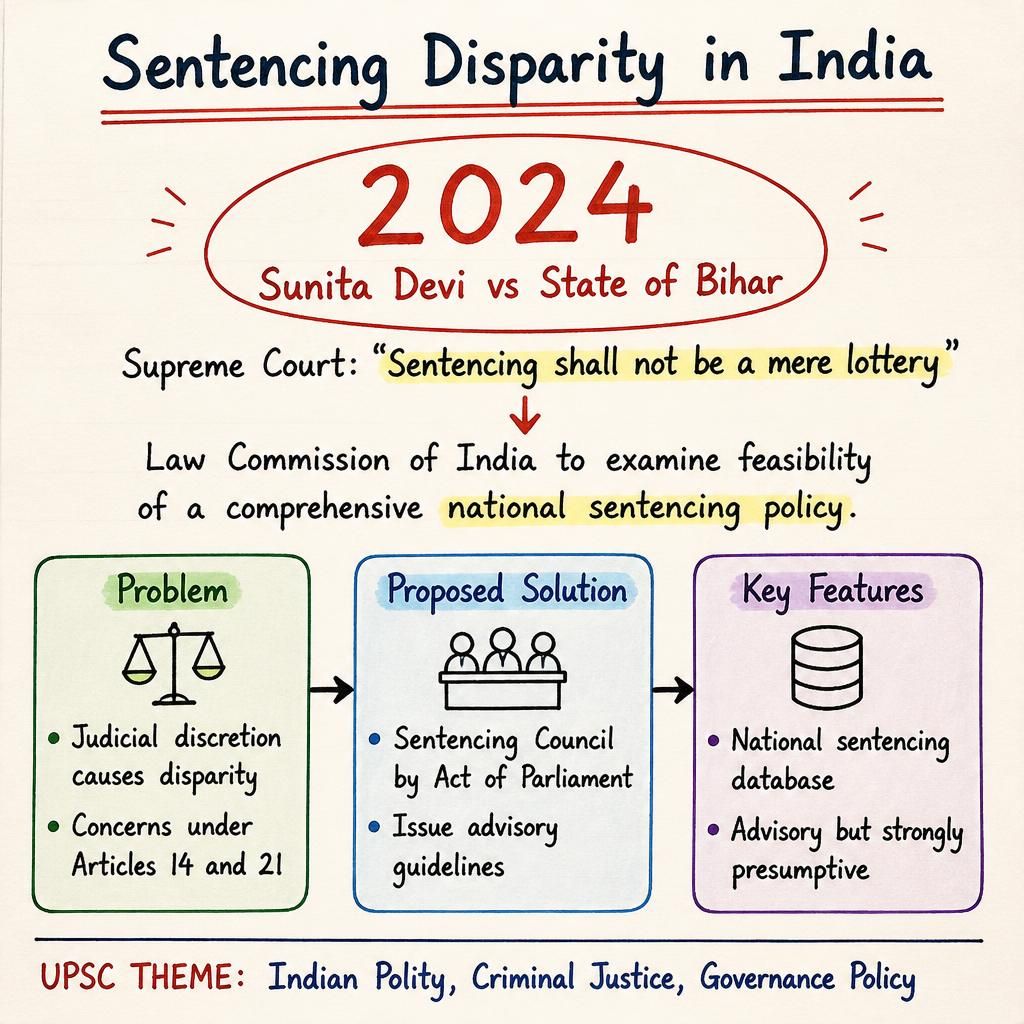
- The Supreme Court, in Sunita Devi vs State of Bihar (2024), highlighted this issue, stating that "sentencing shall not be a mere lottery" and urged the Centre to explore a national sentencing policy.
- The Law Commission of India has been tasked with examining the feasibility of a comprehensive national sentencing policy, a concern it previously raised in its 47th Report over 30 years ago.
- A proposed Sentencing Council, established by an Act of Parliament, could develop offence-specific guidelines, build a national sentencing database, and issue advisory guidelines.
Sentencing Disparity.jpg
Detailed Insights:
- The current system, where judges have almost complete discretion, raises concerns regarding Articles 14 (equality before the law) and 21 (protection of life and personal liberty) of the Indian Constitution.
- Research indicates that sentences have been reduced based on legally irrelevant factors, such as a complainant's perceived "chastity," while ignoring psychological harm.
- The existing legal framework already provides alternatives to custody, including Sections 401 and 402 of the Bharatiya Nagarik Suraksha Sanhita (BNSS) and Sections 3, 4, and 6 of the Probation of Offenders Act 1958, which courts are mandated to consider.
- The Supreme Court in Soman vs State Of Kerala (2012) acknowledged the competing principles in sentencing and noted it as a weak part of criminal justice administration.
- Appellate courts frequently spend valuable time correcting sentences due to the lack of a common yardstick, instead of the primary responsibility lying with the convicting court under Section 258(2) of the BNSS.
- A national sentencing database, leveraging the National Judicial Data Grid, would provide anonymized data on offence types, culpability, and sentences, enabling transparency and evaluation of guidelines.
- Guidelines issued by such a council would be advisory but strongly presumptive, requiring courts to provide reasons for any departure, thereby balancing judicial independence with accountability.
Key Concepts Involved:
- Sentencing Disparity: Inconsistent application of punishments for similar crimes, leading to unequal outcomes.
- Sentencing Council/Commission: A body proposed to formulate guidelines and policies for consistent and fair sentencing.
- Probation: A system allowing offenders to remain in the community under supervision instead of imprisonment, focusing on rehabilitation.
- Aggravating/Mitigating Factors: Circumstances that increase or decrease the severity of a crime or the culpability of an offender, influencing sentencing.

SuperKalam is your personal mentor for UPSC preparation, guiding you at every step of the exam journey.
Download the App


STUDY RESOURCES
CONTACT US
ⓒ Snapstack Technologies Private Limited